


The head of the Philippine military on Monday visited a coral-fringed island his country occupies in the South China Sea, a move that could stoke already heightened tensions between Manila and Beijing in disputed waters claimed by both countries.
During the visit, Philippine Armed Forces Lieutenant General Cirilito Sobejana commended service members for the role they played in protecting the island’s residents and “guarding the country’s territories” in the strategic waterway.
The visit comes after diplomatic protests made by the Philippines in the past few months over what it says is the illegal presence of hundreds of “Chinese maritime militia” vessels inside its exclusive economic zone and near its occupied islands.

Photo: Reuters
Chinese diplomats have said that the boats were sheltering from rough seas and no militia were aboard.
Information on Sobejana’s trip to Thitu Island (Jhongye Island, 中業島), known in the Philippines as Pagasa, were only made public by Agence France-Presse yesterday.
Thitu is the biggest of the nine reefs, shoals and islands the Philippines occupies in the Spratly Islands (Nansha Islands, 南沙群島), and is home to a small number of military personnel and civilians.
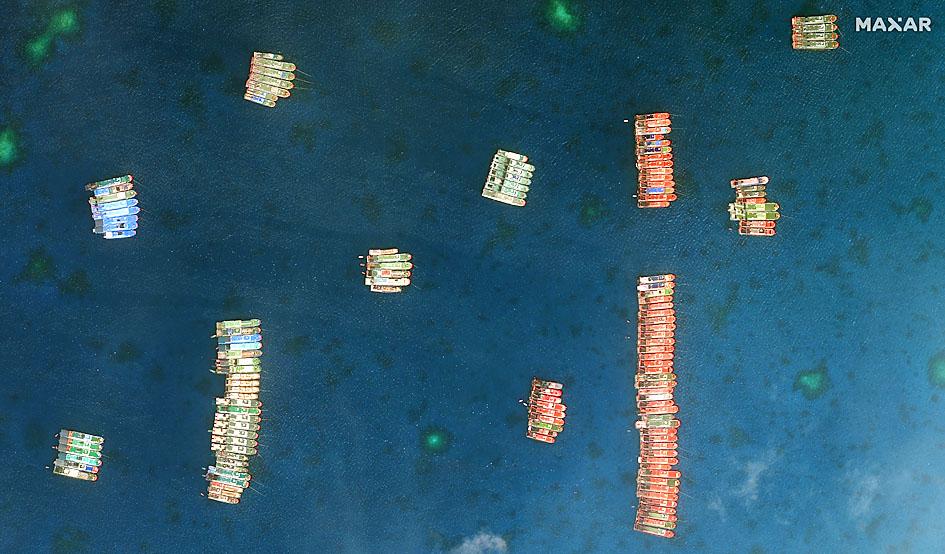
Photo: AP
The troops on the island “are in very high spirit, their level of moral is high especially after our visit,” Sobejana told reporters on Tuesday evening, adding that he also wanted to inspect the island to oversee plans to convert it into a logistics hub to make it easier for naval assets conducting patrols to refuel.
The Chinese embassy in Manila did not immediately respond to a request for comment.
Taiwan, Brunei, China, Malaysia, the Philippines and Vietnam have competing claims of sovereignty in the South China Sea, a conduit for goods in excess of US$3 trillion every year.
The foreign ministers of China and Southeast Asian countries during a meeting on Monday agreed to exercise restraint in the South China Sea and avoid actions that could escalate tensions.

When a hiker fell from a 55m waterfall in wild New Zealand bush, rescuers were forced to evacuate the badly hurt woman without her dog, which could not be found. After strangers raised thousands of dollars for a search, border collie Molly was flown to safety by a helicopter pilot who was determined to reunite the pet and the owner. A week earlier, an emergency rescue helicopter found the woman with bruises and lacerations after a fall at a rocky spot at the waterfall on the South Island’s West Coast. She was airlifted on March 24, but they were forced to

CONFIDENCE BOOSTER: ’After parkour ... you dare to do a lot of things that you think only young people can do,’ a 67-year-old parkour enthusiast said In a corner of suburban Singapore, Betty Boon vaults a guardrail, crawls underneath a slide, executes forward shoulder rolls and scales a steep slope, finishing the course to applause. “Good job,” the 69-year-old’s coach cheers. This is “geriatric parkour,” where about 20 retirees learned to tackle a series of relatively demanding exercises, building their agility and enjoying a sense of camaraderie. Boon, an upbeat grandmother, said learning parkour has aided her confidence and independence as she ages. “When you’re weak, you will be dependent on someone,” she said after sweating it out with her parkour classmates in suburban Toa Payoh,

HIGH HOPES: The power source is expected to have a future, as it is not dependent on the weather or light, and could be useful for places with large desalination facilities A Japanese water plant is harnessing the natural process of osmosis to generate renewable energy that could one day become a common power source. The possibility of generating power from osmosis — when water molecules pass from a less salty solution to a more salty one — has long been known. However, actually generating energy from that has proved more complicated, in part due the difficulty of designing the membrane through which the molecules pass. Engineers in Fukuoka, Japan, and their private partners think they might have cracked it, and have opened what is only the world’s second osmotic power plant. It generates

Chinese dissident artist Gao Zhen (高兟), famous for making provocative satirical sculptures of former Chinese leader Mao Zedong (毛澤東), was tried on Monday over accusations of “defaming national heroes and martyrs,” his wife and a rights group said. Gao, 69, who was detained in 2024 during a visit from the US, faces a maximum three-year prison sentence, said his wife, Zhao Yaliang (趙雅良), and Shane Yi, a researcher at the Chinese Human Rights Defenders group which operates outside the nation. The closed-door, one-day trial took place at Sanhe City People’s Court in Hebei Province neighboring the capital, Beijing, and ended without a


 RSS
RSS