


Chinese President Xi Jinping (習近平) urged Chinese officials to create a “trustworthy, lovable and respectable” image for the country, in a sign that Beijing might be looking to smooth its hard-edged diplomatic approach.
Xi on Monday told senior Chinese Communist Party leaders that the country must “make friends extensively, unite the majority and continuously expand its circle of friends with those who understand and are friendly to China,” Xinhua news agency reported.
Beijing needed “a grip on tone” in its communication with the world, and should “be open and confident, but also modest and humble,” he said.
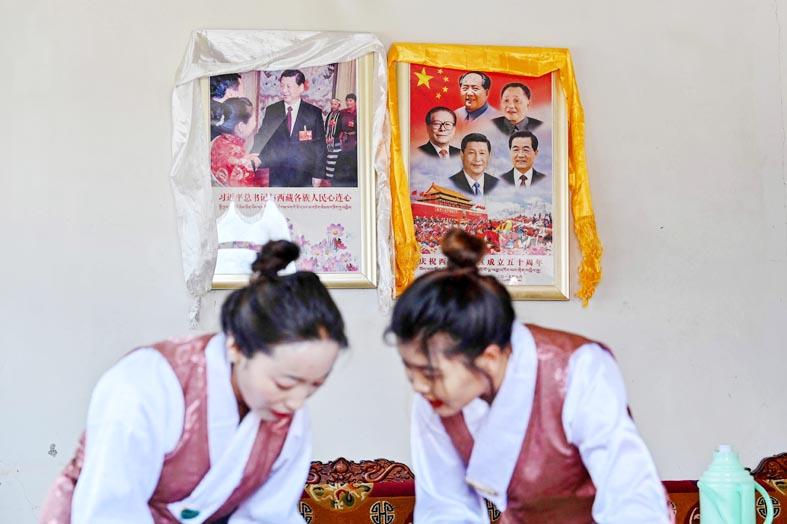
Photo: AFP
The remarks suggest that Xi might be rethinking his communication strategy on the global stage as US President Joe Biden works to bolster US relationships weakened under his predecessor’s “America First” policies.
Xi has cast aside the party’s decades-old “hide-and-bide” strategy of keeping a low international profile in favor of “big country diplomacy.”
China’s has increasingly hit back against perceived violations of its core interests by foreign countries with trade measures, travel bans and diplomatic protests — an approach sometimes criticized as “wolf warrior” diplomacy. That style has been blamed for diplomatic setbacks with partners that appeared open to closer ties with Beijing, such as the EU and the Philippines.
China’s more assertive diplomacy came in response to those in the West who cast the country as a threat, but that has failed to satisfy domestic and international audiences, Renmin University of China international relations professor Wang Yiwei (王義桅) said.
“China’s image in the West has deteriorated since the pandemic, and this needs to be taken seriously,” he said. “The growth in China’s power needs to be accepted by the world. That would be the real growth of power.”
It remains to be seen whether the push would have any impact on China’s policies in disputes with countries such as the US, Australia or the EU, all of which have seen ties deteriorate further in recent months.
Views of China turned sharply negative last year in 14 countries surveyed by the Pew Research Center, data released in October last year showed.
China’s emphasis on the superiority of socialism has caused some concern in the West, Wang said, and the ridicule of other countries’ failure to contain COVID-19 was “a bit overdone.”
The discussion on international communication included a lecture by Zhang Weiwei (張維為) of Fudan University’s Chunqiu Institute, who is also a staunch and vocal advocate for how China’s governance model is superior to Western democracies.
Wang Wen (王文), executive dean of Renmin University’s Chongyang Institute for Financial Studies and an adviser to the government, said it was the first such session held by the 25-member politburo.
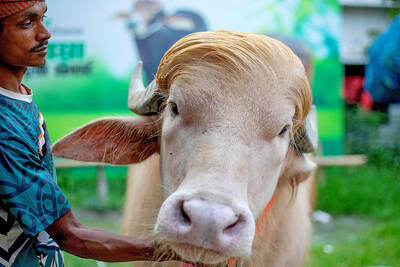
Crowds in Bangladesh are flocking to snap photographs with an unlikely social media star — an albino buffalo with flowing blond hair nicknamed “Donald Trump” that is due to be sacrificed within days. Owner Zia Uddin Mridha, 38, said his brother named the 700kg bull over its flowing helmet of hair resembling the signature look of the US president. “My younger brother picked this name because of the buffalo’s extraordinary hair,” he said at his farm in Narayanganj, just outside the capital, Dhaka. Mridha said that a constant stream of curious visitors — social media fans, onlookers and children — have come throughout

It began as a satirical online project. Now millions of young people in India are flocking to it as an outlet for their frustration. A parody political party called the Cockroach Janta Party, with the insect as its symbol, has exploded across India’s social media by turning absurdist humor into protest. Memes and short videos mocking corruption, joblessness and political dysfunction have flooded social media sites, where millions of users are embracing the cockroach — known for its ability to survive harsh conditions — as a tongue-in-cheek symbol of endurance. The online movement’s rise has been unusually rapid. The Cockroach Janta Party (CJP)
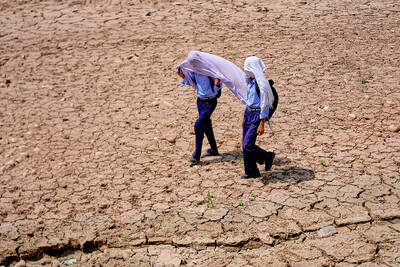
HOTTER: While Indians are accustomed to summer heat, climate change has caused northwestern India to warm faster than other parts of the country, an academic said Roads and markets have emptied during afternoons and some farmers have switched to nighttime work to avoid scorching temperatures as a heat wave grips large parts of India. The India Meteorological Department forecast maximum temperatures for yesterday of about 45°C in the capital, New Delhi, where authorities have opened temporary “cooling zones” to help people cope. The weather department warned that conditions would likely persist across several northern regions in the coming days, with temperatures staying well above seasonal averages. Authorities urged people to stay indoors during the hottest hours and take precautions against heat-related illnesses. India declares a heat wave whenever maximum temperatures

SPEAKING OUT: After Siranudh Scott’s allegations surfaced, celebrities and public figures took to social media to share their own experiences of sexual misconduct and abuse A high-profile alleged sexual abuse case within a wealthy Thai beer brewing family has prompted a wave of painful accounts from survivors of unconnected abuse in the conservative nation. Siranudh Scott, a member of the billionaire Thai family that founded the ubiquitous Singha beer brand, posted an emotional video this month accusing his elder brother Sunit of repeatedly abusing him when he was a teenager. Sunit, who is in his 30s, later denied the allegations in a video posted online, but Singha parent Boonrawd dismissed him from his executive role with the company on Tuesday last week. “I felt I needed to speak


 RSS
RSS