


The RMS Titanic is being brought back from the deep, more than a century after its ill-fated maiden voyage, at a landlocked Chinese theme park where tourists can soon splash out for a night on a full-scale replica.
The project’s main backer was inspired to recreate the world’s most infamous cruise liner by the 1997 box office hit of the same name — once the world’s top-grossing film and wildly popular in China.
The original luxury vessel, the largest of its time and branded “unsinkable” by its owners, has become a byword for hubris ever since it plunged into the depths of the Atlantic in 1912 after striking an iceberg, leaving more than 1,500 people dead.
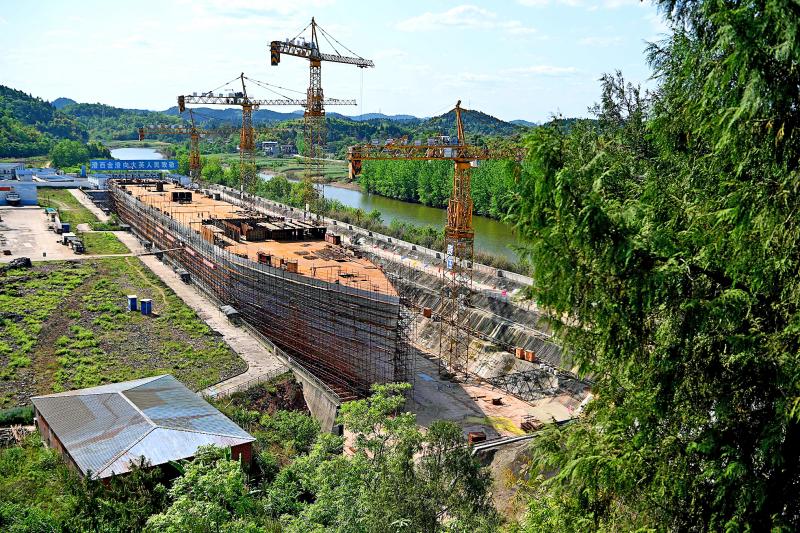
Photo: AFP
Su Shaojun, a Chinese investor who funded the replica, said that he was motivated to finance the audacious, 260m ship to keep memories of the Titanic alive.
“I hope this ship will be here in 100 or 200 years,” Su said. “We are building a museum for the Titanic.”
It has taken six years — longer than the construction of the original vessel — as well as 23,000 tonnes of steel, more than 100 workers and a hefty 1 billion yuan (US$153.5 million) price tag.
Everything from the dining room to the luxury cabins and even the door handles are styled on the original Titanic.
It forms the centerpiece of a Sichuan Province theme park more than 1,000km from the sea. The site features a replica of the Port of Southampton seen in the 1997 disaster epic, directed by James Cameron, where Leonardo DiCaprio’s fictional character, Jack, swings on board after winning his ticket in a bet.
Tour buses play the film’s theme tune, Celine Dion’s My Heart Will Go On, on repeat.
It costs up to 2,000 yuan to spend one night on the ship for the “five-star cruise service,” Su said, adding that with a functioning steam engine, guests would feel that they are really at sea.
He was so excited by the challenge that he sold his energy industry assets, including a stake in several hydropower projects, to invest in his Titanic.
However, even before opening, the replica has drawn plenty of controversy.
Online users have questioned whether the famous ship would attract tourists given the disaster that struck its real-life inspiration. Others feared that it would join other ambitious Chinese building projects that turned into white elephants — including a 2008 replica of the USS Enterprise, a US aircraft carrier, which cost more than US$18 million and was abandoned shortly after it opened.
Su hopes that as many as 5 million annual visitors will come to see his Titanic.
“This tourist volume should guarantee the return of our investment,” he added.
Xu Junnian, who manages the project, said that he felt it was important to preserve the vessel’s memory.
“The greatest significance of building this ship is to carry forward and inherit the great spirit of Titanic,” he said.
Aside from the enduring appeal of the Hollywood blockbuster, the Titanic has over the past few weeks stolen headlines in China with the release of a new documentary called The Six.
The film tells the story of a group of Chinese travelers on board when the ship sinks, of whom six survived.
However, the developers are hoping to rope in some bigger names to help draw visitors.
“We’d like to invite Jack, Rose and James Cameron to the inauguration ceremony,” Su said.
ROCKY RELATIONS: The figures on residents come as Chinese tourist numbers drop following Beijing’s warnings to avoid traveling to Japan The number of Chinese residents in Japan has continued to rise, even as ties between the two countries have become increasingly fractious, data released on Friday showed. As of the end of December last year, the number of Chinese residents had increased by 6.5 percent from the previous year to 930,428. Chinese people accounted for 22.6 percent of all foreign residents in Japan, making them by far the largest group, Japanese Ministry of Justice data showed. Beijing has criticized Tokyo in increasingly strident terms since Japanese Prime Minister Sanae Takaichi last year suggested that a military conflict around Taiwan could

A retired US colonel behind a privately financed rocket launch site in the Dominican Republic sees the project as a response to China’s dominance of the space race in Latin America. Florida-based Launch on Demand is slated to begin building a US$600 million facility in a remote region near the border with Haiti late this year. The project is designed to meet surging demand for the heavy-lift rockets needed to put clusters of satellites into orbit. It is also an answer to China’s growing presence in the region, said CEO Burton Catledge, a former commander of the US Air Force’s 45th Operations

Germany is considering Australia’s Ghost Bat robot fighter as it looks to select a combat drone to modernize its air force, German Minister of Defense Boris Pistorius said yesterday. Germany has said it wants to field hundreds of uncrewed fighter jets by 2029, and would make a decision soon as it considers a range of German, European and US projects developing so-called “collaborative combat aircraft.” Australia has said it will integrate the Ghost Bat, jointly developed by Boeing Australia and the Royal Australian Air Force, into its military after a successful weapons test last year. After inspecting the Ghost Bat in Queensland yesterday,

A pro-Iran hacking group claimed to breach FBI Director Kash Patel’s personal e-mail inbox and posted some of the contents online. The e-mails provided by the hacking group include travel details, correspondence with leasing agents in Washington and global entry, and loyalty account numbers. The e-mail address the hackers claim to have compromised has been previously tied to Patel’s personal details, and the leaked e-mails contain photos of Patel and others, in addition to correspondence with family members and colleagues. “The FBI is aware of malicious actors targeting Director Patel’s personal email information,” the agency said in a statement on


 RSS
RSS