


Protesters against military rule yesterday marched in Myanmar, three months after a coup ended a democratic transition, with several small blasts compounding a sense of crisis that a UN envoy warned could bring state administration to a halt.
The military has tried to end dissent and impose its authority on a people largely opposed to the return of rule by the generals after 10 years of democratic reforms that included a government led by deposed Burmese State Counselor Aung San Suu Kyi.
Despite a relentless crackdown in which at least 759 protesters have been killed, according to the Assistance Association for Political Prisoners (AAPP) advocacy group, crowds come out day after day to reject the junta.
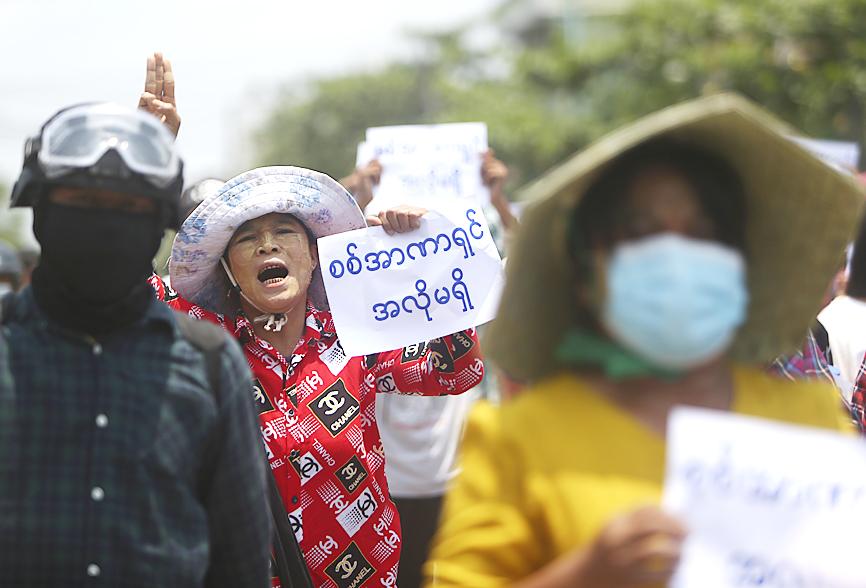
Photo: EPA-EFE
“Our cause, democracy, our cause, a federal union. Free arrested leaders,” protesters chanted at one of two rallies in the main city of Yangon.
Aung San Suu Kyi, 75, has been detained since the coup, along with many other members of her party.
The AAPP says that more than 3,400 people have been detained for opposing the military.
People also rallied in the second city of Mandalay and the southern town of Dawei, media reported.
There were no immediate reports of violence.
Media reported several small blasts in different places, including Yangon, late on Friday and yesterday. There were no immediate reports of casualties and no claims of responsibility.
A spokesman for the junta did not answer calls seeking comment. The military has accused pro-democracy activists of planting bombs.
UN Special Envoy to Myanmar Christine Schraner Burgener on Friday told the UN Security Council that in the absence of a collective international response to the coup, violence is worsening and the running of the state risked coming to a standstill, said diplomats who attended the private meeting.
Schraner Burgener briefed the 15-member council from Thailand, where she has been meeting regional leaders. She hopes to travel to Myanmar, but the military has yet to approve a visit.
“The general administration of the state could risk coming to a standstill as the pro-democracy movement continues in spite of the ongoing use of lethal force, arbitrary arrests and torture as part of the military’s repression,” Schraner Burgener said, according to diplomats.
She told diplomats that reports of a continuing crackdown risked undermining momentum toward ending the crisis following a meeting of the 10-member ASEAN on April 25 with the junta leader, Burmese Army Senior General Min Aung Hlaing.
Schraner Burgener, expressing concern about rising violence, cited reports of bomb attacks and of civilians, mostly students from the urban areas, receiving weapons training from ethnic minority insurgents.
The UN Security Council reiterated its “deep concern” at the situation and its support for Myanmar’s democratic transition.
It called for an immediate end to violence in Myanmar as stated in an ASEAN plan, giving unanimous approval to a statement watered down to satisfy China and Russia.
The plan, which also calls for the naming of an envoy from ASEAN to address the crisis should be applied “without delay,” the council statement said.
Additional reporting by AFP

‘CROSSING THE LINE’: China’s embassy in Seoul criticized US Forces Korea Commander General Xavier Brunson, asking if his ‘hostile’ remarks were authorized by Washington South Korea and the US are in talks over recent public remarks by the commander of US Forces Korea, Seoul’s presidential office said yesterday, after the comments drew sharp criticism from China. In a recent podcast interview, US Forces Korea Commander General Xavier Brunson described South Korea as “the dagger in the heart of Asia” from China’s east coast, prompting the Chinese embassy in Seoul to say that he had “truly crossed the line.” The interview came amid growing speculation that Washington might seek to expand the role of US Forces Korea in countering the growing regional influence of China, a key

SEEKING ORDER: Rodrigo Paz said that ‘anyone who wants to destroy the nation will have to deal with this president and the full force of the constitution’ Bolivian President Rodrigo Paz on Wednesday said that the nation was at a “breaking point” after nearly a month of protests that have caused shortages of food, fuel and medicine. Paz, who took office six months ago amid the worst economic crisis there in four decades, is battling a groundswell of fury over his policies. The political capital, La Paz, has been besieged by low-income workers and members of the indigenous majority calling for his resignation. “The country needs order and is reaching breaking point,” the 58-year-old said at a public event in La Paz, renewing his appeal for dialogue. On Tuesday, the Bolivian

Australian researchers have trained lab-grown brain cells on a silicon computer chip to play the 1990s shooter game Doom and said they are just scratching the surface of what the neurons could be capable of doing. It is the science-fiction work of biotech boffins at Cortical Labs, who researched and developed the technology that harnesses the workings of the brain’s networking system. Each so-called “biological computer” contains about 200,000 living human brain cells, grown from stem cells that were harvested from blood donations. Having mastered the simple computer game Pong, where a paddle is moved up and down to send a ball

Through the noise of rushing papers and whirring belts at a print factory in Kyoto, two creators watch their photo essay come to life in broadsheet form — part of an effort to win new audiences in the age of artificial intelligence (AI). Despite the decline of the publishing industry, self-publication and handmade “zine” magazines are growing in popularity in Japan, reflecting the nation’s enduring love of paper in the digital era. While speaking to Agence France-Presse at the plant, his hands black with ink, one of the creators, Kazuma Obara, said: “I think [paper] is a medium that engages all five


 RSS
RSS