


Texas is to gain two seats in the US House of Representatives under new census numbers released on Monday, while states in the northeast and the midwest are to lose seven in a shift of political clout to Republican strongholds before the midterm elections next year.
US Census Bureau numbers showed that the nation’s population grew much more slowly than expected, with fewer people migrating to the south and west than earlier projections.
The result was an extraordinarily close battle for the last congressional seat, with New York losing one of its 27 House members by just 89 people, census officials said.

Photo: AFP
The bureau’s release of its decennial count of state populations begins the process of reshuffling the 435 House seats among the 50 states to account for population changes over the past decade.
Those changes alone could be enough to decide the balance of power: Democrats hold a narrow advantage in the House now, with a margin of fewer than half a dozen seats.
The states gaining seats are largely ones that former US president Donald Trump won last year, while states US President Joe Biden won — including the so-called “Blue Wall” states of the industrial north — are losers.
Texas is to gain two seats. Colorado, Florida, Montana, North Carolina and Oregon are also to gain one seat each.
Because the size of the House has been capped since 1911, those new seats must come at the expense of seven states: California, Illinois, Michigan, New York, Ohio, Pennsylvania and West Virginia. Moreover, because the Electoral College factors in House representation, those states would also lose influence in the 2024 presidential vote.
At just 7.4 percent, the 2010s saw the second-slowest growth rate in the nation’s history, just ahead of the 7.3 percent growth of the 1930s, during the Great Depression. The total US population as of April 1 last year was 331,449,281.
Moreover, state-to-state migration was also slower than at any time since World War II. That means fewer congressional seats would be redistributed than at any time since the US Congress refused to allow reapportionment following the 1920 census.
Texas had been expected to gain three seats and Florida two, and Arizona was also expected to gain a seat based on the bureau’s own annual estimates. Acting Census Bureau Director Ron Jarmin attributed that difference to slower-than-expected growth, but officials said the discrepancy was within 1 percent.
Alabama, Minnesota and Rhode Island were projected to lose seats, but were spared a cut in the final numbers. Minnesota gained the seat New York lost.
The average House seat would now represent 761,169 people, up from 710,767 from 2010.
The bureau sent questionnaires out in March last year, just as the national COVID-19 lockdowns began, asking people to say where they lived by April 1 last year. New York bore the brunt of COVID-19 deaths early in the pandemic.
California, while still the most populous state, is to lose a congressional seat for the first time since it joined the Union in 1850. Montana is to have two representatives for the first time since the 1980s.
Some states, such as New York, or interest groups might seek to challenge the count, given that it was conducted during a devastating public health crisis and amid Trump’s unsuccessful attempt to exclude undocumented immigrants from the count and add a citizenship question.
However, a challenge to the numbers used would be “extremely uphill and difficult,” said Jeffrey Wice, an expert on redistricting, voting rights and census law.
States, cities and civil rights groups have filed court challenges to reapportionment in the past, but the US Supreme Court has uniformly rejected them, he said.

Four contenders are squaring up to succeed Antonio Guterres as secretary-general of the UN, which faces unprecedented global instability, wars and its own crushing budget crisis. Chile’s Michelle Bachelet, Argentina’s Rafael Grossi, Costa Rica’s Rebeca Grynspan and Senegal’s Macky Sall are each to face grillings by 193 member states and non-governmental organizations for three hours today and tomorrow. It is only the second time the UN has held a public question-and-answer, a format created in 2016 to boost transparency. Ultimately the five permanent members of the UN’s top body, the Security Council, hold the power, wielding vetoes over who leads the

A humanoid robot that won a half-marathon race for robots in Beijing on Sunday ran faster than the human world record in a show of China’s technological leaps. The winner from Honor, a Chinese smartphone maker, completed the 21km race in 50 minutes and 26 seconds, said a WeChat post by the Beijing Economic-Technological Development Area, also known as Beijing E-Town, where the race began. That was faster than the human world record holder, Ugandan Jacob Kiplimo, who finished the same distance in about 57 minutes in March at the Lisbon road race. The performance by the robot marked a significant step forward

An earthquake registering a preliminary magnitude of 7.7 off northern Japan on Monday prompted a short-lived tsunami alert and the advisory of a higher risk of a possible mega-quake for coastal areas there. The Cabinet Office and the Japan Meteorological Agency said there was a 1% chance for a mega-quake, compared to a 0.1% chance during normal times, in the next week or so following the powerful quake near the Chishima and Japan trenches. Officials said the advisory was not a quake prediction but urged residents in 182 towns along the northeastern coasts to raise their preparedness while continuing their daily lives. Prime
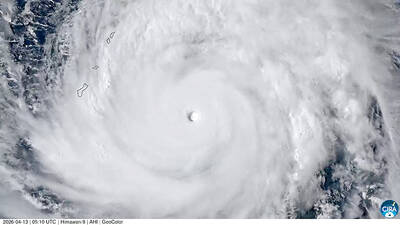
HAZARDOUS CONDITION: The typhoon’s sheer size, with winds extending 443km from its center, slowed down the ability of responders to help communities, an official said The US Coast Guard was searching for six people after losing contact with their disabled boat off the coast of Guam following Typhoon Sinlaku. The crew of the 44m dry cargo vessel, the US-registered Mariana, on Wednesday notified the coast guard that the boat had lost its starboard engine and needed assistance, Petty Officer 3rd Class Avery Tibbets said yesterday. The coast guard set up a one-hour communication schedule with the vessel, but lost contact on Thursday. A Coast Guard HC-130 Hercules aircraft was launched to search for the six people on board, but it had to return to Guam because of


 RSS
RSS