


The Oriental lute is making a comeback in Iran after decades in the shadows as musicians reconnect with an instrument integral to Arab and Turkish musical tradition in a fragmented region.
Known as the oud in Arabic and Turkish, it is commonly called the barbat in Persian, although some would argue that the instruments differ slightly.
“The number of [oud] students has increased considerably over the past 15 years or so; before, a known teacher would have had a dozen students, whereas today they’ll be [sic] about 50,” said Majid Yahyanejad, a 35-year-old oud teacher in Tehran.
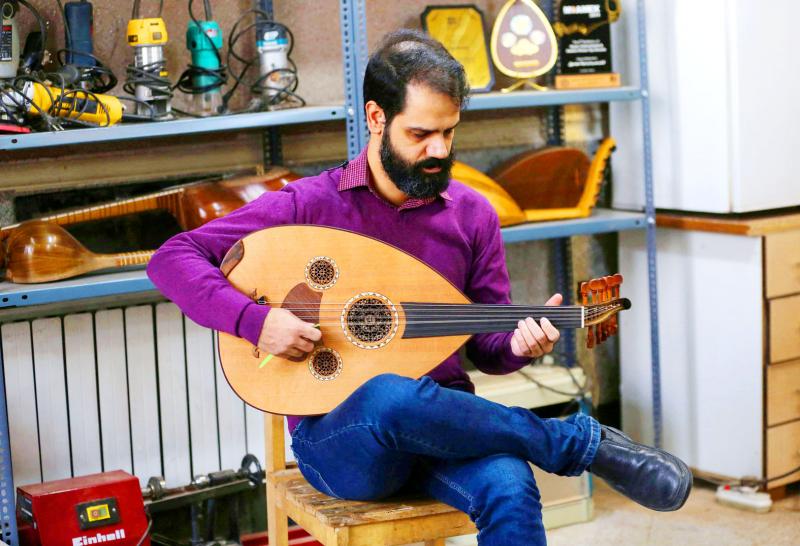
Photo: AFP
Noushin Pasdar, a 40-year-old musician in the Iranian capital, made the same observation.
She started teaching the stringed instrument “about 23 years ago” after graduating from professional arts school, known as honarestan in Persian.
“At the time, most of my students were old, really old. Now they’re more on the young side,” Pasdar said.
“We only knew the oud as played in Egypt and Iraq. We knew nothing of the oud in Turkey. But today we know it’s also played in Syria, Kuwait and Jordan,” she said.
Yahyanejad said young Iranian oud players were “taking more interest in Arabic and Turkish culture ... and Turkish, Arab and Iranian musicians are becoming friends on the Internet.”
The barbat has been around for centuries and it takes up a whole chapter of the Shahnameh (Book of Kings), written in the 10th century.
Iran and Syria are lobbying for the manufacture and playing of the oud to be added to UNESCO’s “intangible heritage” list.
The barbat had fallen out of Iran’s classical and traditional repertoires, with other stringed instruments, such as the setar, tar, santur and kamancheh, given preference.
However, in the second half of the 20th century, a man named Mansour Nariman introduced oud instruction at the honarestan and published the first Persian-language manual on the instrument, Yahyanejad said.
Nariman, who died in 2015, had been drawn to the “warmth” of its sound, at a time when the Arab oud did not even figure on Iran’s musical periscope.
In the absence of any teachers back then, Nariman taught himself and wrote off letters to Egyptians he had heard playing the instrument on the radio.
He received a reply from one of the biggest names in Arab music, Mohamed Abdelwahab.
Many years later, Mohammad Firouzi, a student of Nariman, recorded several pieces of music with the undisputed maestro of Persian song, Mohammad-Reza Shajarian, who died in October last year.
Among them were masterpieces such as Aseman-e Eshgh in 1991, Aram-e Jan in 1998 and Ghoghaye Eshghbazan in 2007.
Pasdar remembered the first time music teachers showed her an oud, triggering a hunt for the instrument in central Tehran’s Baharestan Square, a paradise for musicians.
She said she found only two, both made in Egypt, and too bulky for a budding musician.
Fatemeh Moussavi, who crafts ouds in a small Tehran studio, said very few artisans manufactured the instruments and they were pricey back in the day.
Things did not change much until the early 2000s, when thousands of ouds landed in Iran, mostly from Syria and Turkey, bringing down prices.
It was a time of liberalization under then-Iranian president Mohammad Khatami, who served from 1997 to 2005.
The arts scene benefited from this period in the Islamic republic, where the Shiite clergy prioritizes study of the Koran and religious jurisprudence.
For Hamid Khansari, who has written an introduction to the oud, the bow-shaped instrument is “a blessing” that “expands the possibilities of creation.”
Lebanon’s Charbel Rouhana played the instrument on stage in Tehran with Iranian group Gardoun in 2016, followed the next year by Yurdal Tokcan from Turkey.

‘CROSSING THE LINE’: China’s embassy in Seoul criticized US Forces Korea Commander General Xavier Brunson, asking if his ‘hostile’ remarks were authorized by Washington South Korea and the US are in talks over recent public remarks by the commander of US Forces Korea, Seoul’s presidential office said yesterday, after the comments drew sharp criticism from China. In a recent podcast interview, US Forces Korea Commander General Xavier Brunson described South Korea as “the dagger in the heart of Asia” from China’s east coast, prompting the Chinese embassy in Seoul to say that he had “truly crossed the line.” The interview came amid growing speculation that Washington might seek to expand the role of US Forces Korea in countering the growing regional influence of China, a key

Through the noise of rushing papers and whirring belts at a print factory in Kyoto, two creators watch their photo essay come to life in broadsheet form — part of an effort to win new audiences in the age of artificial intelligence (AI). Despite the decline of the publishing industry, self-publication and handmade “zine” magazines are growing in popularity in Japan, reflecting the nation’s enduring love of paper in the digital era. While speaking to Agence France-Presse at the plant, his hands black with ink, one of the creators, Kazuma Obara, said: “I think [paper] is a medium that engages all five

Australian researchers have trained lab-grown brain cells on a silicon computer chip to play the 1990s shooter game Doom and said they are just scratching the surface of what the neurons could be capable of doing. It is the science-fiction work of biotech boffins at Cortical Labs, who researched and developed the technology that harnesses the workings of the brain’s networking system. Each so-called “biological computer” contains about 200,000 living human brain cells, grown from stem cells that were harvested from blood donations. Having mastered the simple computer game Pong, where a paddle is moved up and down to send a ball
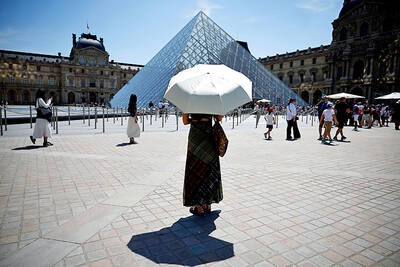
France experienced its hottest spring on record, the French weather service said on Tuesday, after an exceptional early heat wave that also broke highs for the season in England and Wales. Meteo-France said the average nationwide temperature over March to May was 13.8°C — about 1.7°C above the norm, and surpassing records set in 2011 and 2020. “The warmest spring since records began in 1900,” it said in a bulletin. All three months were warmer than average, but the onset of an “unprecedented heatwave” late last month pushed the mercury to highs typically seen at the height of the summer. “Our country had never


 RSS
RSS