


A visit by EU ambassadors to the Xinjiang region of China has stalled over their request for access to jailed Uighur academic Ilham Tohti, a diplomatic source said yesterday.
China said it has since 2019 invited foreign diplomats and UN High Commissioner for Human Rights Michelle Bachelet to visit Xinjiang, where rights groups allege more than 1 million Uighurs and other Muslim minorities are detained in internment camps.
However, there has been little sign of progress.
A European diplomat told reporters that it was because the mission wants to visit Tohti, a Uighur economist jailed for life on separatism charges in 2014.
He received the Sakharov Prize — the EU’s top human rights award — in 2019.
“Negotiations are in a stalemate because of Tohti and other conditions,” the diplomat said. “I don’t think they are going soon.”
Chinese Ambassador to the EU Zhang Ming (張明) on Tuesday said “almost everything had been arranged” for EU member states’ ambassadors to visit Xinjiang.
However, it had snagged on “unacceptable requests,” he added.
“They insist on a meeting with one criminal convicted by Chinese law,” he said. “This is unacceptable, I’m so sorry.”
China has denied allegations of abuse involving Uighurs in Xinjiang and said that all inmates have “graduated” from “vocational training centers,” which it claims have helped stamp out extremism in the region and raise incomes.
A delegation of three EU officials who took part in a carefully organized Xinjiang visit in January 2019 previously said they believed the people they met in a “training center” were reciting a dictated speech.
Zhang added that Chinese Minister of Foreign Affairs Wang Yi (王毅) extended an invitation to Bachelet on March 7, after she late last month called for an “independent and comprehensive assessment of the human rights situation” in Xinjiang.
He said that Xinjiang is “open to foreign diplomats, journalists and tourists.”
All foreign journalists have faced extensive harassment and surveillance from Chinese authorities when attempting to report from Xinjiang over the past year, the Foreign Correspondents’ Club of China has said.

An American scientist convicted of lying to US authorities about payments from China while he was at Harvard University has rebuilt his research lab in Shenzhen, China, to pursue technology the Chinese government has identified as a national priority: embedding electronics into the human brain. Charles Lieber, 67, is among the world’s leading researchers in brain-computer interfaces. The technology has shown promise in treating conditions such as amyotrophic lateral sclerosis and restoring movement in paralyzed people. It also has potential military applications: Scientists at the Chinese People’s Liberation Army have investigated brain interfaces as a way to engineer super soldiers by boosting

Indonesian police have arrested 13 people after shocking images of alleged abuse against small children at a daycare center went viral, sparking outrage across the nation, officials said on Monday. Police on Friday last week raided Little Aresha, a daycare center in Yogyakarta on Java island, following a report from a former employee. CCTV footage circulating on social media showed children, most younger than two, lying on the floor wearing only diapers, their hands and feet bound with rags. The police have confirmed that the footage is authentic. Police said they also found 20 children crammed into a room just 3m by 3m. “So

A highway bomb attack in a restive region of southwestern Colombia on Saturday killed 14 people and injured at least 38, the latest spate of violence ahead of next month’s presidential election. Authorities blamed the attack in the Cauca department — a conflict-ridden, coca-growing region — on dissidents of the now-disbanded FARC guerrilla army, who have been sowing violence across the country. “Those who carried out this attack ... are terrorists, fascists and drug traffickers,” Colombian President Gustavo Petro said on social media. “I want our very best soldiers to confront them,” he added. The leftist leader blamed the bombing
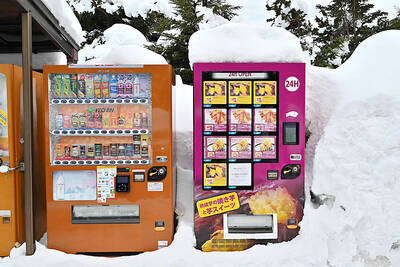
From post offices and parks to stations and even the summit of Mount Fuji, Japan’s vending machines are ubiquitous, but with the rapid pace of inflation cooling demand for their drinks, operators are being forced to rethink the business. Last month beverage giant DyDo Group Holdings announced it would remove about 20,000 vending machines — about 7 percent of their stock nationwide — by January next year, to “reconstruct a profitable network.” Pokka Sapporo Food & Beverage, based in Nagoya, also said last month it would sell its 40,000-machine operation to Osaka-based Lifedrink Co. “The strength of the vending machine


 RSS
RSS