


Andrix Serrano studies alone inside a Manila slum shack he shares with his street-sweeper grandmother. Like many in his fourth-grade class, he has no Internet for his shuttered school’s online lessons.
A year after the COVID-19 pandemic sent the Philippines into a months-long lockdown, classrooms across the nation remain empty and children are still stuck at home.
Fearing youngsters could catch the coronavirus and infect elderly relatives, Philippine President Rodrigo Duterte refuses to lift the restrictions until vaccinations are widespread — something that could take years.
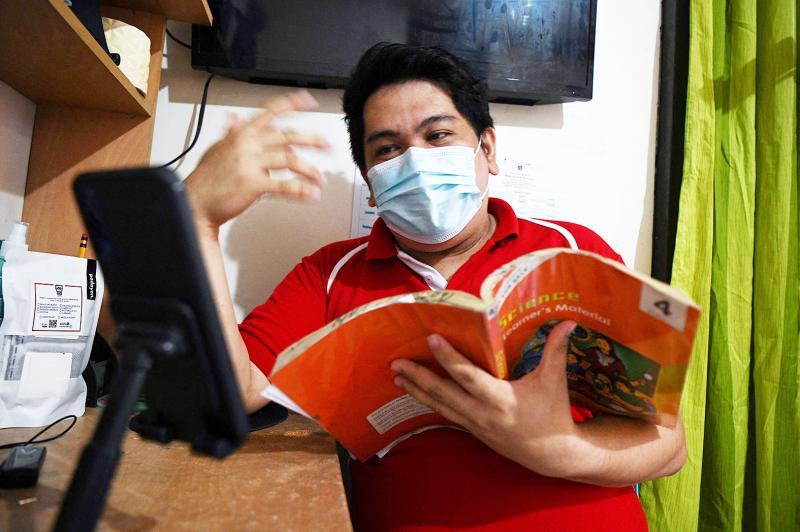
Photo: AFP
A “blended learning” program involving online classes, printed materials, and lessons broadcast on TV and social media was launched in October last year, four months after the school year was supposed to start.
It has been plagued with problems — most students in the Philippines do not have a computer or Internet access at home.
“I can’t do it, it’s difficult for me,” said Serrano, sitting in his shack next to a polluted river, a photograph of him wearing a class graduation gown hanging on the wall behind him. “It’s fun in school. It’s easier to learn there.”
The nine-year-old’s science teacher, Kristhean Navales, runs a class on Facebook Messenger, but less than half of his 43 students have access to a device. Using heart and thumb emojis, those that can join signal if they have understood or have questions about the lesson Navales has pasted into the group chat.
They do not always have Internet access and what bandwidth they have is not enough for videoconference calls.
“Subjects that require hands-on activity like science, mathematics — how can we do that in the messenger?” Navales said.
The rest of his students rely on printed materials that have been simplified by the school to ease the burden on children. After class, Navales visits Serrano and other students who are struggling to keep up — and delivers bags of vegetables to their families.
He worries that his students are not learning much and he is frustrated by the government’s failure to prepare schools for a return to in-person classes.
“Their right to education should not be hampered by this pandemic,” he said.
Fifteen-year-olds in the Philippines were already at or near the bottom in reading, mathematics and science, according to Organisation for Economic Co-operation and Development data, but since the shutdown enrollments have dropped by more than 1 million, the UN International Children’s Emergency Fund (UNICEF) estimates.
Experts worry that many students are falling even further behind and those that have dropped out might not return to the classroom.
“COVID is affecting all school systems in the world, but here it is even worse,” said Isy Faingold, head of education work at UNICEF-Philippines.
Classroom closures also leave children at greater risk of sexual violence, teenage pregnancy and recruitment by armed groups, he said.
A stay-at-home order for children under 15 makes it even more dangerous.
Many parents have flouted the order, allowing their children to play in parks or on the street, but it is taking a toll on their development.
The rule was briefly lifted for some children in January, but Duterte quickly reimposed it, telling them to watch TV instead.
Plans for a limited reopening were scrapped after a more infectious COVID-19 variant emerged. Data show the coronavirus largely spares children, but it remains unclear how much they transmit.
Duterte’s own economic managers have warned of “permanent scarring” to children that could hurt their earning potential if home-based learning is prolonged.
“Not being able to see and relate physically face to face with their classmates and friends has had a tremendous impact on the emotional development of children,” clinical child psychologist Maria Lourdes Carandang said.
She has seen “alarming” levels of depression and anxiety. Parents and grandparents are also feeling the strain.
Every week, Aida Castillo, 65, picks up printed lessons from school for her five grandchildren and supervises their study while their parents work. Only the eldest has access to a smartphone for online classes when their mother comes home.
“It’s like you’re the one teaching them and what if you don’t know about [the subject]?” said Castillo, who left school after sixth grade.
She wants face-to-face classes to resume, but only “if the pandemic is over” — something that seems even more distant as the infection rate soars again.
School closures have affected all students, but the nation’s devastating rich-poor divide has made the impact unequal.
Parents with money can hire tutors for their children — or even a live-in teacher.
Recruitment company Ikon Solutions Asia has placed dozens of qualified teachers in a “bubble” with wealthy families during the pandemic, managing director Paolo Martel said.
For poor students like Maria Fe Morallos, who lives in a smoky charcoal-making neighborhood, such opportunities do not exist.
The 10th-grade student cannot afford a smartphone, so she sits under a naked light bulb writing answers on worksheets, skipping lessons she does not understand.
“The rich have everything they need,” Morallos said. “It’s hard for the poor because we don’t have a gadget or the money to buy it.”

PHISHING: The con might appear convincing, as the scam e-mails can coincide with genuine messages from Apple saying you have run out of storage For a while you have been getting messages from Apple saying “your iCloud storage is full.” They say you have exceeded your storage plan, so documents are no longer being backed up, and photos you take are not being uploaded. You have been resisting Apple’s efforts to get you to pay a minimum of £0.99 (US$1.33) a month for more storage, but it seems that you cannot keep putting off the inevitable: You have received an e-mail which says your iCloud account has been blocked, and your photos and videos would be deleted very soon. To keep them you need

For two decades, researchers observed members of the Ngogo chimpanzee group of Kibale National Park in Uganda spend their days eating fruits and leaves, resting, traveling and grooming in their tropical rainforest abode, but this stable community then fractured and descended into years of deadly violence. The researchers are now describing the first clearly documented example of a group of wild chimpanzees splitting into two separate factions, with one launching a series of coordinated attacks against the other. Adult males and infants were targeted, with 28 deaths. “Biting, pounding the victim with their hands, dragging them, kicking them — mostly adult males,
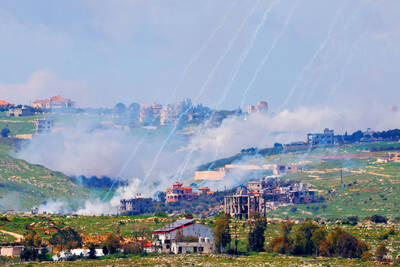
The Israeli military has demolished entire villages as part of its invasion of south Lebanon, rigging homes with explosives and razing them to the ground in massive remote detonations. The Guardian reviewed three videos posted by the Israeli military and on social media, which showed Israel carrying out mass detonations in the villages of Taybeh, Naqoura and Deir Seryan along the Israel-Lebanon border. Lebanese media has reported more mass detonations in other border villages, but satellite imagery was not readily available to verify these claims. The demolitions came after Israeli Minister of Defense Israel Katz called for the destruction of

SUPERFAN: The Japanese PM played keyboard in a Deep Purple tribute band in middle school and then switched to drums at university, she told the British rock band Legendary British rock band Deep Purple yesterday made Japanese Prime Minister Sanae Takaichi’s day with a brief visit to their high-profile superfan as they returned to the nation they first toured more than half a century ago. Takaichi’s reputation as an amateur drummer, and a fan of hard rock and heavy metal has been well documented, and she has referred to Deep Purple as one of her favorite bands along with the likes of Black Sabbath and Iron Maiden. “You are my god,” a giddy Takaichi said in English to Deep Purple drummer Ian Paice, presenting him with a set of made-in-Japan


 RSS
RSS