


The Year of the Ox begins on Friday, and in the shadow of Hong Kong’s futuristic urban skyline, wild bovines are getting some love.
Cattle and water buffaloes embody hard work and serenity in the 12-animal Chinese zodiac, and were used on Hong Kong farms for centuries to plough rice fields, pull carts and provide milk and meat.
However, as farms began to shut down in the 1970s, many animals were abandoned, and their descendants became the wild cattle and buffalos commonly seen in rural Hong Kong.
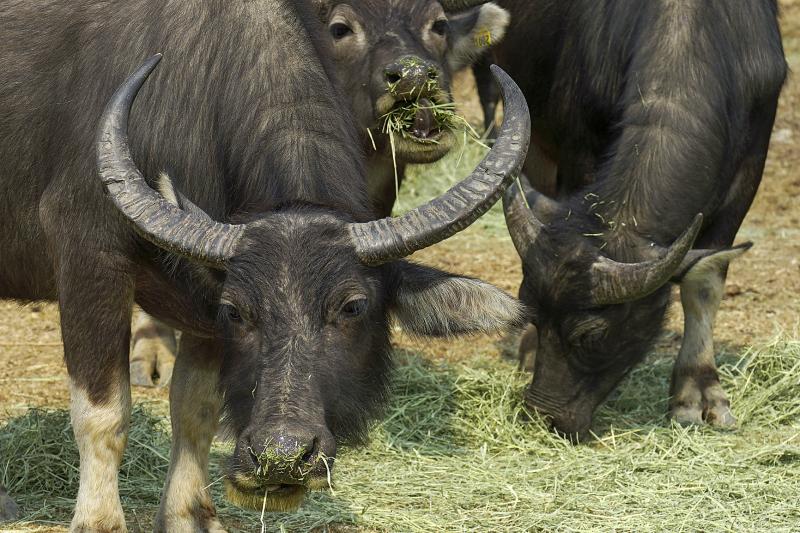
Photo: Vincent Yu, AP
Ho Loy of the Lantau Buffalo Association and her team of volunteers dedicate most weekends to checking on the cattle that roam the biggest island within the territory of Hong Kong.
Starting in the middle of the morning, they distribute grass and hay bought with donated funds to various herds around the island.
“The animals are a very important part of our culture, of our regional planning — especially of our rural planning,” Ho said.
The animals provide an opportunity to explore “what that means to Hong Kongers about the nature, the remaining nature value in Hong Kong.”
The Hong Kong Agriculture, Fisheries and Conservation Department estimates that there are about 1,100 brown cattle and 120 water buffalo distributed across the territory’s Lantau Island and rural parts of the New Territories, near the border with mainland China.
The Lantau Buffalo Association hopes to preserve the animals and their habitat, reduce friction with growing human communities and lobby for long-term environmental preservation policies.
While Hong Kong is best known for its neon-lit, densely packed urban environment, more than three-quarters of the remains green hills and forests.
Over her 14 years of caring for the animals, Ho, a Lantau resident, has come to know them well.
Water buffalo are “very shy, they spend most of the time in the wetland. So, preserving the wetland is one thing will help them to live healthy,” she said.
Cattle, on the other hand, are very sociable, especially if you have food.
“They will come and get your food and they are not scared of humans,” Ho said.
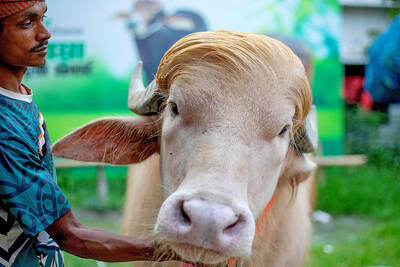
Crowds in Bangladesh are flocking to snap photographs with an unlikely social media star — an albino buffalo with flowing blond hair nicknamed “Donald Trump” that is due to be sacrificed within days. Owner Zia Uddin Mridha, 38, said his brother named the 700kg bull over its flowing helmet of hair resembling the signature look of the US president. “My younger brother picked this name because of the buffalo’s extraordinary hair,” he said at his farm in Narayanganj, just outside the capital, Dhaka. Mridha said that a constant stream of curious visitors — social media fans, onlookers and children — have come throughout

It began as a satirical online project. Now millions of young people in India are flocking to it as an outlet for their frustration. A parody political party called the Cockroach Janta Party, with the insect as its symbol, has exploded across India’s social media by turning absurdist humor into protest. Memes and short videos mocking corruption, joblessness and political dysfunction have flooded social media sites, where millions of users are embracing the cockroach — known for its ability to survive harsh conditions — as a tongue-in-cheek symbol of endurance. The online movement’s rise has been unusually rapid. The Cockroach Janta Party (CJP)
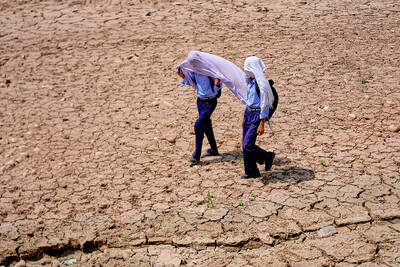
HOTTER: While Indians are accustomed to summer heat, climate change has caused northwestern India to warm faster than other parts of the country, an academic said Roads and markets have emptied during afternoons and some farmers have switched to nighttime work to avoid scorching temperatures as a heat wave grips large parts of India. The India Meteorological Department forecast maximum temperatures for yesterday of about 45°C in the capital, New Delhi, where authorities have opened temporary “cooling zones” to help people cope. The weather department warned that conditions would likely persist across several northern regions in the coming days, with temperatures staying well above seasonal averages. Authorities urged people to stay indoors during the hottest hours and take precautions against heat-related illnesses. India declares a heat wave whenever maximum temperatures

A Hong Kong astronaut is to join a Chinese space mission for the first time as part of a three-person crew launching today, as Beijing edges closer to its goal of landing people on the moon. The Tiangong space station — crewed by teams of three astronauts that are typically rotated every six months — is the crown jewel of China’s space program, boosted by billions in state investment in a bid to catch up with the US and Russia. The Shenzhou-23 mission is to blast off at 11:08pm from the Jiuquan Satellite Launch Center in northwestern China, carrying three astronauts to


 RSS
RSS