


A Chinese court yesterday handed a four-year jail term to a citizen-journalist who reported from Wuhan at the peak of the COVID-19 outbreak, on grounds of “picking quarrels and provoking trouble,” her lawyer said.
Zhang Zhan (張展), 37, the first such person known to have been tried, was among a handful of people whose firsthand accounts from crowded hospitals and empty streets painted a more dire picture of the epicenter of the pandemic than the official narrative.
“We will probably appeal,” said the lawyer, Ren Quanniu (任全牛), adding that the trial at a court in Shanghai’s Pudong district ended at 12:30pm with Zhang being sentenced to four years in prison.
“Ms Zhang believes she is being persecuted for exercising her freedom of speech,” Ren had said before the trial.
Criticism of China’s early handling of the COVID-19 outbreak has been censored and whistle-blowers, such as doctors, warned. State media have credited success in reining in the pandemic to the leadership of Chinese President Xi Jinping (習近平).
The coronavirus has spread worldwide to infect more than 80.7 million people and kill more than 1.76 million, paralyzing air travel as nations threw up barriers against it that have disrupted industries and livelihoods.
Police in Shanghai enforced tight security outside the court where the trial opened seven months after Zhang’s detention, although some supporters were undeterred.
A man in a wheelchair, who said that he came from Henan Province to demonstrate support for Zhang as a fellow Christian, wrote her name on a poster before police arrived to escort him away.
Foreign journalists were denied entry to the court “due to the pandemic,” court security officials said.
A former lawyer, Zhang traveled to Wuhan on Feb. 1 from her home in Shanghai.
Her short videos uploaded to YouTube consisted of interviews with residents, commentary and footage of a crematorium, railway stations, hospitals and the Wuhan Institute of Virology.
Detained in mid-May, she went on a hunger strike in late June, court documents said.
Her lawyers told the court that police strapped her hands and force-fed her with a tube. By this month, she was suffering headaches, giddiness, stomach ache, low blood pressure and a throat infection.
Requests to the court to release Zhang on bail and to livestream the trial were ignored, her lawyer said.
Other citizen-journalists who disappeared without explanation include Fang Bin (方斌), Chen Qiushi (陳秋實) and Li Zehua (李澤華).
While there has been no news of Fang, Li re-emerged in a YouTube video in April to say he was forcibly quarantined, while Chen, although released, is under surveillance and has not spoken publicly, a friend said.

Crowds in Bangladesh are flocking to snap photographs with an unlikely social media star — an albino buffalo with flowing blond hair nicknamed “Donald Trump” that is due to be sacrificed within days. Owner Zia Uddin Mridha, 38, said his brother named the 700kg bull over its flowing helmet of hair resembling the signature look of the US president. “My younger brother picked this name because of the buffalo’s extraordinary hair,” he said at his farm in Narayanganj, just outside the capital, Dhaka. Mridha said that a constant stream of curious visitors — social media fans, onlookers and children — have come throughout
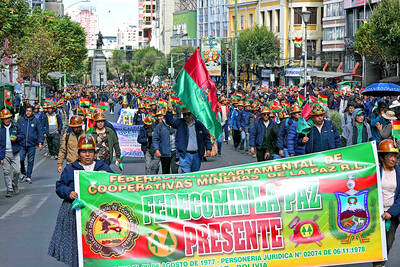
The Bolivian government on Friday struck a deal with protesting miners, but was still grappling with blockades and demonstrations by other workers across La Paz. Other groups are still blocking access roads into the city, which is also the seat of the government. Police on Thursday prevented the miners from entering the main square by using tear gas, while the demonstrators hurled stones and explosives with slingshots. Protests against the policies of Bolivian President Rodrigo Paz have convulsed the Andean nation since early this month, and roadblocks were choking routes into La Paz throughout Friday, the national road authority said. Miners demanded that Paz
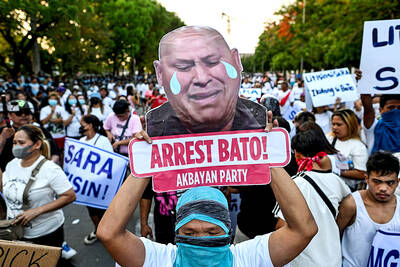
The Philippines said it has asked the country’s Supreme Court to allow it to arrest former Philippine president Rodrigo Duterte’s chief drug war enforcer to stand trial in an international tribunal. The International Criminal Court (ICC) last week unsealed an arrest warrant against Philippine Senator Ronald dela Rosa, accusing him along with Duterte and other “coperpetrators” of the “crime against humanity of murder.” Dela Rosa briefly sought refuge in the Philippine Senate last week while asking the Philippine Supreme Court to stop an ongoing attempt by government agents to arrest him. “By his own conduct, he has placed himself outside the protection of

The researchers in Ireland looked at their computer screen, marveling at a medieval book tracked down in a Roman library. They flipped through its digitized pages and found their sought-after treasure: the oldest surviving English poem. “We were extremely surprised. We were speechless. We couldn’t believe our eyes when we first saw that,” said Elisabetta Magnanti, a visiting research fellow at Trinity College Dublin’s school of English. The poem was also within the main body of Latin text, she said, calling it “extraordinary.” Composed in Old English by a Northumbrian agricultural worker in the 7th century, Caedmon’s Hymn appears within some copies of


 RSS
RSS