


The Swiss this week strongly rejected accusations that a deal allowing Chinese officials to enter Switzerland and interrogate Chinese nationals, which came to light this summer, put dissidents at risk.
Switzerland entered into a so-called readmission agreement with China in 2015. The deal expired on Monday.
The agreement, which remained a secret until Swiss newspaper NZZ revealed its existence in August, specified the terms for Chinese officials to travel to the country and interrogate Chinese nationals set for deportation.
Asia-focused rights group Safeguard Defenders this week published the text of the deal, plus a report about how it differed from similar agreements with other countries, and could pose a threat to “those the Chinese government wants to be returned.”
The details coming to light are “going to tarnish Switzerland’s reputation,” said Peter Dahlin, who heads the organization.
Following the initial revelation of the agreement, since-jailed Hong Kong dissident Joshua Wong weighed in on Twitter, decrying the secretive nature of the deal.
“Five years after the secret deal was signed, no Swiss MP had ever heard of the deal,” he wrote on Aug. 24, warning that “dissidents in exile” from Hong Kong, Taiwan and elsewhere, could risk extradition to China.
The Swiss State Secretariat for Migration denied that there was anything secretive about the China deal, insisting it was a standard, “technical arrangement” like the ones it had reached with 60 other nations.
While the agreement had never been posted publicly like many such deals, it “can be obtained on request at any time,” it said in a statement.
Ministry spokesman Reto Kormann said in an e-mail that persons seen as threatened, like Uighurs or Tibetans, would not be considered for expulsion, and “would not be questioned by Chinese officials.”
He said that readmission agreements were needed because “most states are only willing to take back their own citizens if they can verify their identity.”
“Accordingly, such interviews are standard practice in Switzerland as in other European states,” he added.
The China deal had been put to use only once in the past five years, in 2016, the ministry said.
During that mission, “two Chinese officials stayed in Switzerland for several days to interview a total of 13 people,” it said.
The Safeguard Defenders report maintained that Switzerland’s deal with China was in no way like its agreements with other countries.
The report compared the deal to ones Switzerland has with Sweden, India, Hong Kong and Britain, and said it found glaring differences.
“It differs so much,” Dahlin said, that comparing it to typical readmission agreements “is itself misleading.”
While such agreements are usually reached with immigration departments or foreign ministries, the deal with China was reached with the Chinese Ministry of Public Security, which handles immigration, but also police and intelligence matters.
The Chinese “experts” sent in are not immigration bureaucrats, but “agents,” Dahlin said, adding that the deal allowed them to “roam freely, conduct interviews and interrogations unsupervised.”
He added that the agents could conceivably also move freely throughout Europe’s passport-free Schengen area, which “would obviously be a major concern for the capitals in the countries around Switzerland.”
Chinese Ministry of Foreign Affairs spokeswoman Hua Chunying (華春瑩) said the criticism of its agreement with Switzerland was based on “a misinterpretation of the facts.”
“Other European countries engage in similar cooperation with China,” she said.

Four contenders are squaring up to succeed Antonio Guterres as secretary-general of the UN, which faces unprecedented global instability, wars and its own crushing budget crisis. Chile’s Michelle Bachelet, Argentina’s Rafael Grossi, Costa Rica’s Rebeca Grynspan and Senegal’s Macky Sall are each to face grillings by 193 member states and non-governmental organizations for three hours today and tomorrow. It is only the second time the UN has held a public question-and-answer, a format created in 2016 to boost transparency. Ultimately the five permanent members of the UN’s top body, the Security Council, hold the power, wielding vetoes over who leads the
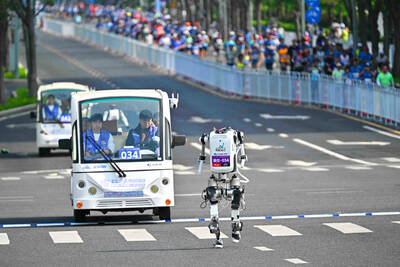
A humanoid robot that won a half-marathon race for robots in Beijing on Sunday ran faster than the human world record in a show of China’s technological leaps. The winner from Honor, a Chinese smartphone maker, completed the 21km race in 50 minutes and 26 seconds, said a WeChat post by the Beijing Economic-Technological Development Area, also known as Beijing E-Town, where the race began. That was faster than the human world record holder, Ugandan Jacob Kiplimo, who finished the same distance in about 57 minutes in March at the Lisbon road race. The performance by the robot marked a significant step forward
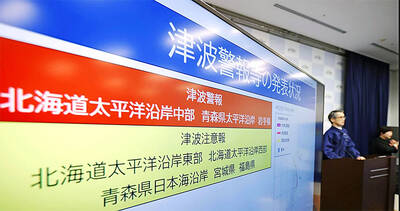
An earthquake registering a preliminary magnitude of 7.7 off northern Japan on Monday prompted a short-lived tsunami alert and the advisory of a higher risk of a possible mega-quake for coastal areas there. The Cabinet Office and the Japan Meteorological Agency said there was a 1% chance for a mega-quake, compared to a 0.1% chance during normal times, in the next week or so following the powerful quake near the Chishima and Japan trenches. Officials said the advisory was not a quake prediction but urged residents in 182 towns along the northeastern coasts to raise their preparedness while continuing their daily lives. Prime
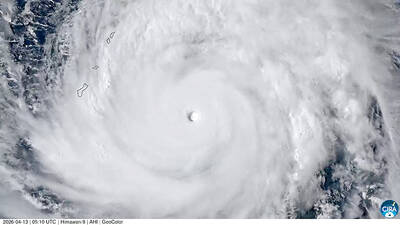
HAZARDOUS CONDITION: The typhoon’s sheer size, with winds extending 443km from its center, slowed down the ability of responders to help communities, an official said The US Coast Guard was searching for six people after losing contact with their disabled boat off the coast of Guam following Typhoon Sinlaku. The crew of the 44m dry cargo vessel, the US-registered Mariana, on Wednesday notified the coast guard that the boat had lost its starboard engine and needed assistance, Petty Officer 3rd Class Avery Tibbets said yesterday. The coast guard set up a one-hour communication schedule with the vessel, but lost contact on Thursday. A Coast Guard HC-130 Hercules aircraft was launched to search for the six people on board, but it had to return to Guam because of


 RSS
RSS