


South Koreans are facing a shortage of a beloved dietary staple after a summer of extreme weather destroyed crops of cabbages — the main ingredient of kimchi.
In what is being described as a full-blown crisis, fields of napa, or Chinese cabbages, were wiped out in August and last month, when the Korean Peninsula was struck by typhoons, floods and landslides, sparking a sudden spike in the vegetable’s price.
The damage has left households struggling to find affordable cabbages to turn into the spicy pickle, which accompanies almost every meal in South Korea and has become a popular “superfood” around the globe, from burger fillings to pizza toppings.
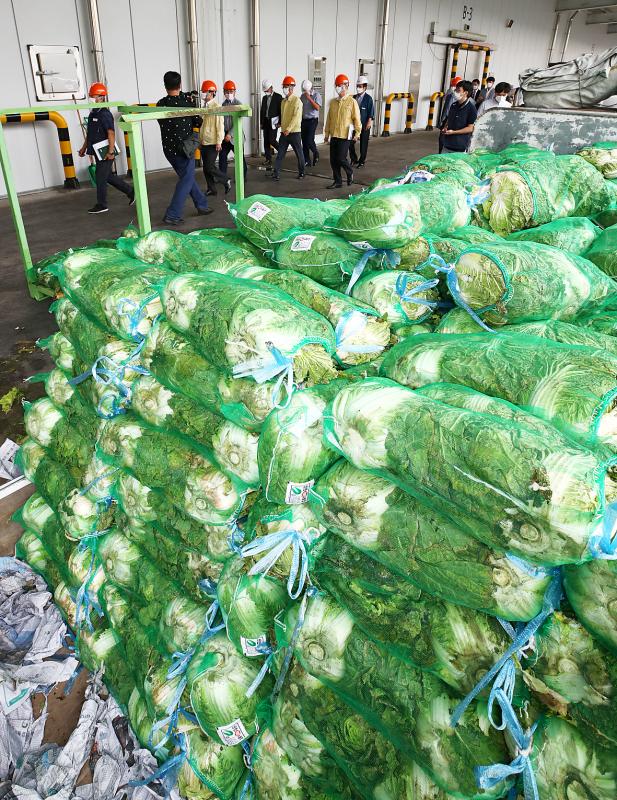
Photo: EPA-EFE
The shortage, which has seen prices rise by up to 60 percent, comes just before the start of the traditional kimchi-making season, when people who prefer to make their own version season cabbages with chili powder, garlic and other ingredients before leaving it to ferment.
The communal act of making kimchi, known as kimjang, was added to UNESCO’s Intangible Cultural Heritage list in 2013.
The UN body said the tradition “forms an essential part of Korean meals, transcending class and regional differences. The collective practice of kimjang reaffirms Korean identity and is an excellent opportunity for strengthening family cooperation.”
However, this year the autumnal rite got off to a slow start after crops were ruined by an unusually long rainy season and three strong typhoons late this summer.
The cabbage shortfall is also affecting commercial producers, according to Bloomberg, with the country’s biggest kimchi maker, Daesang, saying that it has been forced to suspend online sales.
Another said it was looking for alternative supplies — possibly from China, a major cabbage exporter — to meet higher demand as more people choose to eat at home during the COVID-19 pandemic.
“Cabbage in particular is quite sensitive to climate change and any sort of extreme weather will be detrimental to its output,” Kim Da-jung, a research fellow at the Korea Rural Economic Institute, told Bloomberg. “While prices are starting to stabilize, uncertainties over price will continue to persist until the kimjang season begins in mid-November.”
Kimchi is an indispensable part of the Korean diet, with South Koreans eating more than 2 million tonnes every year.
Though it often appears in stews and soups, no meal is considered complete without a side dish of the pungent, fermented cabbage, along with kimchi variations made from daikon radish, cucumber, perilla leaf or other seasonal vegetables.
There are an estimated 200 varieties, from the milder, crunchy version preferred in the north to the more pungent pickle commonly eaten further south.
The South Korean Cultural Heritage Administration says about 95 percent of Koreans eat kimchi more than once a day, and more than 60 percent percent have it for breakfast, lunch and dinner.


Through the noise of rushing papers and whirring belts at a print factory in Kyoto, two creators watch their photo essay come to life in broadsheet form — part of an effort to win new audiences in the age of artificial intelligence (AI). Despite the decline of the publishing industry, self-publication and handmade “zine” magazines are growing in popularity in Japan, reflecting the nation’s enduring love of paper in the digital era. While speaking to Agence France-Presse at the plant, his hands black with ink, one of the creators, Kazuma Obara, said: “I think [paper] is a medium that engages all five
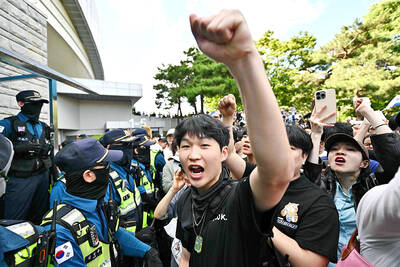
‘ABSURD MISTAKE’: The election commission said that there had been a failure to anticipate turnout after 14 polling stations ran short of ballot papers South Korean riot police yesterday cleared protesters from a Seoul polling station after a 35-hour blockade sparked by a shortage of ballot papers during local elections earlier this week. Wednesday’s election was the first nationwide vote since South Korean President Lee Jae-myung took office following the ouster of Yoon Suk-yeol over his short-lived martial law declaration. Lee’s ruling Democratic Party swept most races, but failed to flip the crucial Seoul mayoral seat. The South Korean National Election Commission apologized, blaming a failure to anticipate turnout after 14 polling stations in Seoul ran short of ballot papers. Some polling stations stayed open until 10pm to

France experienced its hottest spring on record, the French weather service said on Tuesday, after an exceptional early heat wave that also broke highs for the season in England and Wales. Meteo-France said the average nationwide temperature over March to May was 13.8°C — about 1.7°C above the norm, and surpassing records set in 2011 and 2020. “The warmest spring since records began in 1900,” it said in a bulletin. All three months were warmer than average, but the onset of an “unprecedented heatwave” late last month pushed the mercury to highs typically seen at the height of the summer. “Our country had never

A Sherpa guide was found crawling to base camp on Mount Everest a week after he went missing and was reunited with his family, who had given up hope he would return. Dawa Sherpa was last seen on Friday last week descending the mountain, but he did not reach base camp even though his client did. The pair were among the last climbers on the mountain as the climbing season came to an end and the route was dismantled. Dawa was located by a cleaning crew on Thursday morning as he was crawling down the snowy slopes around the Khumbu Icefall, just above


 RSS
RSS