


A high-security and physically distanced courtroom is tomorrow to see the end, of sorts, to one of the darkest and most traumatic moments in New Zealand’s history: the day an Australian terrorist stormed two mosques in the city of Christchurch, killing dozens of worshipers at prayer.
The shooting survivors and families bereaved by the gunman, are to face the perpetrator in the Christchurch High Court, as he is to be sentenced for 51 murders, 40 counts of attempted murder, and engaging in a terrorist act on March 15 last year, all of which he admitted.
Brenton Tarrant, a self-professed white supremacist who broadcast part of the massacre live on Facebook, faces the possibility of being the first offender in New Zealand sentenced to life in prison without the chance of ever leaving jail.
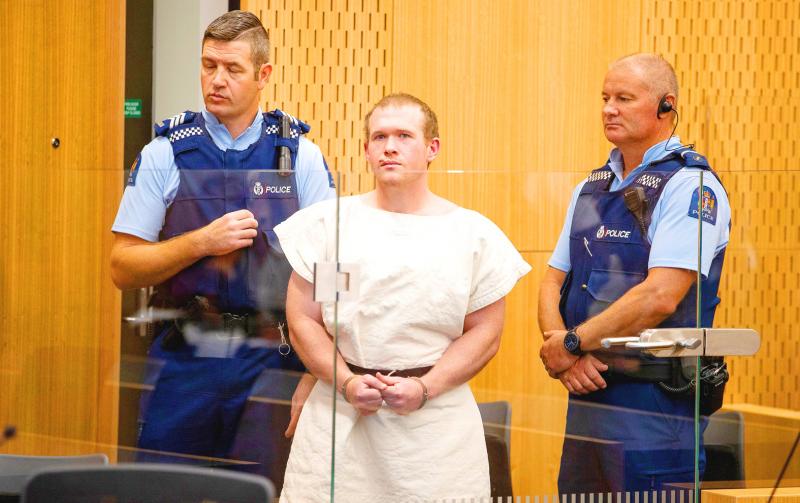
Photo: AFP
After electing to represent himself, the gunman is to have the opportunity to speak in court during a hearing.
The mosque attacks were the largest mass shooting in New Zealand’s history and the first act of terrorism in decades, prompting an outpouring of grief in the normally peaceful nation and exhortations from many in the Muslim community for the country — and its leaders — to confront what they said had been a rising tide of white supremacist threats.
Tarrant’s abrupt guilty plea to all the charges reversed his earlier decision to plead not guilty. It also subverted plans for a lengthy trial scheduled to begin in June that some of his victims welcomed, but many were dreading.
Instead, over four days next week, more than 60 of those wounded or bereaved in the attacks, and those who witnessed them, are to read statements about the effect of the gunman’s actions on their lives.
Among those making statements would be Aya al-Umari, whose brother Hussein al-Umari, 35, was killed trying to protect others at the Al-Noor Mosque.
“There’s only one line that I plan to eyeball him in,” al-Umari said, referring to the gunman. “When I say that I used to talk to Hussein and vent to him, and I still have the urge to pick up the phone and call him ... but now that you’ve killed him, you’ve actually made me turn to God and that’s made my faith in Islam even stronger.”
New Zealand’s courts issue an automatic life sentence for murder, but judges have always allowed for an offender to seek parole after a set number of years, which varies by case.
No one has ever been sentenced to life without parole, the longest previous sentence being a minimum term of 30 years for a man who killed three people in 2001.
“If anything, this should be where [a sentence of life without parole] needs to be utilized,” al-Umari said.
Brenda Midson, a senior law lecturer at the University of Waikato, said the use of such a sentence must pass “a really high threshold” and take into account all factors surrounding the attacks including Tarrant’s age, the length of time he is likely to spend in jail and his admission of the crimes — which usually results in a shorter prison term.
The vulnerability of his victims during Friday prayers would also be considered, she said.
Even though courts were reluctant to send people to jail without the chance of release, “if there was ever a case [for that sentence], it would be this one,” Midson said.

When a hiker fell from a 55m waterfall in wild New Zealand bush, rescuers were forced to evacuate the badly hurt woman without her dog, which could not be found. After strangers raised thousands of dollars for a search, border collie Molly was flown to safety by a helicopter pilot who was determined to reunite the pet and the owner. A week earlier, an emergency rescue helicopter found the woman with bruises and lacerations after a fall at a rocky spot at the waterfall on the South Island’s West Coast. She was airlifted on March 24, but they were forced to
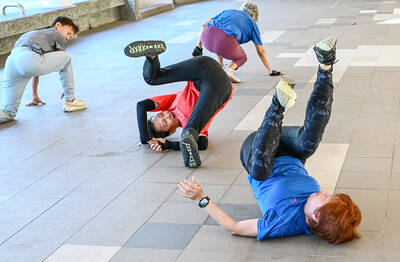
CONFIDENCE BOOSTER: ’After parkour ... you dare to do a lot of things that you think only young people can do,’ a 67-year-old parkour enthusiast said In a corner of suburban Singapore, Betty Boon vaults a guardrail, crawls underneath a slide, executes forward shoulder rolls and scales a steep slope, finishing the course to applause. “Good job,” the 69-year-old’s coach cheers. This is “geriatric parkour,” where about 20 retirees learned to tackle a series of relatively demanding exercises, building their agility and enjoying a sense of camaraderie. Boon, an upbeat grandmother, said learning parkour has aided her confidence and independence as she ages. “When you’re weak, you will be dependent on someone,” she said after sweating it out with her parkour classmates in suburban Toa Payoh,

HIGH HOPES: The power source is expected to have a future, as it is not dependent on the weather or light, and could be useful for places with large desalination facilities A Japanese water plant is harnessing the natural process of osmosis to generate renewable energy that could one day become a common power source. The possibility of generating power from osmosis — when water molecules pass from a less salty solution to a more salty one — has long been known. However, actually generating energy from that has proved more complicated, in part due the difficulty of designing the membrane through which the molecules pass. Engineers in Fukuoka, Japan, and their private partners think they might have cracked it, and have opened what is only the world’s second osmotic power plant. It generates

Chinese dissident artist Gao Zhen (高兟), famous for making provocative satirical sculptures of former Chinese leader Mao Zedong (毛澤東), was tried on Monday over accusations of “defaming national heroes and martyrs,” his wife and a rights group said. Gao, 69, who was detained in 2024 during a visit from the US, faces a maximum three-year prison sentence, said his wife, Zhao Yaliang (趙雅良), and Shane Yi, a researcher at the Chinese Human Rights Defenders group which operates outside the nation. The closed-door, one-day trial took place at Sanhe City People’s Court in Hebei Province neighboring the capital, Beijing, and ended without a


 RSS
RSS