


The mummified corpse of Rascar Capac thrilled and terrified generations of young fans of the Tintin comic book story The Seven Crystal Balls.
Now, Herge’s fictional Inca has sparked a row between rival Belgian tourist attractions, each of which displays a mummy they say inspired Tintin’s creator.
The very serious Art and History Museum is in Brussels’ Jubilee Park, near where Herge used to live, and he was known to frequent its collections.
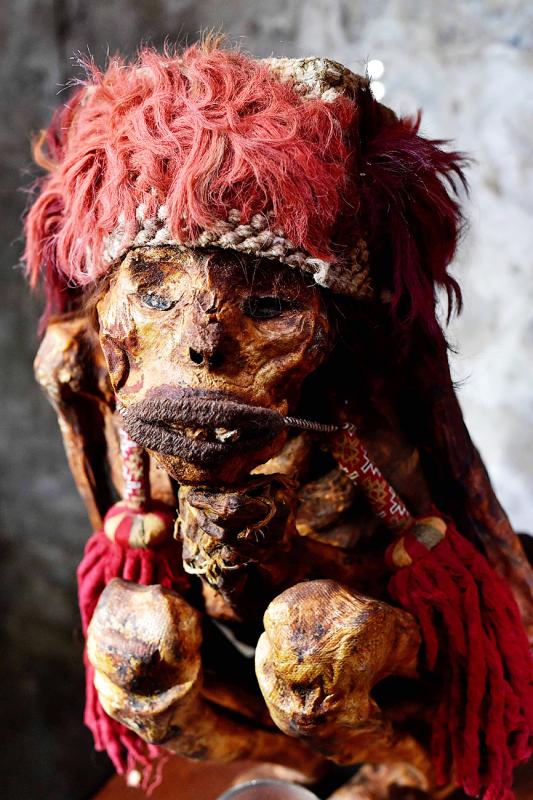
Photo:AFP
The museum’s Andean mummy, squatting upright with knees bent, appears similar to the haunting effigy in the author’s illustrated tale of Tintin’s adventure.
Curators thought that they had established the link beyond doubt 10 years ago, but the Pairi Daiza animal park in southern Belgium is touting a rival mummy.
Last week, the popular zoo began marketing an exhibit of the “authentic mummy nicknamed Rascar Capac.”
The royal museum is not taking this well and has all but accused the park of false advertising.
“We don’t attract visitors by promising them pandas,” museum director-general Alexandra de Poorter said.
The zoo has expressed regret over an “argument started by the royal museums,” but said that “no one can say for sure which mummy inspired Herge.”
If there is confusion, it dates back until at least 1979, when the 2,000-year-old preserved corpse now on display at the zoo appeared in Brussels at an exhibit titled “Tintin’s museum of the imagination.”
The collection was assembled to mark the 50th anniversary of the 1929 release of the boy reporter’s first book-length adventure, Tintin in the Land of the Soviets.
Author and illustrator Georges Remi — better known under his pen name Herge — attended the show, adding some credibility to the mummy’s significance.
However, that was a mistake, the Art and History Museum’s curator of Latin American relics Serge Lemaitre said.
The mummy in question was bought by a Belgian collector in the 1960s, long after Herge published the Seven Crystal Balls in 1948.
“And in the first frames serialized in 1941 in the newspaper Le Soir, Rascar Capac was hairless and had very bent knees, just like our mummy,” Lemaitre said.
Herge lived near the Jubilee Park and knew the museum and its curator, Jean Capart, well.
Capart even seems to have been fictionalized as Professeur Bergamotte — or Professor Hercules Tarragon in the English-language version of The Seven Crystal Balls.
Items drawn from other pieces in the museum’s ethnographic collections have also appeared in the Tintin tales, notably a Peruvian figurine that inspired its eponymous twin in The Broken Ear.
The museum is thus confident in its claim, but — as is often the case in a Tintin mystery — the plot might have a further twist, independent expert Philippe Goddin said.
“We should stop arguing. Herge looked at lots of Inca mummies, but his first sketches of Rascar Capac are essentially based on a drawing in the Larousse dictionary,” he said.
This is an explanation that will not suit anyone in Belgium, where tourist attractions have seized upon any Tintin link to exploit as a key draw.
The drawing in the Larousse was based on a mummy brought back from Peru by the 19th-century French explorer Charles Wiener and is today in the Quai Branly Museum — in Paris.

‘CROSSING THE LINE’: China’s embassy in Seoul criticized US Forces Korea Commander General Xavier Brunson, asking if his ‘hostile’ remarks were authorized by Washington South Korea and the US are in talks over recent public remarks by the commander of US Forces Korea, Seoul’s presidential office said yesterday, after the comments drew sharp criticism from China. In a recent podcast interview, US Forces Korea Commander General Xavier Brunson described South Korea as “the dagger in the heart of Asia” from China’s east coast, prompting the Chinese embassy in Seoul to say that he had “truly crossed the line.” The interview came amid growing speculation that Washington might seek to expand the role of US Forces Korea in countering the growing regional influence of China, a key

Through the noise of rushing papers and whirring belts at a print factory in Kyoto, two creators watch their photo essay come to life in broadsheet form — part of an effort to win new audiences in the age of artificial intelligence (AI). Despite the decline of the publishing industry, self-publication and handmade “zine” magazines are growing in popularity in Japan, reflecting the nation’s enduring love of paper in the digital era. While speaking to Agence France-Presse at the plant, his hands black with ink, one of the creators, Kazuma Obara, said: “I think [paper] is a medium that engages all five

Australian researchers have trained lab-grown brain cells on a silicon computer chip to play the 1990s shooter game Doom and said they are just scratching the surface of what the neurons could be capable of doing. It is the science-fiction work of biotech boffins at Cortical Labs, who researched and developed the technology that harnesses the workings of the brain’s networking system. Each so-called “biological computer” contains about 200,000 living human brain cells, grown from stem cells that were harvested from blood donations. Having mastered the simple computer game Pong, where a paddle is moved up and down to send a ball

France experienced its hottest spring on record, the French weather service said on Tuesday, after an exceptional early heat wave that also broke highs for the season in England and Wales. Meteo-France said the average nationwide temperature over March to May was 13.8°C — about 1.7°C above the norm, and surpassing records set in 2011 and 2020. “The warmest spring since records began in 1900,” it said in a bulletin. All three months were warmer than average, but the onset of an “unprecedented heatwave” late last month pushed the mercury to highs typically seen at the height of the summer. “Our country had never


 RSS
RSS