


A Japanese supercomputer that has been named the world’s fastest is using its extraordinary capacity to identify potential treatments for COVID-19.
Japan this week regained the top spot for the first time since 2011, ending years of US and Chinese dominance on the TOP500 site, which tracks the evolution of computer processing power.
Its Fugaku supercomputer can perform more than 415 quadrillion computations a second, 2.8 times faster than the Summit system developed by the Oak Ridge National Laboratory in the US, which held the title when the twice-yearly rankings were last published in November last year.
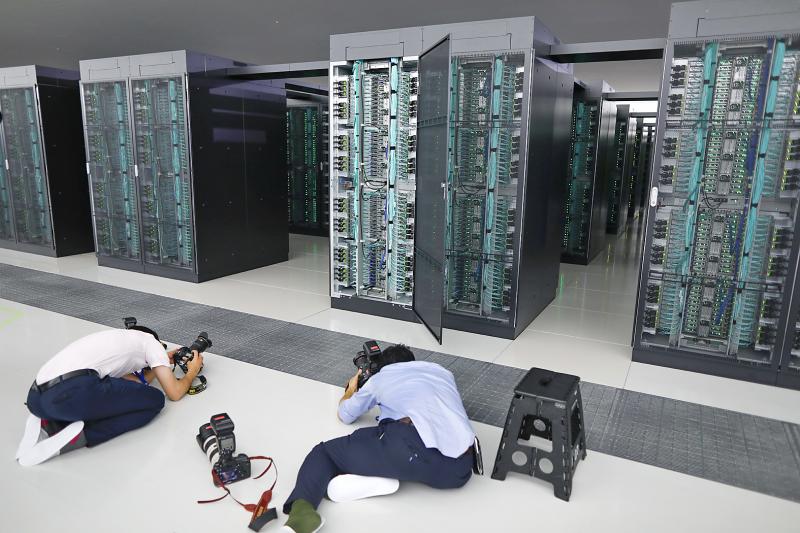
Photo: EPA-EFE
Developed over the past six years by the Japanese technology giant Fujitsu and RIKEN, a government-backed research institute in Kobe, Fugaku includes 150,000 high-performance processing units and can test thousands of substances a week.
Supercomputers, which are more than 1,000 times faster than a regular computer, can be used to simulate nuclear explosions, perform virtual weapons testing and model climate systems.
Although it will not be fully operational until next year, experts are hoping the ¥130 billion (US$1.23 billion) supercomputer can help identify treatments for COVID-19 from about 2,000 existing drugs, including those that have yet to reach the clinical trial stage.
It has already run simulations on how respiratory droplets spread in partitioned office spaces and on packed trains when the carriage windows are open.
“I hope that the cutting-edge IT developed for Fugaku will contribute to major advances on difficult social challenges such as COVID-19,” RIKEN Center for Computational Science director Satoshi Matsuoka said in a statement.

Young Chinese, many who fear age discrimination in their workplace after turning 35, are increasingly starting “one-person companies” that have artificial intelligence (AI) do most of the work. Smaller start-ups are already in vogue in Silicon Valley and elsewhere, with rapidly advancing AI tools seen as a welcome teammate even as they threaten layoffs at existing firms. More young people in China are subscribing to the model, as cities pledge millions of dollars in funding and rent subsidies for such ventures, in alignment with Beijing’s political goal of “technological self-reliance.” “The one-person company is a product of the AI era,” said Karen Dai

South Korea’s air force yesterday apologized for a 2021 midair collision involving two fighter jets, a day after auditors said the pilots were taking selfies and filming during the flight and held them responsible for the accident. “We sincerely apologize to the public for the concern caused by the accident that occurred in 2021,” an air force spokesman told a news conference, adding that one of the pilots involved had been suspended from flying duties, received severe disciplinary action and has since left the military. The apology followed a report released on Wednesday by the South Korean Board of Audit and Inspection,

About 240 Indians claiming descent from a Biblical tribe landed at Tel Aviv airport on Thursday as part of a government operation to relocate them to Israel. The newcomers passed under a balloon arch in blue and white, the colors of the Israeli flag, as dozens of well-wishers welcomed them with a traditional Jewish song. They were the first “bnei Menashe” (“sons of Manasseh”) to arrive in Israel since the government in November last year announced funding for the immigration of about 6,000 members of the community from the states of Manipur and Mizoram in northeast India. The community claims to descend from

‘TROUBLING’: The firing of Phelan, who was an adviser to a nonprofit that supported the defense of Taiwan, was another example of ‘dysfunction’ under Trump, a US senator said US Secretary of the Navy John Phelan has been fired, a US official and a person familiar with the matter said on Wednesday, in another wartime shakeup at the Pentagon coming just weeks after US Secretary of Defense Pete Hegseth ousted the Army’s top general. The Pentagon announced his departure in a brief statement, saying he was leaving the administration “effective immediately,” but it did not provide a reason or say whether it was his decision to go. The sources, who spoke on condition of anonymity, said Phelan was dismissed in part because he was moving too slowly to implement reforms to


 RSS
RSS