


Mining giant BHP Billiton is poised to destroy at least 40 — and possibly as many as 86 — significant Aboriginal sites in the central Pilbara to expand its South Flank iron ore mining operation, even though its own reports show it is aware that the traditional owners are deeply opposed to the move.
A BHP archeological survey identified rock shelters that were occupied between 10,000 and 15,000 years ago, and noted that evidence in the broader area showed “occupation of the surrounding landscape has been ongoing for approximately 40,000 years.”
BHP’s report in September last year identified 22 sites scattered with artifacts, culturally modified trees, rock shelters with painted rock art, stone arrangements and 40 built structures believed to be potential archeological sites.
Under section 18 of the Western Australian Aboriginal Heritage Act, the traditional owners — in this case the Banjima people — are unable to lodge objections or to prevent their sacred sites from being damaged.
They are also unable to raise concerns publicly about the expansion, having signed comprehensive agreements with BHP as part of a native title settlement.
BHP agreed to financial and other benefits for the Banjima people, while the Banjima made commitments to support the South Flank project.
However, the Banjima titleholders in April told the Western Australian Government that they did not want any of the 86 archeological sites within the project area to be damaged, saying the “impending harm” to the area “is a further significant cumulative loss to the cultural values of the Banjima people.”
“The significance of the sites impacted by the notice to Banjima people is such that Banjima people cannot and do not support the destruction of those sites as proposed by the notice, as to do so would be inconsistent with their cultural obligations to protect those sites,” the titleholders said in a letter sent in December last year.
They would “suffer spiritual and physical harm if they are destroyed,” it added.
BHP’s report said that “it had taken into account the views and recommendations provided by the Banjima representatives during the consultation and inspection,” but decided it was “not reasonably practicable” for BHP to avoid the potential archeological sites” at the South Flank mine.
BHP suggested the areas could be excavated, salvaged or deconstructed, but said that the Banjima did not want any of the objects or heritage values within the potential archeological sites to be removed or relocated.
Western Australian Minister for Aboriginal Affairs Ben Wyatt confirmed that he approved the South Flank expansion on May 29, three days after the destruction of Juukan Gorge made global headlines, but he has urged BHP to cooperate with the Banjima under what are now “changed circumstances.”
Wyatt said that impending reforms to Western Australian Aboriginal heritage legislation would end the section 18 process and reinforce the need for land users to negotiate directly with traditional owners.
BHP on Thursday said that it was clarifying earlier statements by promising not to destroy any of the 40 sites in the central Pilbara to expand its South Flank iron ore mining operation without further consultation with the Banjima.
“We will not disturb the sites identified without further extensive consultation with the Banjima people,” a BHP spokesman said. “That consultation will be based on our commitment to understanding the cultural significance of the region, and on the deep respect we have for the Banjima people and their heritage.”
The revelations follow last week’s apology Rio Tinto chief executive Chris Salisbury for destroying the rock shelter in Juukan Gorge, which was blown up in mining works at the Brockman 4 iron ore mine near Tom Price in the Pilbara region on May 24, saying that there had been a “misunderstanding” with the traditional owners.

Four contenders are squaring up to succeed Antonio Guterres as secretary-general of the UN, which faces unprecedented global instability, wars and its own crushing budget crisis. Chile’s Michelle Bachelet, Argentina’s Rafael Grossi, Costa Rica’s Rebeca Grynspan and Senegal’s Macky Sall are each to face grillings by 193 member states and non-governmental organizations for three hours today and tomorrow. It is only the second time the UN has held a public question-and-answer, a format created in 2016 to boost transparency. Ultimately the five permanent members of the UN’s top body, the Security Council, hold the power, wielding vetoes over who leads the

A humanoid robot that won a half-marathon race for robots in Beijing on Sunday ran faster than the human world record in a show of China’s technological leaps. The winner from Honor, a Chinese smartphone maker, completed the 21km race in 50 minutes and 26 seconds, said a WeChat post by the Beijing Economic-Technological Development Area, also known as Beijing E-Town, where the race began. That was faster than the human world record holder, Ugandan Jacob Kiplimo, who finished the same distance in about 57 minutes in March at the Lisbon road race. The performance by the robot marked a significant step forward

An earthquake registering a preliminary magnitude of 7.7 off northern Japan on Monday prompted a short-lived tsunami alert and the advisory of a higher risk of a possible mega-quake for coastal areas there. The Cabinet Office and the Japan Meteorological Agency said there was a 1% chance for a mega-quake, compared to a 0.1% chance during normal times, in the next week or so following the powerful quake near the Chishima and Japan trenches. Officials said the advisory was not a quake prediction but urged residents in 182 towns along the northeastern coasts to raise their preparedness while continuing their daily lives. Prime
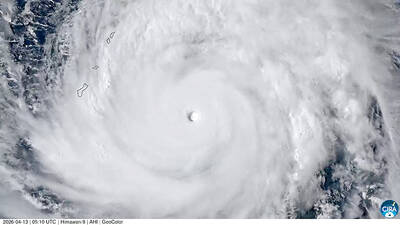
HAZARDOUS CONDITION: The typhoon’s sheer size, with winds extending 443km from its center, slowed down the ability of responders to help communities, an official said The US Coast Guard was searching for six people after losing contact with their disabled boat off the coast of Guam following Typhoon Sinlaku. The crew of the 44m dry cargo vessel, the US-registered Mariana, on Wednesday notified the coast guard that the boat had lost its starboard engine and needed assistance, Petty Officer 3rd Class Avery Tibbets said yesterday. The coast guard set up a one-hour communication schedule with the vessel, but lost contact on Thursday. A Coast Guard HC-130 Hercules aircraft was launched to search for the six people on board, but it had to return to Guam because of


 RSS
RSS