


On most mornings, Somaya Farooqi and four other teenage girls pile into her dad’s car and head to a mechanic’s workshop. They use back roads to skirt police checkpoints set up to enforce a lockdown in their city of Herat, one of Afghanistan’s hot spots of the coronavirus pandemic.
The members of Afghanistan’s prize-winning girls’ robotics team say that they are on a lifesaving mission — to build a ventilator from used car parts and help their war-stricken country battle the virus.
“If we even save one life with our device, we will be proud,” Farooqi, 17, said.
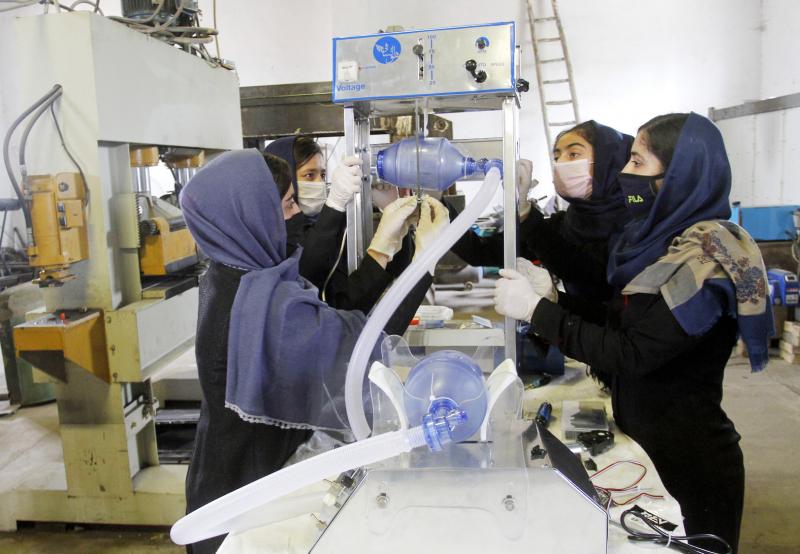
Photo: AP
Their pursuit is particularly remarkable in conservative Afghanistan. Only a generation ago, during the rule of the Islamic fundamentalist Taliban in the late 1990s, girls were not allowed to go to school. Farooqi’s mother was pulled from school in third grade.
After the US invasion of Afghanistan in 2001, girls returned to schools, but gaining equal rights remains a struggle. Farooqi is undaunted.
“We are the new generation,” she said in a telephone interview. “We fight and work for people. Girl and boy, it does not matter anymore.”
Afghanistan faces the pandemic nearly empty-handed. It has only 400 ventilators for a population of more than 36.6 million.
So far, it has reported more than 900 coronavirus cases, including 30 deaths, but the actual number is suspected to be much higher since test kits are in short supply.
The Herat Province in western Afghanistan is one of the nation’s hot spots because of its proximity to Iran, the region’s center of the outbreak.
This has spurred Farooqi and her team members, ages 14 to 17, to help come up with a solution.
On a typical morning, Farooqi’s father collects the girls from their homes and drives them to the team’s office in Herat, zigzagging through side streets to skirt checkpoints.
From there, another car takes them to a mechanic’s workshop on the outskirts of the city.
In Herat, residents are only permitted to leave their homes for urgent needs. The robotics team has a limited number of special permits for cars
So far, Farooqi’s father has not been able to get one, but the girls are in a hurry.
“We are concerned about security driving out of the city, but there is no other option, we have to try to save people’s life,” Farooqi said.
At the workshop, the team is experimenting with two different designs, including an open-source blueprint from the Massachusetts Institute of Technology.
The parts being used include the motor of a Toyota windshield wiper, batteries and sets of bag valve masks, or manual oxygen pumps. A group of mechanics helps them build the frame of a ventilator.
Farooqi, who was just 14 years old in 2017 when she participated in the first World Robot Olympiad in the US, said that she and her team members hope to make a contribution.
“Afghans should be helping Afghanistan in this pandemic,” she said.
“We should not wait for others,” she added.
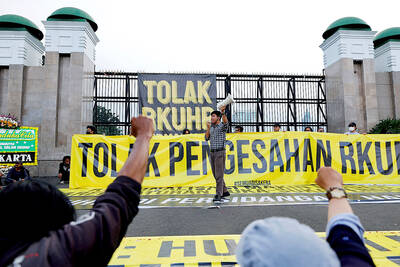
Indonesia yesterday began enforcing its newly ratified penal code, replacing a Dutch-era criminal law that had governed the country for more than 80 years and marking a major shift in its legal landscape. Since proclaiming independence in 1945, the Southeast Asian country had continued to operate under a colonial framework widely criticized as outdated and misaligned with Indonesia’s social values. Efforts to revise the code stalled for decades as lawmakers debated how to balance human rights, religious norms and local traditions in the world’s most populous Muslim-majority nation. The 345-page Indonesian Penal Code, known as the KUHP, was passed in 2022. It

‘DISRESPECTFUL’: Katie Miller, the wife of Trump’s most influential adviser, drew ire by posting an image of Greenland in the colors of the US flag, captioning it ‘SOON’ US President Donald Trump on Sunday doubled down on his claim that Greenland should become part of the US, despite calls by the Danish prime minister to stop “threatening” the territory. Washington’s military intervention in Venezuela has reignited fears for Greenland, which Trump has repeatedly said he wants to annex, given its strategic location in the arctic. While aboard Air Force One en route to Washington, Trump reiterated the goal. “We need Greenland from the standpoint of national security, and Denmark is not going to be able to do it,” he said in response to a reporter’s question. “We’ll worry about Greenland in
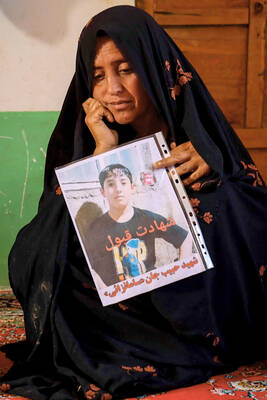
PERILOUS JOURNEY: Over just a matter of days last month, about 1,600 Afghans who were at risk of perishing due to the cold weather were rescued in the mountains Habibullah set off from his home in western Afghanistan determined to find work in Iran, only for the 15-year-old to freeze to death while walking across the mountainous frontier. “He was forced to go, to bring food for the family,” his mother, Mah Jan, said at her mud home in Ghunjan village. “We have no food to eat, we have no clothes to wear. The house in which I live has no electricity, no water. I have no proper window, nothing to burn for heating,” she added, clutching a photograph of her son. Habibullah was one of at least 18 migrants who died
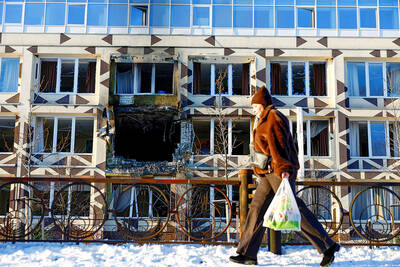
Russia early yesterday bombarded Ukraine, killing two people in the Kyiv region, authorities said on the eve of a diplomatic summit in France. A nationwide siren was issued just after midnight, while Ukraine’s military said air defenses were operating in several places. In the capital, a private medical facility caught fire as a result of the Russian strikes, killing one person and wounding three others, the State Emergency Service of Kyiv said. It released images of rescuers removing people on stretchers from a gutted building. Another pre-dawn attack on the neighboring city of Fastiv killed one man in his 70s, Kyiv Governor Mykola


 RSS
RSS