


Police on Greece’s border with Turkey on Wednesday used tear gas and water cannons to repel hundreds of refugees and migrants clustered on the Turkish side who attempted to break down a border fence and enter Greece.
The evening clashes took place near the Kastanies border crossing.
Greek police said that Turkish authorities also fired tear gas at Greek forces, and migrants later lit fires on the Turkish side of the fence.
Similar clashes occurred before dawn on Wednesday, lasting for about two hours.
An estimated 2,000 people are still camped out on the Greek-Turkish border, weeks after Turkey declared its borders to Europe open, and encouraged migrants and refugees living in the country to try crossing into EU member Greece.
Tens of thousands of people headed to the frontier, despite Greece’s insistence that its eastern border, which is also the EU’s external border, was shut.
The move came after months of threats by Turkish President Recep Tayyip Erdogan that he would allow millions of refugees into Europe unless the bloc provided more support for refugee care in Turkey.
The EU says it is adhering to a 2016 deal with Turkey under which it provides billions of dollars in funds in return for Turkey caring for more than 3.5 million refugees from Syria.
On Wednesday, Turkey declared that it was closing down its six land and sea border crossings with Greece and Bulgaria in an effort to contain the spread of COVID-19.
However, a senior Turkish official said that the measure did not amount to an end of Ankara’s policy of not preventing refugees from leaving Turkey.
The borders were sealed to people and not the transportation of goods, the official added, speaking on condition of anonymity in line with Turkish government protocol.
The violence on the border came hours after Erdogan on Tuesday held a four-way videoconference with the leaders of France, Germany and Britain to discuss the refugee crisis.
A statement from Erdogan’s office said the four leaders also discussed ways of resolving the Syria conflict and providing humanitarian aid in Syria’s troubled Idlib Province. It did not immediately provide further details.
The teleconference between Erdogan, German Chancellor Angela Merkel, French President Emmanuel Macron and British Prime Minister Boris Johnson was arranged after the European leaders canceled plans to travel to Istanbul due to the coronavirus crisis.

SPEAKING OUT: After Siranudh Scott’s allegations surfaced, celebrities and public figures took to social media to share their own experiences of sexual misconduct and abuse A high-profile alleged sexual abuse case within a wealthy Thai beer brewing family has prompted a wave of painful accounts from survivors of unconnected abuse in the conservative nation. Siranudh Scott, a member of the billionaire Thai family that founded the ubiquitous Singha beer brand, posted an emotional video this month accusing his elder brother Sunit of repeatedly abusing him when he was a teenager. Sunit, who is in his 30s, later denied the allegations in a video posted online, but Singha parent Boonrawd dismissed him from his executive role with the company on Tuesday last week. “I felt I needed to speak

SEEKING ORDER: Rodrigo Paz said that ‘anyone who wants to destroy the nation will have to deal with this president and the full force of the constitution’ Bolivian President Rodrigo Paz on Wednesday said that the nation was at a “breaking point” after nearly a month of protests that have caused shortages of food, fuel and medicine. Paz, who took office six months ago amid the worst economic crisis there in four decades, is battling a groundswell of fury over his policies. The political capital, La Paz, has been besieged by low-income workers and members of the indigenous majority calling for his resignation. “The country needs order and is reaching breaking point,” the 58-year-old said at a public event in La Paz, renewing his appeal for dialogue. On Tuesday, the Bolivian
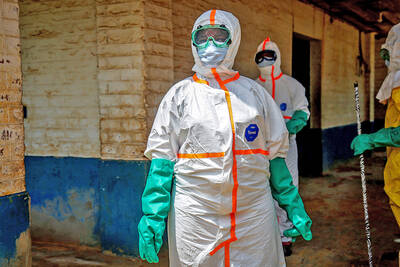
COMMUNITY CONFLICT: Concerns about disease spread from corpses has run up against friends and families’ desire to bury their dead as infection spreads in the area Angry residents of a town at the epicenter of the Ebola outbreak in the Democratic Republic of the Congo (DR Congo) attacked and burned a tent that was part of a health center where people are being treated for the virus, the staff there said Saturday. It was the second such attack in the region in a week. No one was hurt in the attack, according to reports but as patients ran out to escape the fire, 18 people with suspected Ebola infections fled the facility and are unaccounted for, a hospital director said. Angry residents arrived at the clinic in the

Forecasters in Europe yesterday warned of exceptional heat as record temperatures driven by a “heat dome” push temperatures well above seasonal norms across the continent. The surge follows a record-breaking Monday, with France logging its hottest day in the month of May on record, its weather agency said, and the UK also posting unprecedented highs. A so-called “heat dome” of warm air from northern Africa trapped under a high-pressure system over western Europe is behind the high temperatures not usually seen until high summer. Restrictions on outdoor work were imposed in parts of Italy, beaches in southwest France filled earlier than usual and


 RSS
RSS