


Centuries before Captain James Cook claimed Australia for Britain in 1770, Muslim Makassan sailors from Indonesia regularly traveled thousands of kilometers across open sea to trade with Aboriginal people in Australia’s far north.
Now, a voyage in a specially constructed replica boat has rekindled ties between the Makassans from Sulawesi Island and the Yolngu community in northeast Arnhem Land, providing a powerful message about belonging for young Australian Muslims.
The project is the brainchild of the Abu Hanifa Institute, an organization promoting education, identity and inclusiveness for Muslims in Sydney.
Screen grab from Abu Hanifa Institute video / via Reuters
“We ran a workshop with young people and we asked them what it meant to be an Australian and many people really could not identify with that concept,” Wesam Charkawi of Abu Hanifa said. “They felt that the discourse that they hear on a daily basis — ‘Go back to where you came from,’ ‘You don’t belong here,’ ‘Love it or leave it’ — that it alienated them.”
Muslims make up less than 3 percent of Australia’s population and many report experiencing prejudice or hostility regarding their faith.
The 60,000 year history of Australia’s “First Nations,” and their long and deep relationship with the Makassans resonated with many Muslim youth.
The two peoples traded sea cucumbers, exchanged ideas and language, intermarried and lived among each other from the 1500s or possibly earlier, historians have said.
The 15m vessel was built by Makassan artisans on a beach in Sulawesi using traditional methods and local timber.
Launching the boat was just one of many challenges the project had to overcome.
“On the day, we didn’t realize how we were going to get it [into the sea], then all of a sudden, hundreds of people turned up and they began pushing this thing, digging the sand with their own hands — not with shovels, but their own hands — to try and push this vessel into the sea,” Charkawi said. “Eventually, they made it happen.”
With no engine to rely on, the vessel and its 12 Makassan crew sailed for 25 days to make the nearly 2,000km journey to Darwin.
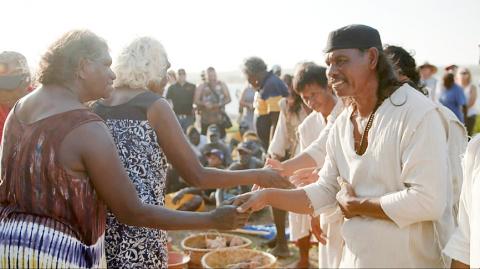
From there, the crew sailed to the Gove Peninsula, in northeast Arnhem Land, where it was met by hundreds of Yolngu and other Aborigines from the area, performing songs and ceremonies of welcome.
Muslim and Aboriginal leaders both wanted to share the history more widely, including getting the story of the Yolngu and Makassan relationship into school curriculums.
“This is a unique and very important thing,” said Aboriginal leader Timmy “Djawa” Burarrwanga, who shared the Makassan story with visiting young Muslims and helped spark the project.
“They are family. They are people that gave something to us — a special gift,” he said at the welcome ceremony.
Charkawi, whose institute is producing a documentary about the project to air later this year, said that the arrival was an emotional experience.
“The atmosphere was amazing. It was breathtaking,” he said. “They’d come out with their children, they’d come out with their elderly, with people who couldn’t walk, who were in wheelchairs, so the whole community had rallied behind this event.”

An American scientist convicted of lying to US authorities about payments from China while he was at Harvard University has rebuilt his research lab in Shenzhen, China, to pursue technology the Chinese government has identified as a national priority: embedding electronics into the human brain. Charles Lieber, 67, is among the world’s leading researchers in brain-computer interfaces. The technology has shown promise in treating conditions such as amyotrophic lateral sclerosis and restoring movement in paralyzed people. It also has potential military applications: Scientists at the Chinese People’s Liberation Army have investigated brain interfaces as a way to engineer super soldiers by boosting
Indonesian police have arrested 13 people after shocking images of alleged abuse against small children at a daycare center went viral, sparking outrage across the nation, officials said on Monday. Police on Friday last week raided Little Aresha, a daycare center in Yogyakarta on Java island, following a report from a former employee. CCTV footage circulating on social media showed children, most younger than two, lying on the floor wearing only diapers, their hands and feet bound with rags. The police have confirmed that the footage is authentic. Police said they also found 20 children crammed into a room just 3m by 3m. “So

Jailed media entrepreneur Jimmy Lai (黎智英) has been awarded Deutsche Welle’s (DW) freedom of speech award for his contribution to Hong Kong’s pro-democracy movement. The German public broadcaster on Thursday said Lai would be presented in absentia with the 12th iteration of the award on June 23 at the DW Global Media Forum in Bonn. Deutsche Welle director-general Barbara Massing praised the 78-year-old founder of the now-shuttered news outlet Apple Daily for standing “unwaveringly for press freedom in Hong Kong at great personal risk.” “With Apple Daily, he gave journalists a platform for free reporting and a voice to the democracy movement in

PHILIPPINE COMMITTEE: The head of the committee that made the decision said: ‘If there is nothing to hide, there is no reason to hide, there is no reason to obstruct’ A Philippine congressional committee on Wednesday ruled that there was “probable cause” to impeach Philippine Vice President Sara Duterte after hearing allegations of unexplained wealth, misuse of state funds and threats to have the president assassinated. The unanimous decision of the 53-member committee in the Philippine House of Representatives sends the two impeachment complaints to deliberations and voting by the entire lower chamber, which has more than 300 lawmakers. The complaints centered on Duterte’s alleged illegal use and mishandling of intelligence funds from the vice president’s office, and from her time as education secretary under Philippine President Ferdinand Marcos Jr. Duterte and the


 RSS
RSS