


UNITED STATES
Conspiracy given 40 months
A diplomat on Tuesday was sentenced to 40 months in prison for lying to investigators about money she received from Chinese intelligence agents in exchange for US documents. Candace Marie Claiborne, 63, pleaded guilty to conspiracy to defraud the US in one of several high-profile cases involving Beijing spies’ recruitment of US officials, the Department of Justice said. She would also be fined US$40,000. Claiborne was a Department of State office management specialist based in Beijing and Shanghai who in 2007 became involved with two men the justice department said she knew were agents of the Chinese Ministry of State Security. They gave her “tens of thousands” of US dollars in exchange for documents and information, it said.
THAILAND
Detention power retained
The new civilian government is to retain the power to arbitrarily detain critics, despite the imminent easing of junta-era security controls, prompting warnings from rights groups of enduring “martial law.” Nearly 2,000 people have been tried in military courts since Prime Minister Prayuth Chan-ocha seized power in 2014. The junta last year eased a ban on political activities in the run-up to national elections and Prayuth on Tuesday phased out dozens of additional junta-enacted orders, transferring military cases to civilian courts. However, the government retained more than 100 orders, including the right for police to detain suspects for seven days on national security grounds. Political analyst Titipol Phakdeewanich said the continuing restrictions showed that full democracy remains a distant prospect.
CHINA
Rare ‘terrorism’ charge
A Chinese advocate against corruption who had urged officials to disclose their wealth was arrested for allegedly “promoting terrorism.” Zhang Baocheng (張寶成), 60, was a member of the now-defunct New Citizens Movement, which campaigned for democracy and government transparency. It is unusual for members of civil society or human rights advocates to be accused of terrorism, and his wife said that she fears it suggests Zhang might receive a heavy prison sentence. What led to his latest arrest is unclear. Zhang on Thursday last week was arrested by Beijing police, suspected of “picking quarrels, promoting terrorism, extremism and inciting terrorism,” according to an arrest warrant shared by his wife.
VANUATU
Suspects extradited to China
The nation has denied bowing to pressure from Beijing by allowing Chinese police to extract six criminal suspects without them facing a local court. Critics have accused the government of bypassing due process to please China. Plainclothes police officers from both countries flanked five men and one woman — all reportedly Chinese nationals — as they were escorted onto a privately chartered plane on Friday last week. Four of the six reportedly had Vanuatuan passports obtained under a scheme allowing wealthy foreigners to get citizenship in return for substantial fees or investments. Minister of Internal Affairs Andrew Napuat told Radio New Zealand there was nothing unusual about the operation, and said that foreign criminals should not obtain citizenship in an attempt to hide from the law. “To those other foreigners who have obtained Vanuatu passports through the citizenship program, you must understand that the government can revoke your passports at any time if you are caught in illegal acts,” he told the Daily Post.

‘SHORTSIGHTED’: Using aid as leverage is punitive, would not be regarded well among Pacific Island nations and would further open the door for China, an academic said New Zealand has suspended millions of dollars in budget funding to the Cook Islands, it said yesterday, as the relationship between the two constitutionally linked countries continues to deteriorate amid the island group’s deepening ties with China. A spokesperson for New Zealand Minister of Foreign Affairs Winston Peters said in a statement that New Zealand early this month decided to suspend payment of NZ$18.2 million (US$11 million) in core sector support funding for this year and next year as it “relies on a high trust bilateral relationship.” New Zealand and Australia have become increasingly cautious about China’s growing presence in the Pacific

The team behind the long-awaited Vera Rubin Observatory in Chile yesterday published their first images, revealing breathtaking views of star-forming regions as well as distant galaxies. More than two decades in the making, the giant US-funded telescope sits perched at the summit of Cerro Pachon in central Chile, where dark skies and dry air provide ideal conditions for observing the cosmos. One of the debut images is a composite of 678 exposures taken over just seven hours, capturing the Trifid Nebula and the Lagoon Nebula — both several thousand light-years from Earth — glowing in vivid pinks against orange-red backdrops. The new image
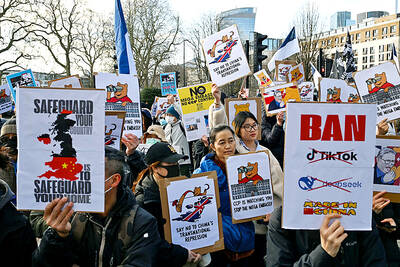
ESPIONAGE: The British government’s decision on the proposed embassy hinges on the security of underground data cables, a former diplomat has said A US intervention over China’s proposed new embassy in London has thrown a potential resolution “up in the air,” campaigners have said, amid concerns over the site’s proximity to a sensitive hub of critical communication cables. The furor over a new “super-embassy” on the edge of London’s financial district was reignited last week when the White House said it was “deeply concerned” over potential Chinese access to “the sensitive communications of one of our closest allies.” The Dutch parliament has also raised concerns about Beijing’s ideal location of Royal Mint Court, on the edge of the City of London, which has so
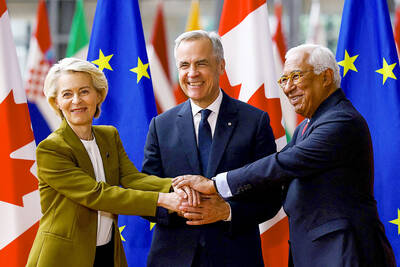
Canada and the EU on Monday signed a defense and security pact as the transatlantic partners seek to better confront Russia, with worries over Washington’s reliability under US President Donald Trump. The deal was announced after a summit in Brussels between Canadian Prime Minister Mark Carney and European Commission President Ursula von der Leyen and European Council President Antonio Costa. “While NATO remains the cornerstone of our collective defense, this partnership will allow us to strengthen our preparedness ... to invest more and to invest smarter,” Costa told a news conference. “It opens new opportunities for companies on both sides of the


 RSS
RSS