


A French animal rights group on Thursday published unsettling images of cows with a plastic “porthole” surgically inserted into their sides to allow access to their stomach contents, rekindling a debate over the welfare of animals in industrial farming.
The practice has been in use for decades by researchers and the agricultural industry, though it is not widely known to the general public.
Known as cannulated or fistulated cows, the animals are fitted with a porthole-like device that can be opened, allowing direct access to the largest of their four stomachs in order to optimize and regulate nutrition.
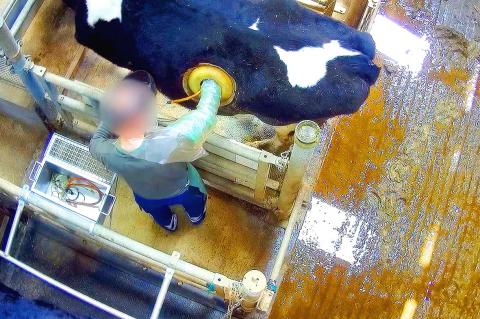
Photo: AFP / L214
The L214 activist group published video footage it said was secretly shot between February and last month at the Sourches Experimental Farm in northwestern France.
The site belongs to Sanders, one of France’s top providers of animal feed and a subsidiary of the food research group Avril.
“They have pierced a hole into the cows’ stomach so they can regularly access its content. Employees come regularly to open the porthole to deposit food samples or take them out,” a video released by the group said.
“The aim is to perfect the most effective form of feeding so the cows produce as much milk as possible,” it said, describing the animals as little more than “milk-producing machines” that put out some 27 liters per day.
L214 said it had filed a complaint with the regional prosecutor over the “illegal experiments and the serious animal abuses” at the farm. “For Sanders and those involved in intensive livestock production, which is the norm in France, these animals are nothing more than production machines, a basic raw material at our disposal,” the video said.
Fabrice Belargent, prosecutor in the Mans region, confirmed that he had received the L214 complaint by e-mail.
Footage of the animals was widely shared on social media, prompting a sharp rebuke from Avril, which said it “deplores the manipulation of images filmed at night for the purposes of sensationalism.”
It said the procedure had been “used for many years in research on animals” and was currently being used “on six cows [at the farm] in the context of a research study designed to develop alternative practices.”
The aim is to “improve the digestive health of millions of animals, reduce the use of antibiotics, and lower the nitrate and methane emissions linked to livestock farming,” it said.
As Europe’s second-largest milk producer after Germany, France has about 3.6 million dairy cows housed at more than 61,700 dairy farms, with the industry accounting for nearly 300,000 jobs across France, official figures show.
Last year, the industry produced 23.9 billion liters of milk.

A US YouTuber who caused outrage for filming himself kissing a statue commemorating Korean wartime sex slaves has been sentenced to six months in prison, a court in Seoul said yesterday. Johnny Somali, 25, gained notoriety several years ago for recording himself doing a series of provocative stunts in South Korea and Japan, and streaming them on platforms such as YouTube and Twitch. South Korean authorities indicted Somali — whose real name is Ramsey Khalid Ismael — in 2024 on public order violations and obstruction of business, and banned him from leaving the country. “The court has sentenced him to six months in

Former Lima mayor Rafael Lopez Aliaga, a Peruvian presidential hopeful, gathered hundreds of supporters in Lima on Tuesday and gave authorities 24 hours to annul the first round of the country’s election over allegations of fraud. Lopez Aliaga is locked in a tight three-way race with two other candidates for second place in Sunday’s vote. The election runner-up wins a ticket to June’s presidential run-off against front-runner Keiko Fujimori. “I am giving them 24 hours to declare this electoral fraud null and void,” said Lopez Aliaga, surrounded by a crowd of several hundred supporters. “If it is not declared null and void tomorrow,

PAPAL RETORT: Pope Leo told reporters that he has ‘no fear, neither of the Trump administration nor speaking out loudly about the message of the Gospel’ US President Donald Trump has feuded with Pope Leo XIV over the Iran conflict — setting off an unholy row that could have serious political implications for the Republican leader back in the US. Trump has drawn barbs even from some allies over the attacks on the US-born pontiff, who has criticized the Trump administration over its immigration crackdown, the intervention in Venezuela and the Iran war. The president risks alienating the religious right in November’s crucial US midterm elections. So far the unprecedented clash between the leader of the most powerful military on Earth and the head of the world’s 1.4 billion

A 16-year-old boy has been charged with murder and aggravated sexual abuse in Florida in the death of his 18-year-old stepsister on a Carnival Cruise ship, the US Department of Justice said on Monday. Timothy Hudson was initially charged in February and subsequently indicted on March 10, but the breadth of the case was not known until a seal was lifted on Friday last week, weeks after US District Judge Beth Bloom in Miami said that he would be prosecuted as an adult at the request of the government. Anna Kepner had been traveling on the Carnival Horizon ship in November last


 RSS
RSS