


Mousumi Akter left her home in rural Bangladesh in 2017 and traveled 5,000km to work as a maid in Jordan to support her struggling family. In less than two years, she was dead.
The young woman was one of 3,793 Bangladeshis who died while working abroad last year, according to newly released government data, the highest annual toll since 2005.
Many poor Bangladeshi families depend on remittances from migrant workers to survive, but as the toll rises, more families are demanding to know why so many people are coming back in body bags.
“Medical reports from Jordan say that she died due to a stroke,” Akter’s uncle, Mohammad Imran Khan, told the Thomson Reuters Foundation.
“But we noticed black marks on her body once it arrived, which suggested to us that she was tortured. Also, how can she suffer from a stroke? She was only 20,” he said.
Khan said the government should have conducted a second autopsy to determine the true cause of his niece’s death — a procedure the family could not afford to pay for.
“Any kind of dead body that returns home should have a second autopsy,” he said.
They are not the only family with doubts. Relatives of Bilal Hossain, who was 23 when he died, were initially told he had suffered a stroke.
They later learned through his roommates in Saudi Arabia that he was killed by an electric shock suffered while cleaning up water on a public street.
Data from the Wage Earners’ Welfare Board, a government agency, show stroke was the official cause of more than half the deaths of Bangladeshi workers overseas in November and last month.
The government points out that the number of Bangladeshis taking up jobs abroad is also rising: Official data showed that more than 1 million Bangladeshis got jobs abroad in 2017, the highest number ever recorded.
However, experts said the growing number of dead reflected the poor treatment of many migrant workers.
“Stress plays a big role,” said C.R. Abrar, professor of International Relations at the University of Dhaka.
“Even before going there, they are having to spend so much. They have no idea about the pain they are about to go through... We need more protective measures, because stress-related issues are ignored,” he said.
On Sunday, about 100 Bangladeshi workers, most of them women, returned from Saudi Arabia, where BRAC — a charity that provides counseling to returning migrants — said they had faced physical and mental abuse.
Some were so seriously hurt they were hospitalized on their return, BRAC said.
The head of Ovibashi Karmi Unnayan Program, a research organization that specializes in migrant issues, said the high cost of going abroad and the poor conditions workers had to endure were key factors behind the rising toll.
“Workers die because of a number of reasons. For one, they work in poor conditions,” Shakirul Islam said.
“Secondly, they have to pay a high migration cost in order to get a visa to go work there. This is accomplished through loans. This in turn creates a mental pressure on the workers,” he said.
Remittances from migrant workers are the second-highest source of foreign currency earnings for Bangladesh after garment manufacturing, and both experts said the government needed to do more to help families establish the truth.
“We need to think about this,” said Raunaq Jahan, a senior civil servant with the Ministry of Expatriates’ Welfare and Overseas Employment.
“If we feel that a dead body requires another autopsy, then why not? These are new issues that we need to think about,” he said.
For the family of Mousumi Akter, any change will come too late.
“I used to speak to Mousumi once a week. The first few months were fine, but gradually she sounded upset. She would say that she had to work all day long without any breaks,” her mother Anwara said.
“The last time I spoke to her, she told me that she was going to come home before taking up her next job, but I don’t know what happened after that. I think they killed my daughter,” she said.
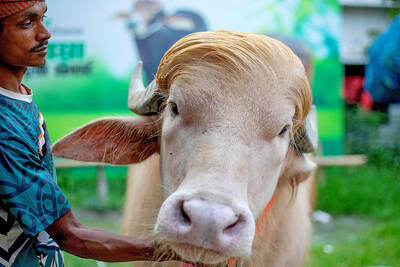
Crowds in Bangladesh are flocking to snap photographs with an unlikely social media star — an albino buffalo with flowing blond hair nicknamed “Donald Trump” that is due to be sacrificed within days. Owner Zia Uddin Mridha, 38, said his brother named the 700kg bull over its flowing helmet of hair resembling the signature look of the US president. “My younger brother picked this name because of the buffalo’s extraordinary hair,” he said at his farm in Narayanganj, just outside the capital, Dhaka. Mridha said that a constant stream of curious visitors — social media fans, onlookers and children — have come throughout

It began as a satirical online project. Now millions of young people in India are flocking to it as an outlet for their frustration. A parody political party called the Cockroach Janta Party, with the insect as its symbol, has exploded across India’s social media by turning absurdist humor into protest. Memes and short videos mocking corruption, joblessness and political dysfunction have flooded social media sites, where millions of users are embracing the cockroach — known for its ability to survive harsh conditions — as a tongue-in-cheek symbol of endurance. The online movement’s rise has been unusually rapid. The Cockroach Janta Party (CJP)
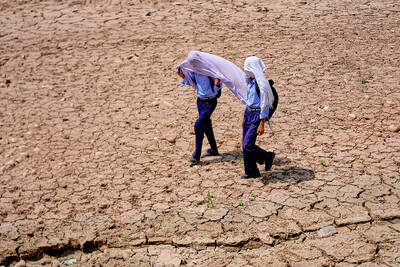
HOTTER: While Indians are accustomed to summer heat, climate change has caused northwestern India to warm faster than other parts of the country, an academic said Roads and markets have emptied during afternoons and some farmers have switched to nighttime work to avoid scorching temperatures as a heat wave grips large parts of India. The India Meteorological Department forecast maximum temperatures for yesterday of about 45°C in the capital, New Delhi, where authorities have opened temporary “cooling zones” to help people cope. The weather department warned that conditions would likely persist across several northern regions in the coming days, with temperatures staying well above seasonal averages. Authorities urged people to stay indoors during the hottest hours and take precautions against heat-related illnesses. India declares a heat wave whenever maximum temperatures

A Hong Kong astronaut is to join a Chinese space mission for the first time as part of a three-person crew launching today, as Beijing edges closer to its goal of landing people on the moon. The Tiangong space station — crewed by teams of three astronauts that are typically rotated every six months — is the crown jewel of China’s space program, boosted by billions in state investment in a bid to catch up with the US and Russia. The Shenzhou-23 mission is to blast off at 11:08pm from the Jiuquan Satellite Launch Center in northwestern China, carrying three astronauts to


 RSS
RSS