


For Hong Kong’s famed neon lights, the future looks dim.
Neon-lit signs were once ubiquitous, illuminating the streets with their soft, warm glow and giving the dynamic Asian territory a signature look to match its post-World War II economic boom.
Tens of thousands of signs on countless tower blocks advertise restaurants, nightclubs, saunas, camera shops and jewelry boutiques in a rainbow of garish hues. Many are cantilevered far out over the street, competing for people’s attention.
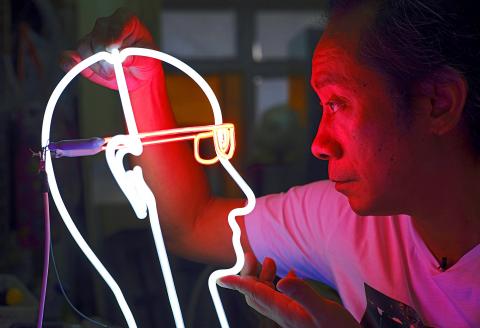
Photo: AP
Few symbols have come to represent Hong Kong as much as its skyline of flashing and blinking neon billboards. That visual heritage is now under threat.
Over the past two decades, Hong Kong’s neon industry has been gradually dying out, a victim of changing tastes, new technologies and tighter regulations. Some groups have been fighting to save the neon signs as part of the territory’s cultural heritage before they disappear completely.
“Neon signs are not just something that illuminate,” said Cardin Chan of Hong Kong Neon Heritage, whose members are cataloging the signs that remain and working on creative ways to preserve them. “They should be considered as art and it is very unique to Hong Kong.”
Wu Chi-kai is one of about half a dozen neon sign masters left in Hong Kong.
The 50-year-old said he now earns about one-third of what he made during the “golden era for the neon sign industry” in the 1980s and early 1990s.
At the time, Hong Kong was at its economic peak.
Wu had done a six-month apprenticeship in his teens before being hired by a signmaker.
Their days were so busy that he sometimes slept in the studio, he said.
“Around 1997, LEDs came out,” Wu said. “I thought that it would be a strong enemy of neon signs. As neon signs had been used for decades, people perceived it as old-fashioned and people usually love to use something new for their store signs.”
LED signs have since proliferated across Hong Kong because they are brighter and more energy efficient, but purists say they also lack neon’s warm tones.
Neon’s appeal also faded because of its association with red-light districts, a turn-off for businesses wanting a wholesome image.
Hong Kong government regulations have also sped neon’s demise.
Decades ago, few regulations governed sign placement and size, Wu said.
Businesses tried to do outdo each other by putting up bigger and bigger signs, held up by cables and jutting out over busy thoroughfares such as the Nathan Road tourist strip in Kowloon’s Tsim Sha Tsui district. At night, they appear to float in the sky.
“When our clients wanted their neon signs to catch the attention of passersby, they would make the signs wider to avoid being blocked by the other ones,” Wu said.
The Hong Kong Department of Buildings has been cracking down and ordering that some signs be removed.
It does not tally how many neon signs Hong Kong has, although it says the territory has about 120,000 signboards, many of which are believed to be unauthorized.
In each of the past two years, the department has removed or repaired about 2,700 dangerous or unauthorized signboards and issued removal orders for about 700 more.
Among those caught up in the clampdown was a sign depicting a giant Angus cow that had long been a local landmark, hanging above the entrance to the restaurant Sammy’s Kitchen since 1977.
The owners donated it to M+, Hong Kong’s museum of visual culture, which is now adding neon signs to its permanent collection and had dedicated an exhibition to neon signs in 2014.
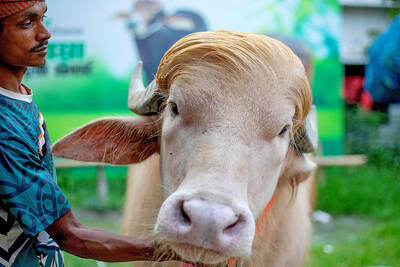
Crowds in Bangladesh are flocking to snap photographs with an unlikely social media star — an albino buffalo with flowing blond hair nicknamed “Donald Trump” that is due to be sacrificed within days. Owner Zia Uddin Mridha, 38, said his brother named the 700kg bull over its flowing helmet of hair resembling the signature look of the US president. “My younger brother picked this name because of the buffalo’s extraordinary hair,” he said at his farm in Narayanganj, just outside the capital, Dhaka. Mridha said that a constant stream of curious visitors — social media fans, onlookers and children — have come throughout

It began as a satirical online project. Now millions of young people in India are flocking to it as an outlet for their frustration. A parody political party called the Cockroach Janta Party, with the insect as its symbol, has exploded across India’s social media by turning absurdist humor into protest. Memes and short videos mocking corruption, joblessness and political dysfunction have flooded social media sites, where millions of users are embracing the cockroach — known for its ability to survive harsh conditions — as a tongue-in-cheek symbol of endurance. The online movement’s rise has been unusually rapid. The Cockroach Janta Party (CJP)
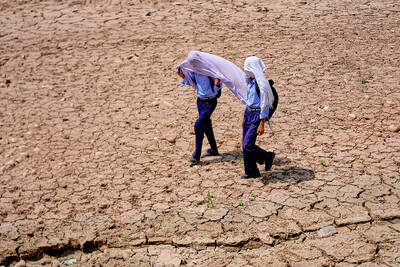
HOTTER: While Indians are accustomed to summer heat, climate change has caused northwestern India to warm faster than other parts of the country, an academic said Roads and markets have emptied during afternoons and some farmers have switched to nighttime work to avoid scorching temperatures as a heat wave grips large parts of India. The India Meteorological Department forecast maximum temperatures for yesterday of about 45°C in the capital, New Delhi, where authorities have opened temporary “cooling zones” to help people cope. The weather department warned that conditions would likely persist across several northern regions in the coming days, with temperatures staying well above seasonal averages. Authorities urged people to stay indoors during the hottest hours and take precautions against heat-related illnesses. India declares a heat wave whenever maximum temperatures
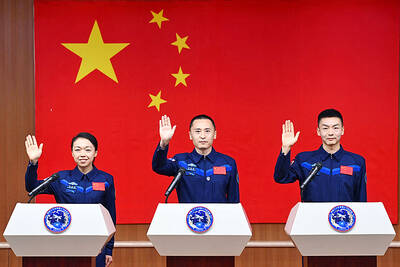
A Hong Kong astronaut is to join a Chinese space mission for the first time as part of a three-person crew launching today, as Beijing edges closer to its goal of landing people on the moon. The Tiangong space station — crewed by teams of three astronauts that are typically rotated every six months — is the crown jewel of China’s space program, boosted by billions in state investment in a bid to catch up with the US and Russia. The Shenzhou-23 mission is to blast off at 11:08pm from the Jiuquan Satellite Launch Center in northwestern China, carrying three astronauts to


 RSS
RSS