


A US federal judge has blocked a Mississippi law intended to allow people who object on religious grounds to refuse wedding and other services to lesbian, gay, bisexual and transgender (LGBT) people.
In a ruling on Thursday, US District Judge Carlton Reeves said that the wide-ranging law adopted in the spring unconstitutionally allowed “arbitrary discrimination” against the LGBT community, unmarried people and others who do not share such views.
“The state has put its thumb on the scale to favor some religious beliefs over others,” wrote Reeves, who issued a preliminary injunction halting the law that was to take effect on Friday.
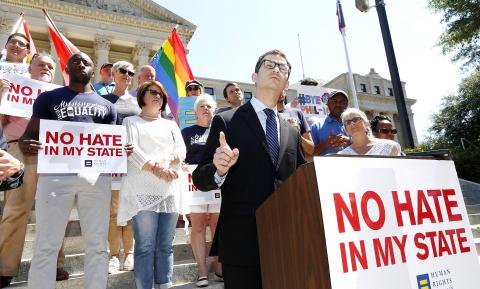
Photo: AP
Mississippi is among a handful of southern US states on the front lines of legal battles over equality, privacy and religious freedom after the US Supreme Court last year legalized same-sex marriage in all 50 states.
Mississippi’s “Protecting Freedom of Conscience from Government Discrimination Act” sought to shield those who believe that marriage involves a man and a woman and that sexual relations should occur within such marriages. The law also protected the belief that gender is defined by sex at birth.
By citing those three religious grounds, the law would have allowed people to refuse to provide a wide range of services, from baking a wedding cake for a same-sex couple to counseling and fertility services. It also permitted dress code and bathroom restrictions to be imposed on transgender people.
Reeves said the law violated the guarantee of religious neutrality and the promise of equal protection under the law by granting special rights to citizens holding certain beliefs.
The law “favors Southern Baptist over Unitarian doctrine, Catholic over Episcopalian doctrine, and Orthodox Judaism over Reform Judaism doctrine,” he said.
Mississippi Governor Phil Bryant, a Republican, signed the measure into law in April. The state has defended it as a reasonable accommodation intended to protect businesses and individuals seeking to exercise their religious views.
“I look forward to an aggressive appeal,” the governor said in a statement on Friday.
However, Mississippi Attorney General Jim Hood, a Democrat named as a defendant in the lawsuit, issued a strongly worded statement in which he said that he would have to “think long and hard” about whether to spend taxpayer money on an appeal.
“The fact is that the church-going public was duped,” Hood said, noting that Mississippi already has a law to protect those seeking to exercise religious freedoms.
“There will be a case in the future in which the US Supreme Court will better define our religious rights,” he added. “This case, however, is not that vehicle.”
An appeal would bring the case before the US Fifth Circuit Court of Appeals, said Roberta Kaplan, an attorney for the Campaign for Southern Equality, one of the plaintiffs.
Critics said the Mississippi law is so broad that it could apply to nearly anyone in a sexual relationship outside of heterosexual marriage, including single mothers. Several legal challenges were filed against various aspects of the law.
Earlier this week, Reeves addressed a provision allowing clerks to recuse themselves from issuing marriage licenses to gay couples based on religious beliefs, saying they had to fulfill their duties under the Supreme Court ruling.
His ruling on Thursday came after religious leaders, including an Episcopal priest and a Jewish rabbi, last week testified that the law did not reflect their religious views. The judge also heard about its harmful potential from members of the gay community.
“As a member of the LGBT community and as minister of the Gospel, I am thankful that justice prevailed,” said plaintiff Susan Hrostowski, an Episcopal priest.

An American scientist convicted of lying to US authorities about payments from China while he was at Harvard University has rebuilt his research lab in Shenzhen, China, to pursue technology the Chinese government has identified as a national priority: embedding electronics into the human brain. Charles Lieber, 67, is among the world’s leading researchers in brain-computer interfaces. The technology has shown promise in treating conditions such as amyotrophic lateral sclerosis and restoring movement in paralyzed people. It also has potential military applications: Scientists at the Chinese People’s Liberation Army have investigated brain interfaces as a way to engineer super soldiers by boosting

Indonesian police have arrested 13 people after shocking images of alleged abuse against small children at a daycare center went viral, sparking outrage across the nation, officials said on Monday. Police on Friday last week raided Little Aresha, a daycare center in Yogyakarta on Java island, following a report from a former employee. CCTV footage circulating on social media showed children, most younger than two, lying on the floor wearing only diapers, their hands and feet bound with rags. The police have confirmed that the footage is authentic. Police said they also found 20 children crammed into a room just 3m by 3m. “So
A grieving mother has ended her life at a clinic in Switzerland four years after the death of her only child. Wendy Duffy, 56, a physically healthy woman, died at the Pegasos clinic in Basel after struggling to cope with the death of her 23-year-old son, Marcus. The former care worker, from the West Midlands, England, had previously attempted to take her own life. The case comes as assisted dying would not become law in England and Wales after proposed legislation, branded “hopelessly flawed” by opponents, ran out of time. Ruedi Habegger, the founder of Pegasos, described Duffy’s death as

From post offices and parks to stations and even the summit of Mount Fuji, Japan’s vending machines are ubiquitous, but with the rapid pace of inflation cooling demand for their drinks, operators are being forced to rethink the business. Last month beverage giant DyDo Group Holdings announced it would remove about 20,000 vending machines — about 7 percent of their stock nationwide — by January next year, to “reconstruct a profitable network.” Pokka Sapporo Food & Beverage, based in Nagoya, also said last month it would sell its 40,000-machine operation to Osaka-based Lifedrink Co. “The strength of the vending machine


 RSS
RSS