


On Broadway, Timon and Pumbaa have entertained audiences for years with their Brooklyn accents.
However, in China, the famous meerkat-warthog duo not only speak Chinese, but they also do so with a distinct beifang, or northern, twang.
The rough-around-the-edges Chinese accent is one of several localized elements that infuse a Mandarin-language production of The Lion King at the new 1,200-seat Walt Disney Grand Theater. The theater is an anchor of the US$5.5 billion Shanghai Disney Resort, which opened on Thursday.
Sitting in the audience at the premiere on Tuesday was a contingent of Disney executives, including chairman and chief executive officer Robert Iger. Local officials and a sprinkling of celebrities, including former NBA player Yao Ming (姚明), also attended.
There were other elements added to enhance the show for Shanghai — different regional dialects, riffs on Chinese pop songs and, for the first time, a new character, the Monkey Master, who is based on the Monkey King, a figure of Chinese legend.
“The Monkey King is China’s favorite character,” director Julie Taymor said in an interview the day before the premiere. “These little touches of familiarity are absolutely what you have to do. It makes the show recognizable.”
The character wears a red-and-yellow Chinese-inspired costume designed by Taymor. Two feathers protrude from the monkey’s hat like antennae. While Monkey Master does not speak, he bursts in to help fight for Simba, the lion protagonist, in several action scenes.
Since its Broadway debut in 1997, The Lion King has been translated into eight languages, including Japanese, Portuguese and Mandarin. In each translation, producers have sought to adapt the script to the local culture, while maintaining the spirit of the original. Altogether, The Lion King has taken in US$7.2 billion from domestic and international productions.
Localizing Broadway’s top-grossing musical has been the focal point for the Shanghai Disney Resort. Disney officials have repeatedly asserted they would create a resort that is both “authentically Disney and distinctly Chinese.”
At the resort, Chinese elements abound. At the Wandering Moon Teahouse, the signature restaurant, for example, visitors can honor the “restless, creative spirit” of Chinese poets. In the Garden of the Twelve Friends, 12 mosaic murals re-imagine Disney characters as the signs of the Chinese zodiac.
Still, the challenge to be “distinctly Chinese” can be difficult to overcome in China, where audiences, especially film audiences, have become adept at sniffing out imported cultural products that plop in so-called “Chinese elements” with little sensitivity.
Producers of The Lion King said they are confident that audiences here would find a seamless integration of Chinese elements into the show.
“The Lion King is, from conception, a very universal piece, both the story and the physical world of it,” Disney Theatrical Group director of international production strategy Felipe Gamba said. “It is an experience that transcends the musical theater genre, which has made it successful in places where musical theater is not a deeply rooted tradition.”
Discussion about bringing a Mandarin version of The Lion King to China began in 2011, Gamba said, the same year officials broke ground on the Shanghai resort. The company had decided that it would build a theater as an anchor for Disneytown, the retail and dining area of the complex.
Within the first few hours of the discussion, it became “quickly obvious” that The Lion King would be the choice, Gamba said.
It helped that the company had toured an English-language production of the show in Shanghai in 2006 to great success.
Soon after, Disney began a search in China for performers who could act, sing, dance and, in some cases, operate the animal masks Taymor designed. However, casting proved to be far more difficult in China, where Broadway-style musical theater is still relatively new. The experiences of earlier adaptations of other musicals such as Cats and Mamma Mia! were helpful.
However, Chinese actors are typically affiliated with theater companies and schools, which limits their availability for outside jobs.
Disney’s reputation in China as an entertainment company did not help, Gamba said.
“A lot of it was about us showing the artistic directors and the actors what a piece of art Julie created,” he said.
In the end, casting took about two-and-a-half years — more than three times the average, Gamba said.
The cast of more than 50 features mostly Chinese actors and others from nations including the Philippines and South Africa.
Gamba said decisions about the length of the show’s run and future productions at the theater depend on how The Lion King fares.
“Right now, we are thinking: ‘Let us just get through the opening,’” he said.

When a hiker fell from a 55m waterfall in wild New Zealand bush, rescuers were forced to evacuate the badly hurt woman without her dog, which could not be found. After strangers raised thousands of dollars for a search, border collie Molly was flown to safety by a helicopter pilot who was determined to reunite the pet and the owner. A week earlier, an emergency rescue helicopter found the woman with bruises and lacerations after a fall at a rocky spot at the waterfall on the South Island’s West Coast. She was airlifted on March 24, but they were forced to
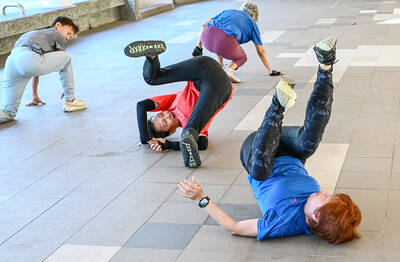
CONFIDENCE BOOSTER: ’After parkour ... you dare to do a lot of things that you think only young people can do,’ a 67-year-old parkour enthusiast said In a corner of suburban Singapore, Betty Boon vaults a guardrail, crawls underneath a slide, executes forward shoulder rolls and scales a steep slope, finishing the course to applause. “Good job,” the 69-year-old’s coach cheers. This is “geriatric parkour,” where about 20 retirees learned to tackle a series of relatively demanding exercises, building their agility and enjoying a sense of camaraderie. Boon, an upbeat grandmother, said learning parkour has aided her confidence and independence as she ages. “When you’re weak, you will be dependent on someone,” she said after sweating it out with her parkour classmates in suburban Toa Payoh,
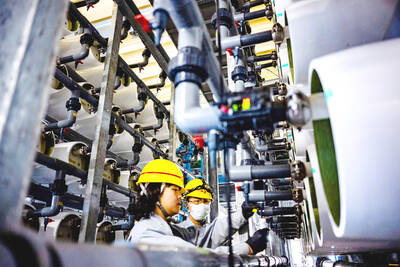
HIGH HOPES: The power source is expected to have a future, as it is not dependent on the weather or light, and could be useful for places with large desalination facilities A Japanese water plant is harnessing the natural process of osmosis to generate renewable energy that could one day become a common power source. The possibility of generating power from osmosis — when water molecules pass from a less salty solution to a more salty one — has long been known. However, actually generating energy from that has proved more complicated, in part due the difficulty of designing the membrane through which the molecules pass. Engineers in Fukuoka, Japan, and their private partners think they might have cracked it, and have opened what is only the world’s second osmotic power plant. It generates
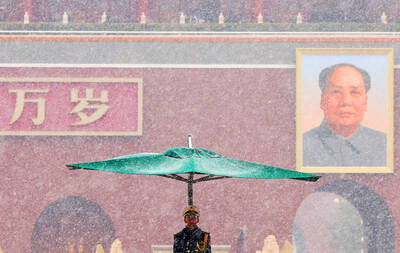
Chinese dissident artist Gao Zhen (高兟), famous for making provocative satirical sculptures of former Chinese leader Mao Zedong (毛澤東), was tried on Monday over accusations of “defaming national heroes and martyrs,” his wife and a rights group said. Gao, 69, who was detained in 2024 during a visit from the US, faces a maximum three-year prison sentence, said his wife, Zhao Yaliang (趙雅良), and Shane Yi, a researcher at the Chinese Human Rights Defenders group which operates outside the nation. The closed-door, one-day trial took place at Sanhe City People’s Court in Hebei Province neighboring the capital, Beijing, and ended without a


 RSS
RSS