


When Swiss engineer Carl Eduard Gruner came up with the idea to build the world’s longest rail tunnel under the Alps in 1947, he predicted the visionary project could be finished by the start of the 21st century.
He would turn out to be off by 16 years.
Gruner’s sketch and technical paper called Journey through the Gotthard Base Tunnel (GBT) in the year 2000 planted the seeds for a venture that will be launched this week and aims to transform travel through the heart of Europe.
Constructing the 57km rail tunnel took more than 12 billion Swiss francs (US$12 billion and about 2,400 workers, according to Swiss government statistics.
More than 28 million tonnes of rock had to be excavated from the mountain near the Gotthard Pass.
The bumpy road from Gruner’s initial idea to the official start of construction in 1999 included bureaucratic delays and concern over the project’s financial viability.
Switzerland’s federal government set up a committee in 1963 to look into the building of an alpine base tunnel, but opinions were split over various proposals, before an official body eventually ruled in 1983 that the project was “not urgent.”
Momentum in favor of the GBT built again ahead of a 1992 referendum, which supported the project, but public outcry about the expense put work on hold.
Eventually, a November 1998 referendum closed the deal, when 64 percent of Swiss voters approved the final plans along with funding schemes, including a new road tax.
ZURICH TO MILAN
“It’s a big engineering achievement,” said Martin Knights of the London-headquartered Institution of Civil Engineers.
The tunnel runs from Erstfeld in the central Swiss canton of Uri, to Bodio in southern Ticino canton, and will shave the train journey from Zurich to Milan in northern Italy down to 2 hours and 40 minutes, roughly an hour less than it currently takes.
The new route also aims to make rail freight more efficient, including by supporting heavier cargo, which should reduce the number of diesel-guzzling lorries on the roads, in turn improving traffic and curbing pollution.
The number of daily rail passengers is also expected to increase from the current rate of 9,000 people to 15,000 by 2020, according to the Swiss federal railway service.
In a study of the GBT’s possible economic benefits, Swiss bank Credit Suisse forecast a range of positive impacts driven by an easier movement of goods, growth in day-trip tourism and higher property values in the affected cantons linked to increased accessibility.
German Chancellor Angela Merkel, French President Francois Hollande and Italian Prime Minister Matteo Renzi, along with Swiss officials, are due to attend Wednesday’s grand opening, which will feature a ceremonial run.
Full service is scheduled to start in December.
A ‘MOVING FACTORY’
Had Gruner attempted to break ground on the tunnel when he conceived the idea 69 years ago, engineers would have had to undertake a costly and dangerous effort to blast and drill through a massive amount of mountain rock.
However, the project benefited in the end from major technical advances in tunnel boring machines that began to pick up in the 1960s and 1970s, Knights said.
The boring machinery used for the Gotthard Tunnel is “a whole moving factory, half a kilometer in length,” which synchronizes all the steps needed to carve a passage through a mountain, he said.
While cutting through the rock, the machine throws the debris backwards and simultaneously places the pre-formed segments of concrete that form the shape of the tunnel.
A separate system grouts the pieces together.
Ground Engineering magazine editor Claire Smith said that the success of the ambitious Gotthard venture, which was completed on schedule, “has cleared the path for many other [similar] projects.”
The GBT has been viewed as a trailblazer for a high-speed rail link between the French city of Lyon and Turin in northern Italy, which has faced delays and opposition from environmental groups.
It also paves the way for Austria’s Brenner Tunnel, set to open in about a decade.
When it officially opens on Wednesday, the GBT will overtake Japan’s 53.9km Seikan Tunnel as the world’s longest train tunnel and bump the 50.5km Channel Tunnel that links England and France into third place.
However, the Brenner Tunnel could slot into second place when it opens, with an estimated length of 55km.

SPEAKING OUT: After Siranudh Scott’s allegations surfaced, celebrities and public figures took to social media to share their own experiences of sexual misconduct and abuse A high-profile alleged sexual abuse case within a wealthy Thai beer brewing family has prompted a wave of painful accounts from survivors of unconnected abuse in the conservative nation. Siranudh Scott, a member of the billionaire Thai family that founded the ubiquitous Singha beer brand, posted an emotional video this month accusing his elder brother Sunit of repeatedly abusing him when he was a teenager. Sunit, who is in his 30s, later denied the allegations in a video posted online, but Singha parent Boonrawd dismissed him from his executive role with the company on Tuesday last week. “I felt I needed to speak

SEEKING ORDER: Rodrigo Paz said that ‘anyone who wants to destroy the nation will have to deal with this president and the full force of the constitution’ Bolivian President Rodrigo Paz on Wednesday said that the nation was at a “breaking point” after nearly a month of protests that have caused shortages of food, fuel and medicine. Paz, who took office six months ago amid the worst economic crisis there in four decades, is battling a groundswell of fury over his policies. The political capital, La Paz, has been besieged by low-income workers and members of the indigenous majority calling for his resignation. “The country needs order and is reaching breaking point,” the 58-year-old said at a public event in La Paz, renewing his appeal for dialogue. On Tuesday, the Bolivian

COMMUNITY CONFLICT: Concerns about disease spread from corpses has run up against friends and families’ desire to bury their dead as infection spreads in the area Angry residents of a town at the epicenter of the Ebola outbreak in the Democratic Republic of the Congo (DR Congo) attacked and burned a tent that was part of a health center where people are being treated for the virus, the staff there said Saturday. It was the second such attack in the region in a week. No one was hurt in the attack, according to reports but as patients ran out to escape the fire, 18 people with suspected Ebola infections fled the facility and are unaccounted for, a hospital director said. Angry residents arrived at the clinic in the
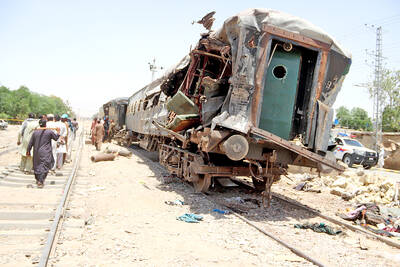
INSURGENT ACTION: A local independence movement in Balochistan, alleged by Pakistan’s government to be backed by India, claimed responsibility for the strike A suicide bomber detonated an vehicle-borne IED near a railway as a passenger train passed through the southwestern Pakistani city of Quetta yesterday, killing at least 23 people and wounding over 70, officials said. The explosion caused two of the train cars to overturn and catch fire, according to footage shared online. The attack happened in an area where security forces are usually stationed, badly damaging several nearby buildings and smashing more than a dozen vehicles parked along the road, according to witnesses and images circulating on social media. Doctors at local hospitals said they had received the wounded, with 20 in critical


 RSS
RSS