


Gripping a monkey-faced chess piece, Thein Zaw swipes his hand across the checkerboard and topples an advancing demon, demonstrating an ancient form of the game that traditionalists are battling to revive.
Sittuyin, as Myanmar’s unique chess is called, is similar to the modern game, but has distinctive pieces as well as moves that echo a time when warriors used it to fine tune real fighting strategies.
Elephants rampage across the squares, a military general marches in place of the queen and players have creative freedom to arrange many of the pieces as they wish, behind front-line pawns that start almost spear-to-chest.
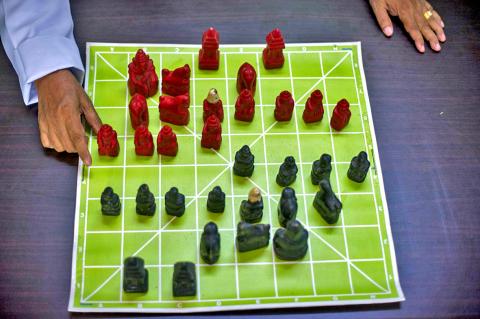
Photo: AFP
“The game can feel like you are fighting a war,” said Thein Zaw, a five-times Myanmar chess champion, during a recent Sittuyin contest in downtown Yangon.
His match is combative from the outset, with slain pieces quickly piling up on either side of the board.
However, soon both armies become entrenched and the games reaches long into the sweltering tropical afternoon, punctuated only by exclamations, the strategic rearrangement of longyi sarongs and pensive twirling of spectacles.
The scene is a rare one in a nation where Sittuyin has retreated into the sporting wilderness.
A scarcity of traditional chess sets and dearth of available knowledge about the rules have whittled down interest, so that just under 100 players actively attend tournaments.
“This is an ancient game and we would like to bring it back to life,” Thein Zaw said.
Thein Zaw’s hand-carved chess set of monkeys and ogres evokes the earliest incarnations of the game in neighboring India, playing out the mythical good-versus-evil battle of Rama and the god Hanuman against the demon king Ravana.
Experts say this suggests the Myanmar version could be more then 1,000 years old.
Jean-Louis Cazaux, who has written extensively on the history of chess, said Sittuyin has similarities to traditional games in Thailand and Cambodia and is an important addition to a global pantheon of chess varieties.
“Diversity is wealth. If these games can be preserved they must be preserved,” he said.
Sittuyin retains some of the full-blooded flamboyance from the days when kings used it to plot real battles in which elephants were a fearsome weapon — sitt in Burmese means “war.”
“Myanmar kings fought in the front lines of every war. Similarly, the result of the game depends on the king being active,” Myanmar Chess Federation vice chairman Win Aung said.
Traditional games were peppered by the combative crack of the pieces against the wooden board.
“When my father and grandfather played it was like this,” said Win Aung, slamming a pawn down onto the table. “We were scared.”
The pieces are now a cherished heirloom, their handsome red and black elephants, castles and galloping horses smoothed by more than a century of table-top warfare.
Old sets are scarce in Myanmar, where five decades of brutal military rule brought both a cultural malaise and poverty that turned intricately carved wooden traditional chess sets into luxury items.
They were sold off piece by piece.
With new carved sets costing about US$300 — far beyond the reach of ordinary people in the still impoverished nation — chess groups are modernizing to chase mass appeal. Cheap plastic pieces and a rule book, in both Burmese and English, are now on the market, and the tech-loving younger generation can play the ancient game on mobile phones — now widely available as the country opens after decades of restrictions.
Web application firm Total Game Play launched a mobile version in late 2013 and says it has since been downloaded up to 200,000 times.
The firm’s 25-year-old marketing manager Sai Pyae Phyo Han said local gamers like Sittuyin’s colorful characters and the ability to switch between a “formal army, Thai army and an ogre army.”

An American scientist convicted of lying to US authorities about payments from China while he was at Harvard University has rebuilt his research lab in Shenzhen, China, to pursue technology the Chinese government has identified as a national priority: embedding electronics into the human brain. Charles Lieber, 67, is among the world’s leading researchers in brain-computer interfaces. The technology has shown promise in treating conditions such as amyotrophic lateral sclerosis and restoring movement in paralyzed people. It also has potential military applications: Scientists at the Chinese People’s Liberation Army have investigated brain interfaces as a way to engineer super soldiers by boosting

Indonesian police have arrested 13 people after shocking images of alleged abuse against small children at a daycare center went viral, sparking outrage across the nation, officials said on Monday. Police on Friday last week raided Little Aresha, a daycare center in Yogyakarta on Java island, following a report from a former employee. CCTV footage circulating on social media showed children, most younger than two, lying on the floor wearing only diapers, their hands and feet bound with rags. The police have confirmed that the footage is authentic. Police said they also found 20 children crammed into a room just 3m by 3m. “So

A grieving mother has ended her life at a clinic in Switzerland four years after the death of her only child. Wendy Duffy, 56, a physically healthy woman, died at the Pegasos clinic in Basel after struggling to cope with the death of her 23-year-old son, Marcus. The former care worker, from the West Midlands, England, had previously attempted to take her own life. The case comes as assisted dying would not become law in England and Wales after proposed legislation, branded “hopelessly flawed” by opponents, ran out of time. Ruedi Habegger, the founder of Pegasos, described Duffy’s death as
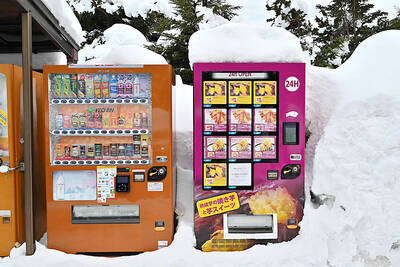
From post offices and parks to stations and even the summit of Mount Fuji, Japan’s vending machines are ubiquitous, but with the rapid pace of inflation cooling demand for their drinks, operators are being forced to rethink the business. Last month beverage giant DyDo Group Holdings announced it would remove about 20,000 vending machines — about 7 percent of their stock nationwide — by January next year, to “reconstruct a profitable network.” Pokka Sapporo Food & Beverage, based in Nagoya, also said last month it would sell its 40,000-machine operation to Osaka-based Lifedrink Co. “The strength of the vending machine


 RSS
RSS