


There is a Vancouver Forest in Beijing, a Thames Town in Shanghai and an Oriental Yosemite in Dalian, China.
China’s suburbs have been filling up lately with housing developments whose names and architectural styles are meant to evoke the US, Europe, Canada, Australia, anywhere, but China. And the authorities do not like it.
Chinese Minister of Civil Affairs Li Liguo (李立國) on Tuesday said that “bizarre” names that “damage sovereignty and national dignity” or “violate the socialist core values and conventional morality” would be stamped out, Xinhua news agency reported.
And it is not just foreignness he objects to. The report quoted Li as saying that excessively grandiose or strange names for roads, bridges, buildings and residential compounds would also face scrutiny.
Housing developments have been the biggest generators of odd names. Beijing alone has a Chateau Regalia, a Rose and Ginkgo, Merlin Champagne Town, Le Leman Lake Villa, Beijing Riviera and International Wonderland.
Developers say the international flavor helps sell houses. On the outskirts of Beijing, the Jackson Hole resort community, known in Chinese as Hometown America, attracts residents dreaming of a “free and uncomplicated life.”
Tides of embrace or rejection of foreign arts, styles and philosophies have occurred through Chinese history. In recent years, officials have tried to push back against Western values in textbooks and English-language acronyms in television and radio broadcasts.
The concern over place names has been raised as part of an official Chinese geographical survey that began in 2014. Along with an explosion in foreign names, there has also been a noticeable disappearance of traditional names, Li said. The survey found that since 1986, 60,000 township names and 400,000 village names had fallen out of use as a result of development and urbanization, Beijing News reported.
It was not supposed to happen. There has been a regulation on the books in China since 1996 that prohibits the use of the names of foreign people or places for locations in China, including housing developments, Beijing News said.
However, the rule has had little impact.
And once a name is in use, changing it can be problematic. Officials tried to rename a street in Zhengzhou, the capital of Henan Province, ostensibly because the Chinese character used to represent its foreign name was often mispronounced by people unfamiliar with the place, China National Radio said.
However, residents objected and filed a lawsuit to block the change, citing the potential loss of historical identity.
Previous efforts to change foreign place names in China have not been wholeheartedly embraced, either. In the southeastern city of Fuzhou, a housing development known as Fontainebleau was ordered by local officials to change its name, which became Gaojiayuan. Afterward, one resident complained to a local newspaper that she missed her bus stop after the signs were changed.
And a real-estate agent confessed that while the official name was now Gaojiayuan, for the purpose of selling houses it would always be called Fontainebleau.

When a hiker fell from a 55m waterfall in wild New Zealand bush, rescuers were forced to evacuate the badly hurt woman without her dog, which could not be found. After strangers raised thousands of dollars for a search, border collie Molly was flown to safety by a helicopter pilot who was determined to reunite the pet and the owner. A week earlier, an emergency rescue helicopter found the woman with bruises and lacerations after a fall at a rocky spot at the waterfall on the South Island’s West Coast. She was airlifted on March 24, but they were forced to

CONFIDENCE BOOSTER: ’After parkour ... you dare to do a lot of things that you think only young people can do,’ a 67-year-old parkour enthusiast said In a corner of suburban Singapore, Betty Boon vaults a guardrail, crawls underneath a slide, executes forward shoulder rolls and scales a steep slope, finishing the course to applause. “Good job,” the 69-year-old’s coach cheers. This is “geriatric parkour,” where about 20 retirees learned to tackle a series of relatively demanding exercises, building their agility and enjoying a sense of camaraderie. Boon, an upbeat grandmother, said learning parkour has aided her confidence and independence as she ages. “When you’re weak, you will be dependent on someone,” she said after sweating it out with her parkour classmates in suburban Toa Payoh,

HIGH HOPES: The power source is expected to have a future, as it is not dependent on the weather or light, and could be useful for places with large desalination facilities A Japanese water plant is harnessing the natural process of osmosis to generate renewable energy that could one day become a common power source. The possibility of generating power from osmosis — when water molecules pass from a less salty solution to a more salty one — has long been known. However, actually generating energy from that has proved more complicated, in part due the difficulty of designing the membrane through which the molecules pass. Engineers in Fukuoka, Japan, and their private partners think they might have cracked it, and have opened what is only the world’s second osmotic power plant. It generates
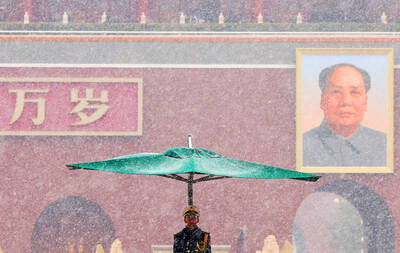
Chinese dissident artist Gao Zhen (高兟), famous for making provocative satirical sculptures of former Chinese leader Mao Zedong (毛澤東), was tried on Monday over accusations of “defaming national heroes and martyrs,” his wife and a rights group said. Gao, 69, who was detained in 2024 during a visit from the US, faces a maximum three-year prison sentence, said his wife, Zhao Yaliang (趙雅良), and Shane Yi, a researcher at the Chinese Human Rights Defenders group which operates outside the nation. The closed-door, one-day trial took place at Sanhe City People’s Court in Hebei Province neighboring the capital, Beijing, and ended without a


 RSS
RSS