


Phurba Tashi, the most accomplished high-altitude climber in history, holds a bucket and crowbar as he claws through the rubble of his home seven months after Nepal’s earthquake shattered the country.
Despite years of guiding wealthy foreign clients up Mount Everest, something he has done 21 times — a joint record — the 44-year-old has been left penniless.
Tashi’s predicament is shared by many Sherpas, whose homes, lodges and restaurants were destroyed in the April disaster and who complain of a slow response from the government, despite billions of dollars of Western aid.
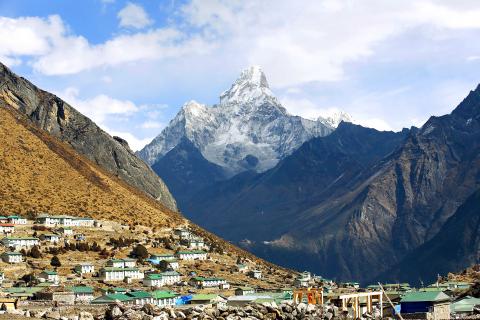
Photo: Reuters
Some retired guides must return to the peaks to earn money. Others are pulling their children out of schools in Kathmandu and hotel owners are firing staff.
To make matters worse, bookings so far point to a sharp drop in foreign mountaineers heading to Nepal next year, deterred by ruined infrastructure and an economic blockade along its border with India that threatens supplies of fuel and equipment.
“Everything I worked for was destroyed in a minute,” Tashi said, standing in his village of Khumjung, a cluster of 80 stone houses perched on a plateau surrounded by breathtaking 7,000m mountains.
The earthquake that killed almost 9,000 people destroyed his eight-bedroom trekking lodge, badly damaged his house and caused a deadly avalanche 14.5km away on the world’s tallest peak.
The remote villages under Everest, which prospered in recent decades thanks to the booming climbing business, suffered some of the heaviest destruction in Nepal’s deadliest disaster.
The Everest industry is in a state of upheaval following avalanches last year and this year that killed 35 people, the two most deadly incidents since climbers began ascending.
In 2013, there was an unprecedented mass brawl between Sherpas and climbers that exposed deep-rooted frustrations over a lack of recognition of the risks local guides take to get foreigners up and down the fabled summit.
They want a bigger slice of Nepal’s US$360 million per year adventure travel industry, of which Everest is the cornerstone.
Bookings to scale the world’s tallest mountain next year have been one-third to half lower than previous years, according to interviews with 18 of the largest climbing firms.
This would be the biggest drop since commercial climbing began on Everest in the early 1990s, and could leave hundreds of struggling Sherpas without work.
In the past, deadly accidents have done little to dent Everest’s popularity, with risk being part of the allure, but next year could be different, as threats to the industry take on a political dimension.
An economic blockade of Nepal’s border with India could disrupt expeditions and deter would-be climbers, who typically pay a non-refundable fee of between US$35,000 and US$100,000 for a chance to scale the peak.
Nepal has been facing an acute fuel crisis for three months since protesters in the lowland south, angered that a new constitution fails to reflect their interests, prevented supply trucks from entering from India.
This is crippling the landlocked Himalayan nation as it tries to recover from the earthquake that displaced millions in the central and eastern regions.
Mountaineering firms say the blockade threatens the climbing season, because there might be a shortage of fuel to airlift equipment, operate emergency rescue flights or provide enough cooking gas cylinders to survive two months on the mountain.
“It is a crisis at the moment. It is going to be a catastrophe if this embargo continues,” New York-based Altitude Junkies owner Phil Crampton said.
Near the warren of royal palaces and temples in central Kathmandu’s bustling old town, Gobinda Bahadur Karkee, director-general of the Nepalese Ministry of Culture, Tourism and Civil Aviation’s Department of Tourism, is more upbeat.
He predicts the blockade will be over before spring and says he is “expecting a good number of climbers” next year, because mountaineers used to assessing risks would not be discouraged by a rare natural disaster.
Back in Khumjung, the resentment is not just about the blockade tripling the cost of building materials that need to be carried from an airport three days’ walk away.
In a rural community where nine of 10 homes were damaged or destroyed by the earthquake, anger is rising over the government’s failure to spend US$4.1 billion of reconstruction money donated by foreign governments six months ago.
“We hear the politicians in Kathmandu are eating the money,” Tashi said.
Nepalese National Planning Commission Vice Chairman Yuba Raj Khatiwada is in charge of spending the money and understands the frustration over the delays, but says the blockade has absorbed attention and prevented aid work.
“It has put us back in the relief, rather than reconstruction stage,” he said.
For almost a century, Western climbers have hired Nepal’s Sherpas to do the most dangerous work on Everest. It is a lucrative way of life in one of the world’s poorest countries, but comes at a cost.
More than 200 Sherpas have lost their lives working in the mountains and as many have been disabled by rockfalls, frostbite and altitude-related illnesses.
Known as the “Everest Yak” because of his immense stamina, the quiet and diminutive Tashi is head Sherpa for Himalayan Experience, one of the largest Everest climbing companies.
He is the record holder at 34 summits for mountains taller than 8,000m.
Yet, he says for most of his career he has been paid less than Western guides. Foreign guides can make between US$10,000 and US$35,000 per season, whereas Sherpas are typically paid about US$6,000, according to two Western professionals.
Since the two recent disasters on Everest, Tashi has been under immense pressure from his family to quit.
“I would rather we were poor than he took the risks,” his wife, Karma Doma, said as she served guests Sherpa tea and biscuits.

When a hiker fell from a 55m waterfall in wild New Zealand bush, rescuers were forced to evacuate the badly hurt woman without her dog, which could not be found. After strangers raised thousands of dollars for a search, border collie Molly was flown to safety by a helicopter pilot who was determined to reunite the pet and the owner. A week earlier, an emergency rescue helicopter found the woman with bruises and lacerations after a fall at a rocky spot at the waterfall on the South Island’s West Coast. She was airlifted on March 24, but they were forced to

CONFIDENCE BOOSTER: ’After parkour ... you dare to do a lot of things that you think only young people can do,’ a 67-year-old parkour enthusiast said In a corner of suburban Singapore, Betty Boon vaults a guardrail, crawls underneath a slide, executes forward shoulder rolls and scales a steep slope, finishing the course to applause. “Good job,” the 69-year-old’s coach cheers. This is “geriatric parkour,” where about 20 retirees learned to tackle a series of relatively demanding exercises, building their agility and enjoying a sense of camaraderie. Boon, an upbeat grandmother, said learning parkour has aided her confidence and independence as she ages. “When you’re weak, you will be dependent on someone,” she said after sweating it out with her parkour classmates in suburban Toa Payoh,

HIGH HOPES: The power source is expected to have a future, as it is not dependent on the weather or light, and could be useful for places with large desalination facilities A Japanese water plant is harnessing the natural process of osmosis to generate renewable energy that could one day become a common power source. The possibility of generating power from osmosis — when water molecules pass from a less salty solution to a more salty one — has long been known. However, actually generating energy from that has proved more complicated, in part due the difficulty of designing the membrane through which the molecules pass. Engineers in Fukuoka, Japan, and their private partners think they might have cracked it, and have opened what is only the world’s second osmotic power plant. It generates
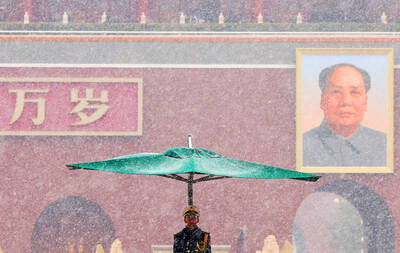
Chinese dissident artist Gao Zhen (高兟), famous for making provocative satirical sculptures of former Chinese leader Mao Zedong (毛澤東), was tried on Monday over accusations of “defaming national heroes and martyrs,” his wife and a rights group said. Gao, 69, who was detained in 2024 during a visit from the US, faces a maximum three-year prison sentence, said his wife, Zhao Yaliang (趙雅良), and Shane Yi, a researcher at the Chinese Human Rights Defenders group which operates outside the nation. The closed-door, one-day trial took place at Sanhe City People’s Court in Hebei Province neighboring the capital, Beijing, and ended without a


 RSS
RSS