


Big public demonstrations following a fire in a Bucharest nightclub in which more than 50 people died reflect growing anger at a culture of official graft in one of Europe’s most corrupt countries.
In the two weeks since it emerged that the Colectiv club had no fire-safety permit, nearly 100,000 Romanians have poured onto the streets shouting “corruption kills” in protests at the sleaze that undermines public administration and basic services.
For many, the nightclub deaths were the first time it had become clear how corruption and greed could result in multiple fatalities.
Romania’s anti-corruption prosecuting agency, known by its acronym DNA, has been cracking down on high-level graft and investigations have shown how deeply entrenched it is — from conflicts of interest and abuse of power to fraud and the award of state contracts in exchange for bribes.
“Corruption is draining state resources toward a narrow stratum of privileged people, to the detriment of the majority of the population,” DNA chief prosecutor Laura Codruta Kovesi said.
“It distorts honest competition, either in business or public office. As a result, holding public office ... is based on connections and money, investors with serious projects are discouraged, and the effects are visible in the quality of public services and infrastructure.”
The demonstrators included young, well-educated urbanites, active on social media and increasingly angry at politicians.
However, many remain pessimistic about any real chance of reform once the furor that followed the nightclub blaze subsides. The protests were among the biggest Romania has seen for years, but still small for a nation of 20 million.
“The Colectiv tragedy made an impressive number of people mobilize quickly because it served as a pressure valve for major discontent against the Ponta government in particular and the political class in general,” said Sergiu Miscoiu, an associate professor at Babes-Bolyai University in Cluj, referring to former Romanian prime minister Victor Ponta.
However, “it is unlikely public policies would change radically,” Miscoiu added.
The protests, which lasted a week, caused the resignation of Ponta, but failed to answer many questions over security and failed oversight.
“Before the fire happened I wasn’t thinking about safety,” said Liviu Vasile, a 38-year-old electrician who joined the protests. “Now, I can’t help but feel unsafe, especially for my two children. Tragedies like the fire would happen again. When the system is corrupt, nothing works.”
Prosecutors have investigated some of the most powerful people in Romania, including Ponta, who is on trial for forgery, money laundering and complicity in tax evasion, charges he denies.
They have also investigated institutions and companies, exposing graft in government, healthcare, education and the judiciary.
The number of convictions obtained by DNA has risen steadily year after year. In the first 10 months of this year, DNA sent more than 900 people for trial, including members of parliament, cabinet ministers and mayors. The agency has a conviction rate of 90 percent and last year secured a record 1,138 convictions.
Romania’s fight against corruption is about a decade old and DNA sent its first cases for trial in 2005 and 2006. The independence of magistrates was guaranteed in 2004, when Romania was a candidate for EU membership. The crackdown intensified under Kovesi, the nation’s former prosecutor general.
Romanians now have significantly more confidence in DNA than in government or parliament, opinion surveys show.
The downside is that people now expect DNA to take on even cases that are not in its purview, Kovesi said.
However, this popularity has helped increase the number of tip-offs, the starting point for most DNA investigations.
“The corruption debate has become one of the main themes in Romanian society,” Kovesi said. “The fact that we are starting to have a high level of intolerance of corruption is partly due to the activity of anti-corruption prosecutors.”
The fire has underscored more problems, due not only to graft, but to chronic underfunding of healthcare and education, poor legislation and politicized state institutions.
Interim Romanian Prime Minister Sorin Cimpeanu has said only a fraction of the nation’s schools have fire inspection permits.
DNA’s ongoing investigation into the Colectiv fire has shown multiple failures. Prosecutors have said fire inspectors deliberately did not record the club’s problems.
The district mayor gave it a permit even though it lacked proof of the mandatory fire inspection. The owners barricaded the windows and a back door and allowed too many people into the club. Contractors put up insulation that was not fireproof.
The government has tightened fire inspection legislation, but it remains to be seen how well it is enforced.
“If the legislation were enforced today, the majority of Bucharest businesses would need to close because of fire inspection permits, labor safety, food safety, construction regulations,” Aspen Institute Romania executive director Andrei Tarnea said.
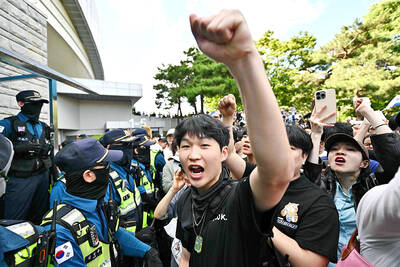
‘ABSURD MISTAKE’: The election commission said that there had been a failure to anticipate turnout after 14 polling stations ran short of ballot papers South Korean riot police yesterday cleared protesters from a Seoul polling station after a 35-hour blockade sparked by a shortage of ballot papers during local elections earlier this week. Wednesday’s election was the first nationwide vote since South Korean President Lee Jae-myung took office following the ouster of Yoon Suk-yeol over his short-lived martial law declaration. Lee’s ruling Democratic Party swept most races, but failed to flip the crucial Seoul mayoral seat. The South Korean National Election Commission apologized, blaming a failure to anticipate turnout after 14 polling stations in Seoul ran short of ballot papers. Some polling stations stayed open until 10pm to

France experienced its hottest spring on record, the French weather service said on Tuesday, after an exceptional early heat wave that also broke highs for the season in England and Wales. Meteo-France said the average nationwide temperature over March to May was 13.8°C — about 1.7°C above the norm, and surpassing records set in 2011 and 2020. “The warmest spring since records began in 1900,” it said in a bulletin. All three months were warmer than average, but the onset of an “unprecedented heatwave” late last month pushed the mercury to highs typically seen at the height of the summer. “Our country had never

A Sherpa guide was found crawling to base camp on Mount Everest a week after he went missing and was reunited with his family, who had given up hope he would return. Dawa Sherpa was last seen on Friday last week descending the mountain, but he did not reach base camp even though his client did. The pair were among the last climbers on the mountain as the climbing season came to an end and the route was dismantled. Dawa was located by a cleaning crew on Thursday morning as he was crawling down the snowy slopes around the Khumbu Icefall, just above
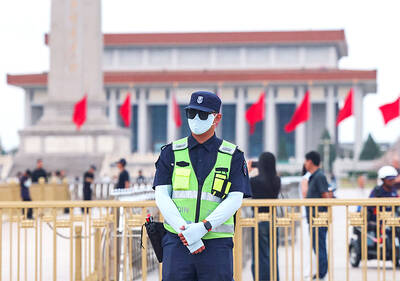
Chinese authorities are snuffing out any remembrance of the deadly 1989 military crackdown on student-led pro-democracy protests in Tiananmen Square, which happened 37 years ago yesterday, in a further tightening of a years-long campaign to erase what happened from public memory. Police told relatives of the victims they would not be allowed to visit a cemetery in Beijing on the anniversary of the crackdown, a person with knowledge of the matter said. Relatives of the victims visited the cemetery on the anniversary for more than 30 years to read memorial statements with police keeping watch, Amnesty International said. Hundreds of people,


 RSS
RSS