


Chinese authorities are snuffing out any remembrance of the deadly 1989 military crackdown on student-led pro-democracy protests in Tiananmen Square, which happened 37 years ago yesterday, in a further tightening of a years-long campaign to erase what happened from public memory.
Police told relatives of the victims they would not be allowed to visit a cemetery in Beijing on the anniversary of the crackdown, a person with knowledge of the matter said.
Relatives of the victims visited the cemetery on the anniversary for more than 30 years to read memorial statements with police keeping watch, Amnesty International said.
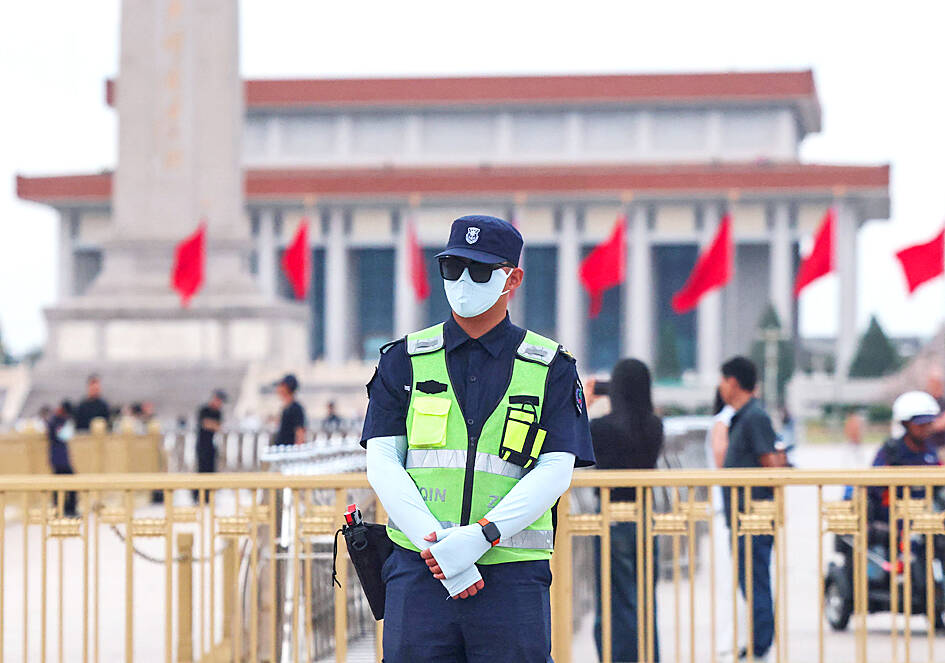
Photo: Reuters
Hundreds of people, and possibly thousands, were killed in 1989 as troops advanced through crowds that were trying to stop the military from reaching the protesters in Tiananmen Square, a vast plaza in the center of the Chinese capital. The decision by the Chinese Communist Party leadership to send in the military was a pivotal moment in China’s modern history, determining that the market reform that transformed the country into the world’s second-largest economy would not be coupled with political liberalization.
In Hong Kong, police stepped up security to prevent any kind of commemoration at or near a park where a massive candlelight vigil lit up the night on the anniversary every year until a clampdown following major anti-government protests in 2019.
US Secretary of State Marco Rubio in a statement marking the anniversary said: “No amount of censorship can erase the past.”
“Those who sacrificed to uphold their unalienable rights of free expression and peaceful assembly will be vindicated someday,” it said.
In response, China accused the US of distorting facts and smearing its political system.
“The Chinese government has long since reached a clear conclusion regarding that political turmoil that occurred in the late 1980s,” Chinese Ministry of Foreign Affairs spokeswoman Mao Ning (毛寧) told a news briefing. “The relevant erroneous remarks by the US side distort historical facts, smear China’s political system and development path, and interfere in China’s internal affairs.”
Tiananmen Mothers issued an annual appeal for justice ahead of this year’s anniversary. The statement, signed by 107 people, demanded full disclosure of what happened, compensation for the victims and their families and the pursuit of legal accountability for those responsible.
“The sacrifice of our family members is an indelible pain etched in our hearts. Our tears have run dry, grief is buried deep within, what remains is eternal remembrance of our family members and hatred for the crime of massacring the people,” Zhang Xianling (張先玲), a member of the group, said in a video message posted on Facebook.

‘CROSSING THE LINE’: China’s embassy in Seoul criticized US Forces Korea Commander General Xavier Brunson, asking if his ‘hostile’ remarks were authorized by Washington South Korea and the US are in talks over recent public remarks by the commander of US Forces Korea, Seoul’s presidential office said yesterday, after the comments drew sharp criticism from China. In a recent podcast interview, US Forces Korea Commander General Xavier Brunson described South Korea as “the dagger in the heart of Asia” from China’s east coast, prompting the Chinese embassy in Seoul to say that he had “truly crossed the line.” The interview came amid growing speculation that Washington might seek to expand the role of US Forces Korea in countering the growing regional influence of China, a key

Through the noise of rushing papers and whirring belts at a print factory in Kyoto, two creators watch their photo essay come to life in broadsheet form — part of an effort to win new audiences in the age of artificial intelligence (AI). Despite the decline of the publishing industry, self-publication and handmade “zine” magazines are growing in popularity in Japan, reflecting the nation’s enduring love of paper in the digital era. While speaking to Agence France-Presse at the plant, his hands black with ink, one of the creators, Kazuma Obara, said: “I think [paper] is a medium that engages all five

Australian researchers have trained lab-grown brain cells on a silicon computer chip to play the 1990s shooter game Doom and said they are just scratching the surface of what the neurons could be capable of doing. It is the science-fiction work of biotech boffins at Cortical Labs, who researched and developed the technology that harnesses the workings of the brain’s networking system. Each so-called “biological computer” contains about 200,000 living human brain cells, grown from stem cells that were harvested from blood donations. Having mastered the simple computer game Pong, where a paddle is moved up and down to send a ball

A surprising gut feeling may help pigeons find their way home. Animals use various techniques to navigate, including following the stars and remembering key landmarks. Birds, fish and turtles orient themselves using Earth’s magnetic field as a compass, but it is not yet clear how exactly they do this. Pigeons are a well-known group of frequent flyers that can traverse hundreds of kilometers in a single day. For thousands of years, humans have used them to carry news, notes and military messages. Scientists have long tried to untangle how pigeons travel without getting lost. Some think the birds detect magnetic cues using light-sensitive


 RSS
RSS