


Ever since the powerful drug lord known as El Chapo escaped from a maximum-security prison through a 1.5km-long tunnel that opened right into the shower of his cell, Mexico has been wondering how his accomplices got their hands on the blueprints to operate with such pinpoint precision.
The answer could be simple: They might have had them for years.
It turns out that the prison is a virtual replica of another lockup that El Chapo, whose real name is Joaquin Guzman Loera, broke out of in 2001 in another escape.

Photo: AP
He essentially broke out of the same prison twice.
Authorities believe that for his first escape, Guzman had the help of a top prison security official who went on to become a trusted member of his Sinaloa cartel.
Investigators think that the confederate, Damaso Lopez, might have taken a copy of the blueprints for the other prison when he left his job at about the time of Guzman’s earlier escape, a senior Mexican law enforcement official said.
And since the layout of the two prisons is almost identical, those blueprints could have helped when planning this month’s breakout.
The official said that Lopez was now a prime suspect in the hunt for the people who planned and carried out this month’s escape. Beyond the possible blueprints, Lopez is believed to have close knowledge of the layout of the prisons and security procedures. The tunnel makers might have also had the GPS coordinates for Guzman’s shower stall.
Authorities have so far detained seven prison employees, including four whose job was to watch closed-circuit television monitors.
Lopez remains at large.
Lopez was charged with drug trafficking in a 2011 indictment filed in a US federal court in Virginia, and in 2013 he was described as Guzman’s right-hand man and a senior lieutenant in the Sinaloa cartel in a statement by the US Treasury Department.
The tunnel that Guzman used to escape extended under the prison walls, ending in a shaft that opened in a hole in the floor of the tiny shower of his cell.
There was little room for error. Being off by a meter would have meant failure.
“Certainly they needed the blueprints,” Mexican Secretary of the Interior Miguel Angel Osorio Chong said last week.
The prison that he escaped from this month, about an hour’s drive from Mexico City, is known as Altiplano, or Federal Social Readaptation Center No. 1, because it was the first of a new set of modern prisons. The prison that Guzman escaped from in 2001 is Federal Social Readaptation Center No. 2. A third prison with the same design near Matamoros on the border with Texas was finished in 1994.
The Mexican law enforcement official, who spoke on the condition of anonymity because the investigation into Guzman’s escape is continuing, confirmed that the design for the three prisons was the same.

When a hiker fell from a 55m waterfall in wild New Zealand bush, rescuers were forced to evacuate the badly hurt woman without her dog, which could not be found. After strangers raised thousands of dollars for a search, border collie Molly was flown to safety by a helicopter pilot who was determined to reunite the pet and the owner. A week earlier, an emergency rescue helicopter found the woman with bruises and lacerations after a fall at a rocky spot at the waterfall on the South Island’s West Coast. She was airlifted on March 24, but they were forced to

CONFIDENCE BOOSTER: ’After parkour ... you dare to do a lot of things that you think only young people can do,’ a 67-year-old parkour enthusiast said In a corner of suburban Singapore, Betty Boon vaults a guardrail, crawls underneath a slide, executes forward shoulder rolls and scales a steep slope, finishing the course to applause. “Good job,” the 69-year-old’s coach cheers. This is “geriatric parkour,” where about 20 retirees learned to tackle a series of relatively demanding exercises, building their agility and enjoying a sense of camaraderie. Boon, an upbeat grandmother, said learning parkour has aided her confidence and independence as she ages. “When you’re weak, you will be dependent on someone,” she said after sweating it out with her parkour classmates in suburban Toa Payoh,
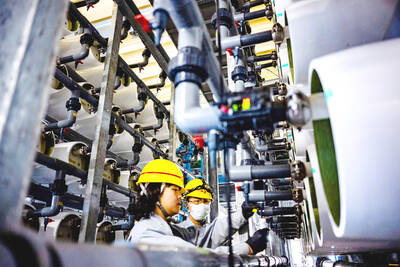
HIGH HOPES: The power source is expected to have a future, as it is not dependent on the weather or light, and could be useful for places with large desalination facilities A Japanese water plant is harnessing the natural process of osmosis to generate renewable energy that could one day become a common power source. The possibility of generating power from osmosis — when water molecules pass from a less salty solution to a more salty one — has long been known. However, actually generating energy from that has proved more complicated, in part due the difficulty of designing the membrane through which the molecules pass. Engineers in Fukuoka, Japan, and their private partners think they might have cracked it, and have opened what is only the world’s second osmotic power plant. It generates

Chinese dissident artist Gao Zhen (高兟), famous for making provocative satirical sculptures of former Chinese leader Mao Zedong (毛澤東), was tried on Monday over accusations of “defaming national heroes and martyrs,” his wife and a rights group said. Gao, 69, who was detained in 2024 during a visit from the US, faces a maximum three-year prison sentence, said his wife, Zhao Yaliang (趙雅良), and Shane Yi, a researcher at the Chinese Human Rights Defenders group which operates outside the nation. The closed-door, one-day trial took place at Sanhe City People’s Court in Hebei Province neighboring the capital, Beijing, and ended without a


 RSS
RSS