

Hong Kong farming villages bordering China are locked in a bitter struggle against property developers accused of “land hoarding,” as resentment of the territory’s vast wealth gap fuels democracy protests.
Now in their second month, the protests were sparked by Beijing’s insistence on vetting candidates in Hong Kong’s next leadership elections in 2017 — but the perceived cosy relationship between the government and the territory’s powerful business elite is also a key source of anger.
While developers snap up valuable real estate across the territory, soaring house prices and rental costs leave the majority of the population struggling to afford private housing.
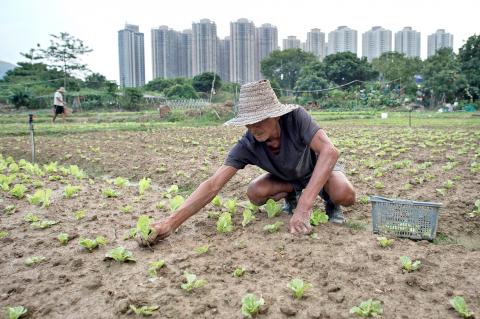
Photo: AFP
Farmers in the outlying New Territories near the Chinese border are now joining the push back against the government and developers as their land comes under threat.
A multibillion-dollar government project will see scarce agricultural land developed and thousands uprooted to make way for townships that officials say will help to meet demand for housing.
However, with only a tiny sliver of the proposed 614 hectares reserved for public housing — and a bigger slice for commercial complexes as well as private flats beyond the reach of most Hong Kongers — villagers argue that the project is designed mainly to enrich real-estate giants.
“Ordinary people like me can only dream of affording the apartments that will be built here,” said Yung King-yu, a 19-year-old resident of Ma Shi Po, one of the affected villages.
“So how will this project meet Hong Kong’s housing needs?” asked Yung, who regularly camps at one of the democracy protest sites.
Given the area’s proximity to the border, the project has also spawned concerns that it will cater more to wealthy Chinese, who are often blamed for driving up Hong Kong property prices.
Hemmed in by skyscrapers towering above tree-lined boulevards, Ma Shi Po is a patchwork of vegetable farms, fish ponds and sprawling pastel-colored houses — a novelty in Hong Kong, where millions live in cramped apartments.
However, there are also abandoned plots which developers have bought up over the years from local landlords, displacing scores of non-indigenous farmers who moved there generations ago, but have no land rights, villagers say.
“Hundreds of farmers have had to leave the village because of this land hoarding,” said 29-year-old Becky Au Hei-man, who manages a community farm in the village.
“This is a kind of land hegemony,” she said, strolling past a fenced plot now owned by Henderson Land Development and overrun by wild undergrowth.
Henderson, led by Hong Kong’s third-richest man Lee Shau-kee (李兆基), is a major landholder in Ma Shi Po, says Liber Research Community, a Hong Kong think tank focused on urban planning.
Becky says her landlord has sold her patch of land to Henderson, but she refuses to leave.
The property giant declined to comment when contacted by reporters.
Besides Henderson, other land-owning developers in areas surrounding Ma Shi Po include billionaire Cheng Yu-tung’s (鄭裕彤) New World Development and Cheung Kong, led by Asia’s richest man Li Ka-shing (李嘉誠), Liber researcher Chan Kim Ching (陳劍青) said.
“Our research shows developers have been quietly stocking up land at low prices since the early 1990s — years before the government declared the project in 1998,” Chan said.
Protesters angered by the government’s “pro-developer policies” attempted to storm the Legislative Council in June after it hastily approved HK$340 million ($US44 million) in funding for the New Territories development project.
Hong Kong’s development chief Paul Chan (陳茂波) also came under fire after he admitted last year that his family owned vast tracts of land in the development zone.
He shrugged off calls for his resignation and denied any conflict of interest, saying the property had been transferred to his wife’s relatives.
The rift between the farmers and developers is indicative of the growing disconnect between the territory’s privileged establishment and ordinary residents.
Hong Kong’s official Gini coefficient, a measure of income inequality, is among the highest in the world for developed economies and poorer citizens feel increasingly overlooked by the government.
Embattled Hong Kong Chief Executive Leung Chun-ying (梁振英) — who was handpicked by a pro-Beijing committee — provoked bewilderment recently when he spoke against fully free elections, saying they would result in the poor dominating politics.
At the other end of the scale, Hong Kong’s 10 wealthiest tycoons control a combined fortune of about US$130 billion and all have interests in real estate, according to Forbes magazine.
However, the “have-nots” are desperately trying to make their voices heard. Hong Kong’s town planning board has received close to 50,000 public objections to the New Territories housing project, a historic high.
At one town planning meeting, farmers delivered impassioned speeches, imploring officials to save their bitter melon and water spinach farms — a rich habitat for rare migratory birds and flowering plants.
“I wake up in the middle of the night crying,” one emotional farmer said. “I can’t abandon my trees, my farm animals, my way of life to live in a skyscraper. This plan is not for me. It’s for the rich.”
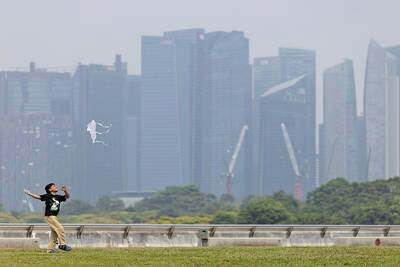
Singapore’s air quality hit an unhealthy level yesterday, as haze from forest fires raging in Indonesia continued to spread across swathes of Southeast Asia. The city-state is currently one of the 10 most-polluted major cities in the world, coming in at third in IQAir’s ranking. Kuching, in the Malaysian part of the island of Borneo, was No. 1. A government taskforce has “activated haze response plans” for schools, workplaces and community centers, Singaporean Minister for Sustainability and the Environment Grace Fu (傅海) said in a video message on Facebook. Most people could continue essential daily activities, but the elderly or vulnerable should

PAINSTAKING PROCESS: Ice makers freeze water for up to 72 hours, replace tainted water with a fresh batch once freezing begins, and are constantly stirring In the historic Japanese city of Kanazawa, craftsmen painstakingly shape and slice blocks of ice destined to chill negronis in some of the world’s trendiest bars. The men work for Kuramoto Ice, a century-old company in Ishikawa on the Sea of Japan coast and one of dozens of Japanese firms producing ultra-clear, premium ice. This luxury product, believed by those in the industry to melt more slowly than regular blocks, is a staple of Japan’s cocktail culture, but its popularity is also spilling over to bars abroad, from the US to Australia, who pay as much as ¥200 (US$1.28) per cube. Kuramoto Ice

WAR CRIMES? An investigation found that a network of countries are supplying Sudan’s RSF with weapons, including drone blamed for large civilian casualties Foreign weapons, military technology, fighters and logistical networks are helping sustain Sudan’s conflict and expanding the warring parties’ ability to strike deep into civilian areas, a UN fact-finding mission said in a report published yesterday, warning that some attacks might amount to war crimes. Sudan’s war erupted in April 2023 following a power struggle between Sudan’s military and the Rapid Support Forces (RSF) ahead of a planned transition to civilian rule. The conflict has devastated the country, displaced more than 14 million people and created what the UN has described as one of the world’s worst humanitarian crises. The UN mission said

‘BYE BYE’: Judge William Tam said after hearing arguments for a leniency that a sentence would be given as soon as possible in Joshua Wong’s second prosecution Hong Kong democracy advocate Joshua Wong (黃之鋒) yesterday pleaded guilty to conspiracy to collude with foreign forces to endanger national security under a Beijing-imposed law. It was the second prosecution of Wong, a former student leader in the democracy movement in the territory and one of its most recognizable faces, under the National Security Law introduced in Hong Kong in 2020 to quell massive anti-government protests the year before. Wong, 29, who wore a blue shirt, appeared thinner as he entered his plea. After hearing his lawyer’s arguments for a lesser prison term, Judge William Tam (譚耀豪) said that a sentence would be


 RSS
RSS