


A Chinese army singer who mysteriously disappeared from public view six years ago has made a surprising reappearance in local media — as the wife of the brother of Chinese President Xi Jinping (習近平).
In a rare glimpse into the life of the Xi family, a newspaper in the southern city of Shenzhen quoted the Chinese Communist Party leader’s younger brother, Xi Yuanping (習遠平), describing his marriage to singer Zhang Lanlan (張瀾瀾).
Zhang was a mainstay on glitzy Chinese TV shows for years, but reportedly made no further appearances after singing in China’s annual official New Year gala in 2008.
The report, which was quickly deleted from Chinese Web sites, quoted Xi Yuanping, 58, as saying that he had married the 34-year-old Zhang — nicknamed the “military’s top beautiful woman” — the same year.
“Lanlan is a simple and sincere woman,” the report — which showed the two seated together — quoted Xi as saying.
Xi Jinping similarly married military singer Peng Liyuan (彭麗媛), who was herself for many years a mainstay of the New Year gala — the most watched TV show in the world.
China’s leaders are highly secretive and tightly restrict any reports about their private lives in local media.
Since her disappearance, Zhang, who also acted in several TV dramas as one of tens of thousands of entertainers who are also members of China’s People’s Liberation Army (PLA), has been subject to lurid rumors, some involving other senior members of the Chinese Communist Party.
The PLA has since its inception maintained its own entertainment troupes, who sometimes become wives and mistresses for officials of the ruling party — former Chinese president Jiang Zemin (江澤民) has long been rumored to have conducted an affair with PLA entertainer Song Zuying (宋祖英).
Former deputy navy commander Wang Shouye (王守業) spent 12 million yuan (US$1.96 million) on five mistresses, all of whom were army performers, before being handed a suspended death penalty in 2006, state-run media reported.

Through the noise of rushing papers and whirring belts at a print factory in Kyoto, two creators watch their photo essay come to life in broadsheet form — part of an effort to win new audiences in the age of artificial intelligence (AI). Despite the decline of the publishing industry, self-publication and handmade “zine” magazines are growing in popularity in Japan, reflecting the nation’s enduring love of paper in the digital era. While speaking to Agence France-Presse at the plant, his hands black with ink, one of the creators, Kazuma Obara, said: “I think [paper] is a medium that engages all five
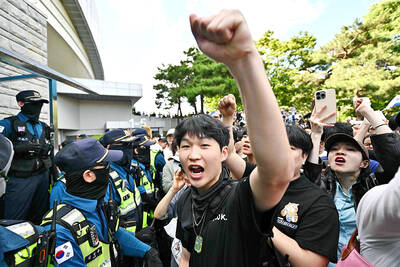
‘ABSURD MISTAKE’: The election commission said that there had been a failure to anticipate turnout after 14 polling stations ran short of ballot papers South Korean riot police yesterday cleared protesters from a Seoul polling station after a 35-hour blockade sparked by a shortage of ballot papers during local elections earlier this week. Wednesday’s election was the first nationwide vote since South Korean President Lee Jae-myung took office following the ouster of Yoon Suk-yeol over his short-lived martial law declaration. Lee’s ruling Democratic Party swept most races, but failed to flip the crucial Seoul mayoral seat. The South Korean National Election Commission apologized, blaming a failure to anticipate turnout after 14 polling stations in Seoul ran short of ballot papers. Some polling stations stayed open until 10pm to

Australian researchers have trained lab-grown brain cells on a silicon computer chip to play the 1990s shooter game Doom and said they are just scratching the surface of what the neurons could be capable of doing. It is the science-fiction work of biotech boffins at Cortical Labs, who researched and developed the technology that harnesses the workings of the brain’s networking system. Each so-called “biological computer” contains about 200,000 living human brain cells, grown from stem cells that were harvested from blood donations. Having mastered the simple computer game Pong, where a paddle is moved up and down to send a ball

France experienced its hottest spring on record, the French weather service said on Tuesday, after an exceptional early heat wave that also broke highs for the season in England and Wales. Meteo-France said the average nationwide temperature over March to May was 13.8°C — about 1.7°C above the norm, and surpassing records set in 2011 and 2020. “The warmest spring since records began in 1900,” it said in a bulletin. All three months were warmer than average, but the onset of an “unprecedented heatwave” late last month pushed the mercury to highs typically seen at the height of the summer. “Our country had never


 RSS
RSS