


A prominent Tunisian blogger who accused police of fabricating cannabis-related charges against him walked free from court on Friday after a judge threw out the case.
Azyz Amami, who was active during Tunisia’s 2011 uprising and was critical of the police both during and after the revolution, was arrested along with a friend on May 12 and charged with “possession and consumption of drugs.”
A conviction can carry a five-year jail term.
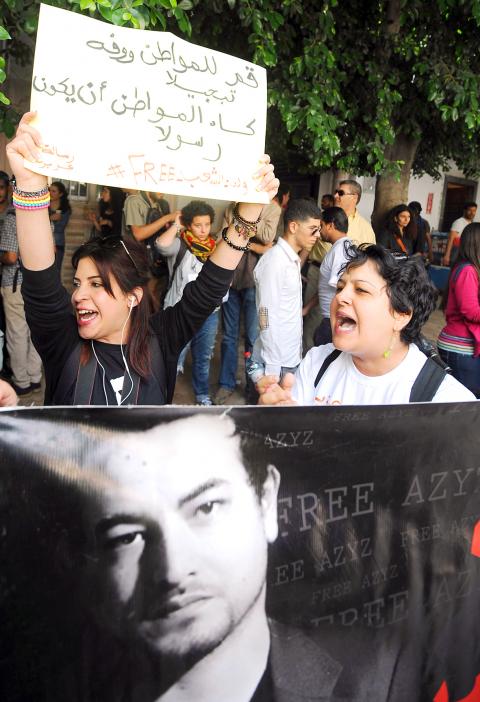
Photo: AFP
The court registry office told reporters that the judge had “pronounced that the case was dismissed.”
“I had no narcotic substance in my possession; I had nothing at all. I have been arrested and attacked” by the police, Amami told the judge earlier in the day at the court in Tunis.
The judge had asked Amami if he was accusing the police of planting the drugs on him, to which he responded: “Yes, sir.”
He also refused to take a drug test, saying it would “undermine his integrity.”
Amami was active during the 2011 uprising against former Tunisian president Zine El Abidine Ben Ali and arrested along with hundreds of other anti-regime protesters.
He often accused police of abuses in his blog.
The defendant said he was arrested and beaten by police in September 2011 for posting a joke deemed insulting to the security forces.
Defense lawyer Bassem Trifi said Amami had refused the drug test because he did not trust police not to tamper with the results.
“The justice system showed that Aziz Amami is not a criminal. A part of that justice system has shown that it is independent,” fellow defense lawyer Ghazi Mrabet said.
Dozens of Amami’s supporters took part in a demonstration outside the courthouse.
“Azyz is a hostage of a judicial and security system... Azyz is an enemy of the police and they attacked him,” said the blogger’s father, Khaled Amami.
Amami has thousands of followers on online social networks.
Drug laws are very tough in Tunisia, with jail terms the norm for those convicted.
Activists have been calling for less severe punishments for convicted drug users.
More than 50 percent of Tunisians held in pretrial detention and around one third of Tunisia’s 11,000 convicts were arrested on drug-related charges, and cannabis in particular, according to UN figures.
Earlier this month Tunisian Prime Minister Mehdi Jomaa announced his support for reforms to the law, saying it was “no longer in tune with the times. We are in the process of amending so that it conforms to new realities.”
The health and justice ministries are trying to “humanize” the legislation, health ministry director general Nabil Ben Salah has told reporters, while cautioning that decriminalization was not an option.

Drug lord Jose Adolfo Macias Villamar, alias “Fito,” was Ecuador’s most-wanted fugitive before his arrest on Wednesday, more than a year after he escaped prison from where he commanded the country’s leading criminal gang. The former taxi driver turned crime boss became the prime target of law enforcement early last year after escaping from a prison in the southwestern port of Guayaquil. Ecuadoran President Daniel Noboa’s government released “wanted” posters with images of his face and offered US$1 million for information leading to his capture. In a country plagued by crime, members of Fito’s gang, Los Choneros, have responded with violence, using car

The team behind the long-awaited Vera Rubin Observatory in Chile yesterday published their first images, revealing breathtaking views of star-forming regions as well as distant galaxies. More than two decades in the making, the giant US-funded telescope sits perched at the summit of Cerro Pachon in central Chile, where dark skies and dry air provide ideal conditions for observing the cosmos. One of the debut images is a composite of 678 exposures taken over just seven hours, capturing the Trifid Nebula and the Lagoon Nebula — both several thousand light-years from Earth — glowing in vivid pinks against orange-red backdrops. The new image

CYBERCRIME, TRAFFICKING: A ‘pattern of state failures’ allowed the billion-dollar industry to flourish, including failures to investigate human rights abuses, it said Human rights group Amnesty International yesterday accused Cambodia’s government of “deliberately ignoring” abuses by cybercrime gangs that have trafficked people from across the world, including children, into slavery at brutal scam compounds. The London-based group said in a report that it had identified 53 scam centers and dozens more suspected sites across the country, including in the Southeast Asian nation’s capital, Phnom Penh. The prison-like compounds were ringed by high fences with razor wire, guarded by armed men and staffed by trafficking victims forced to defraud people across the globe, with those inside subjected to punishments including shocks from electric batons, confinement
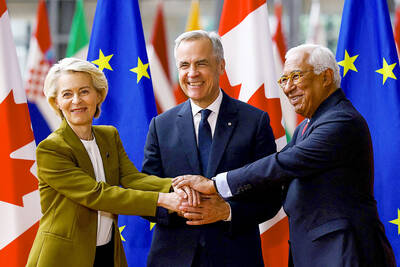
Canada and the EU on Monday signed a defense and security pact as the transatlantic partners seek to better confront Russia, with worries over Washington’s reliability under US President Donald Trump. The deal was announced after a summit in Brussels between Canadian Prime Minister Mark Carney and European Commission President Ursula von der Leyen and European Council President Antonio Costa. “While NATO remains the cornerstone of our collective defense, this partnership will allow us to strengthen our preparedness ... to invest more and to invest smarter,” Costa told a news conference. “It opens new opportunities for companies on both sides of the


 RSS
RSS