


Can giant robots with a deep voice and massive arms be the answer to easing traffic chaos in the capital of the Democratic Republic of the Congo?
A small Congolese cooperative, which developed the novel solution and is testing two robots at key intersections, thinks so — and wants to promote the concept across the country, Africa and the world.
Initial feedback is positive, from both the public and Congolese officials.
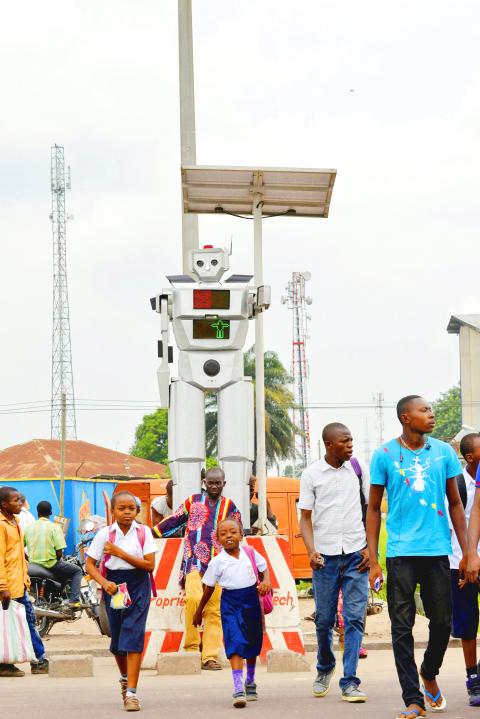
Photo: AFP
“God bless those who invented it,” said taxi-bus driver Franck Mavuzi stuck in traffic. “The robot is good.”
Like many African capitals, Kinshasa, a city of 10 million people, has a reputation for chaotic driving and huge traffic jams. Tricolor traffic lights are rare, many cars are old and battered, and not all drivers are mindful of the highway code.
And Congolese traffic police, who earn minimal salaries, are often accused of extorting money from motorists.
“When the robot stops the traffic you can see that everybody stops and the pedestrians can cross without a problem,” Mavuzi said.
“And the traffic police bother us too much. Let’s leave robots to do the job,” he said.
The first model, which towers 2.5m, was deployed in June last year at the busy Lumumba Boulevard in the central Limete District.
“Drivers, you should make way for pedestrians,” it booms, raising one arm and lowering another while flashing red and green lights signaling cars to stop or carry on.
“We began with this one, which is simply there to offer safe passage” to pedestrians, said Therese Ir Izay Kirongozi, who founded Women’s Technology to provide employment for Congolese women with engineering degrees.
Her seven-member team — which despite the name includes four men — develops the robots in a small workshop with peeling walls and rudimentary equipment.
In October last year, a more sophisticated model designed to control traffic flow was deployed at a junction in front of the Congolese parliament.
Beneath a solar panel providing power, it swivels its torso. A green light on its breastplate turns red while it raises an arm, also fitted with lights — mimicking a human traffic cop stopping one line of traffic and letting another through.
“There are many robots in the world, but a robot handling road safety and traffic control, that’s truly ‘Made in Congo,’” Kirongozi said.
“We must sell our expertise to other countries, as well as central Africa, and why not the US, Europe and Asia,” she said, hoping the project can create more jobs in the vast country where development has been hampered by repeated warfare, notably in the restive east.
Part of the team is due to show off the creation at international trade fairs in Canada and Switzerland next month.
A traffic robot costs about US$15,000 to build, Kirongozi said. Her own restaurant and leisure firm, Planete J, is currently covering costs, but she hopes the robots will eventually turn a profit.
“This is a positive thing ... in the business of road safety,” Congolese National Road Safety Commission head Val Manga said. “We need to multiply these intelligent robots to install them at various intersections in the towns and urban agglomerations of our country.”
The solar panels that power the robots could prove a major asset in a city where whole districts still lack electrical power. Made of aluminum, the robots are designed to resist a harsh equatorial climate with high temperatures, humidity and massive downpours.
A sophisticated electronic detection system tells them when pedestrians are waiting to cross a street. Cameras built into its eyes and its shoulders provide constant video footage of traffic flow.
“When the robot captures images, they are sent over the Internet to a center where they are stored and could be used to prosecute people who have committed offences,” said video surveillance expert Claude Diasuka, who is part of the project.
For the moment, all data belong to Women’s Technology.
However, pointing to money raked in by Western countries for driving offences, Kirongozi said such a system here could guarantee earnings for communities that want to invest in the robots.
In Kinshasa alone, “we have identified 600 dangerous intersections and complicated places” where robots could be put to work, she said.

PARLIAMENT CHAOS: Police forcibly removed Brazilian Deputy Glauber Braga after he called the legislation part of a ‘coup offensive’ and occupied the speaker’s chair Brazil’s lower house of Congress early yesterday approved a bill that could slash former Brazilian president Jair Bolsonaro’s prison sentence for plotting a coup, after efforts by a lawmaker to disrupt the proceedings sparked chaos in parliament. Bolsonaro has been serving a 27-year term since last month after his conviction for a scheme to stop Brazilian President Luiz Inacio Lula da Silva from taking office after the 2022 election. Lawmakers had been discussing a bill that would significantly reduce sentences for several crimes, including attempting a coup d’etat — opening up the prospect that Bolsonaro, 70, could have his sentence cut to

A plan by Switzerland’s right-wing People’s Party to cap the population at 10 million has the backing of almost half the country, according to a poll before an expected vote next year. The party, which has long campaigned against immigration, argues that too-fast population growth is overwhelming housing, transport and public services. The level of support comes despite the government urging voters to reject it, warning that strict curbs would damage the economy and prosperity, as Swiss companies depend on foreign workers. The poll by newspaper group Tamedia/20 Minuten and released yesterday showed that 48 percent of the population plan to vote

A powerful magnitude 7.6 earthquake shook Japan’s northeast region late on Monday, prompting tsunami warnings and orders for residents to evacuate. A tsunami as high as three metres (10 feet) could hit Japan’s northeastern coast after an earthquake with an estimated magnitude of 7.6 occurred offshore at 11:15 p.m. (1415 GMT), the Japan Meteorological Agency (JMA) said. Tsunami warnings were issued for the prefectures of Hokkaido, Aomori and Iwate, and a tsunami of 40cm had been observed at Aomori’s Mutsu Ogawara and Hokkaido’s Urakawa ports before midnight, JMA said. The epicentre of the quake was 80 km (50 miles) off the coast of
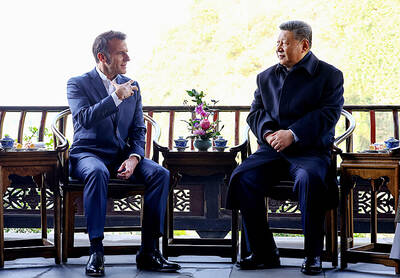
RELAXED: After talks on Ukraine and trade, the French president met with students while his wife visited pandas, after the pair parted ways with their Chinese counterparts French President Emmanuel Macron concluded his fourth state visit to China yesterday in Chengdu, striking a more relaxed note after tough discussions on Ukraine and trade with Chinese President Xi Jinping (習近平) a day earlier. Far from the imposing Great Hall of the People in Beijing where the two leaders held talks, Xi and China’s first lady, Peng Liyuan (彭麗媛), showed Macron and his wife Brigitte around the centuries-old Dujiangyan Dam, a World Heritage Site set against the mountainous landscape of Sichuan Province. Macron was told through an interpreter about the ancient irrigation system, which dates back to the third century


 RSS
RSS