


Japan’s Fukushima Industries yesterday said it was rethinking its “Fukuppy” mascot, after the Internet erupted in sniggers over a name that recalls the catalogue of mishandling at the Fukushima Dai-ichi nuclear power plant.
The Osaka-based refrigerator maker, whose name derives from its founder and has nothing to do with the area hit by an atomic catastrophe, has been much ridiculed on social networking sites for its egg-like mascot with blue wings and red feet.
“I’m Fukuppy. Nice to meet you,” the smiling character with a human face tells visitors to the company’s Web site. “I think I’m kind with a strong sense of justice, but people say I’m a little bit scatterbrained.”
Fukushima Industries unveiled “Fukuppy” in April, blending the first part of the company name — Fuku — and the end of the English word “happy,” saying it represented the corporate philosophy of being a happiness-creating company.
However, the striking moniker was mistaken for “an inappropriate word among people in English-speaking places or its meaning was misunderstood on the Internet,” the company said in a statement.
“We sincerely apologize for worrying many people and creating misunderstanding among them,” the company said, adding: “We will look into the name, including a rethink of it.”
One of Japan’s biggest makers of industrial cooling systems, Fukushima Industries has offices around the country as well as across Asia, including in Taiwan, China, Singapore, Hong Kong and Malaysia.
The firm said the name was nothing to do with the Fukushima Dai-ichi disaster, the world’s worst nuclear accident since Chernobyl in 1986, although it has a sales office in Fukushima Prefecture.
The clean-up at Fukushima, where reactors flung radioactive substances into the air, soil and sea in the days and weeks after it was hit by the March 2011 tsunami, has been beset with problems, and continues to come under the international spotlight.
A series of leaks of radiation-contaminated water over recent months, which came on top of a power outage caused by a stray rat, have added to the impression that the plant’s operator is hapless.
As the name of the broken nuclear plant, “Fukushima” has come to worldwide attention, but it is also a family name, the characters for which mean “fortunate [or good] island.”
It is common for companies and organizations in Japan to have a cuddly mascot character that is used as part of branding. Many are brought to life by adults in full-size costumes who wander around sponsored events.
Last month, Asahikawa Prison in Japan’s far north unveiled “Katakkuri-chan,” a nearly 2m humanoid with a huge square face and an enormous purple flower for hair, that bosses hoped would soften the image of the jail.
Tokyo Metropolitan Police has had its own crime-fighting mascot since the 1980s, who is now well-loved across the nation.

Through the noise of rushing papers and whirring belts at a print factory in Kyoto, two creators watch their photo essay come to life in broadsheet form — part of an effort to win new audiences in the age of artificial intelligence (AI). Despite the decline of the publishing industry, self-publication and handmade “zine” magazines are growing in popularity in Japan, reflecting the nation’s enduring love of paper in the digital era. While speaking to Agence France-Presse at the plant, his hands black with ink, one of the creators, Kazuma Obara, said: “I think [paper] is a medium that engages all five
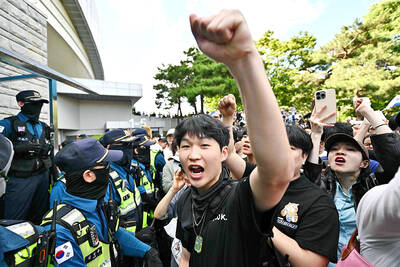
‘ABSURD MISTAKE’: The election commission said that there had been a failure to anticipate turnout after 14 polling stations ran short of ballot papers South Korean riot police yesterday cleared protesters from a Seoul polling station after a 35-hour blockade sparked by a shortage of ballot papers during local elections earlier this week. Wednesday’s election was the first nationwide vote since South Korean President Lee Jae-myung took office following the ouster of Yoon Suk-yeol over his short-lived martial law declaration. Lee’s ruling Democratic Party swept most races, but failed to flip the crucial Seoul mayoral seat. The South Korean National Election Commission apologized, blaming a failure to anticipate turnout after 14 polling stations in Seoul ran short of ballot papers. Some polling stations stayed open until 10pm to

Australian researchers have trained lab-grown brain cells on a silicon computer chip to play the 1990s shooter game Doom and said they are just scratching the surface of what the neurons could be capable of doing. It is the science-fiction work of biotech boffins at Cortical Labs, who researched and developed the technology that harnesses the workings of the brain’s networking system. Each so-called “biological computer” contains about 200,000 living human brain cells, grown from stem cells that were harvested from blood donations. Having mastered the simple computer game Pong, where a paddle is moved up and down to send a ball

France experienced its hottest spring on record, the French weather service said on Tuesday, after an exceptional early heat wave that also broke highs for the season in England and Wales. Meteo-France said the average nationwide temperature over March to May was 13.8°C — about 1.7°C above the norm, and surpassing records set in 2011 and 2020. “The warmest spring since records began in 1900,” it said in a bulletin. All three months were warmer than average, but the onset of an “unprecedented heatwave” late last month pushed the mercury to highs typically seen at the height of the summer. “Our country had never


 RSS
RSS