


Going straight after a lifetime spent as a member of Japan’s feared yakuza organized crime mobs poses a number of challenges. Chief among them is what to do about the fingers you chopped off.
For one reformed wise guy, the answer lay in thousands of dollars’ worth of prosthetics crafted to look exactly like the three of his digits he hacked off to appease his one-time bosses.
“You see how real these fingers are?” said Toru, 53, proudly showing off his artificial body parts — both little fingers and his left ring finger.
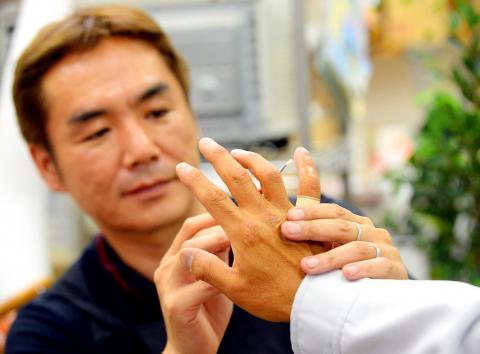
Photo: AFP
“There was only one time that anyone ever knew they were fake. She was an old lady in her 70s. I told her I was injured in a factory,” he said.
Like the Italian Mafia or Chinese triads, yakuza gangs engage in activities ranging from gambling, drugs and prostitution to loan sharking, protection rackets and white-collar crime.
The gangsters in Japan, who number 63,200, have historically been tolerated by the authorities, and are heavily romanticized in popular culture, spawning a vast catalogue of manga and movies.
Observers say the strict code of honor of the yakuza, passed down from the samurai warriors of the 17th and 18th centuries, is largely gone and many are little more than brutal criminals.
However, even in the mob, Japan’s rigid societal rules play out.
This means your peers are always supposed to look out for you and protect you. Likewise, it means you have to look out for them.
Toru — not his real name — used to make his living offering “protection” to the bars and clubs of Tokyo’s Kabukicho red light district.
He was a success, making sure the rival gangs stayed off his turf and keeping the money flowing up to his seniors.
However, then one of the men in his gang — a “brother” — fell foul of the strict prohibition on stealing and drug use.
To assuage his boss’ anger and prove the group was truly penitent, Toru sliced off the top of his left little finger.
Unfortunately, someone got the group into trouble again a short time later, and Toru had to take the knife to the second joint.
“The first joint of a little finger can be sliced easily,” he said. “You tie the bottom of it with thread tightly and put your body weight on a kitchen knife. But the second joint was tougher than I thought.”
Luckily, there was a brother to hand, who could stand on the knife and slice through the knuckle.
The loss of the tip of the pinkie on his right hand was his own fault — he got drunk and started throwing furniture around in a bar.
Unfortunately for him, the bar belonged to a friend of his boss. Out came the kitchen knife again, and off came the top of his little finger.
However, his fourth amputation bore a whole different significance.
“I met my wife,” he said. “I wanted to marry her, but she said she couldn’t possibly marry a yakuza guy. So I quit.”
Of course, you cannot just resign from the yakuza. You need to offer a sacrifice. A ring finger, for instance.
“I tried to do it as usual with a kitchen knife, but the blade didn’t go through because of the muscle. I had to ask a brother to take a hammer and a chisel to lop it off,” he said. “Oh, it was painful.”
Where once the missing fingers were badges of honor, proving to fellow gangsters that Toru was loyal, hard-working and prepared to make sacrifices, they now worked against him.
Life as a katagi (civilian) is tough when everybody knows how you used to make your living, with respectable companies unwilling to be connected to the yakuza. The only solution is to get your fingers back.
That is where prosthetics specialist Shintaro Hayashi came in, crafting three silicone fingers, complete with the creases and lines of a natural digit.
His works are so delicate that he even implants individual hairs taken from his subjects’ hands and arms to give each finger a really lifelike look.
“I think of myself as being like Geppetto,” he said, referring to the woodcarver who created Pinocchio.
“My job requires not only knowing the person well, but also injecting his or her personality into the parts,” he said, adding that he keeps a photo of his client on his desk as he works.
The bulk of Hayashi’s clients are people who have lost hands, feet or ears in accidents, or are born with something missing, but about 5 percent are former yakuza.
Making a mould for the silicone casting is expensive — about ¥300,000 (about US$3,000) for one finger — but it means the prosthetics are easy, and relatively cheap, to replace when they look tatty or worn.
“For me, these fingers are consumable items,” Toru said. “I have to renew them every three months.”
And they have been well worth the initial outlay, allowing him to build a house renovation company that does legitimate work.
“I now run two outlets for my business, making about ¥300 million a year,” he said.
Asked why he granted the interview, Toru has a quick and easy answer — he wants to show yakuza stuck in a life of crime that there is another way.
“They could do well if they work hard, even if they have lost some of their fingers. Life is much easier this way,” he said.

When a hiker fell from a 55m waterfall in wild New Zealand bush, rescuers were forced to evacuate the badly hurt woman without her dog, which could not be found. After strangers raised thousands of dollars for a search, border collie Molly was flown to safety by a helicopter pilot who was determined to reunite the pet and the owner. A week earlier, an emergency rescue helicopter found the woman with bruises and lacerations after a fall at a rocky spot at the waterfall on the South Island’s West Coast. She was airlifted on March 24, but they were forced to
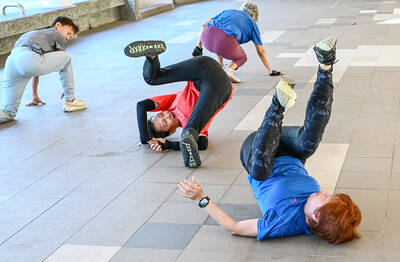
CONFIDENCE BOOSTER: ’After parkour ... you dare to do a lot of things that you think only young people can do,’ a 67-year-old parkour enthusiast said In a corner of suburban Singapore, Betty Boon vaults a guardrail, crawls underneath a slide, executes forward shoulder rolls and scales a steep slope, finishing the course to applause. “Good job,” the 69-year-old’s coach cheers. This is “geriatric parkour,” where about 20 retirees learned to tackle a series of relatively demanding exercises, building their agility and enjoying a sense of camaraderie. Boon, an upbeat grandmother, said learning parkour has aided her confidence and independence as she ages. “When you’re weak, you will be dependent on someone,” she said after sweating it out with her parkour classmates in suburban Toa Payoh,
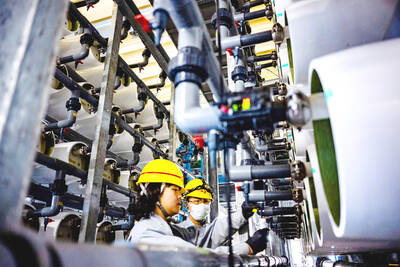
HIGH HOPES: The power source is expected to have a future, as it is not dependent on the weather or light, and could be useful for places with large desalination facilities A Japanese water plant is harnessing the natural process of osmosis to generate renewable energy that could one day become a common power source. The possibility of generating power from osmosis — when water molecules pass from a less salty solution to a more salty one — has long been known. However, actually generating energy from that has proved more complicated, in part due the difficulty of designing the membrane through which the molecules pass. Engineers in Fukuoka, Japan, and their private partners think they might have cracked it, and have opened what is only the world’s second osmotic power plant. It generates
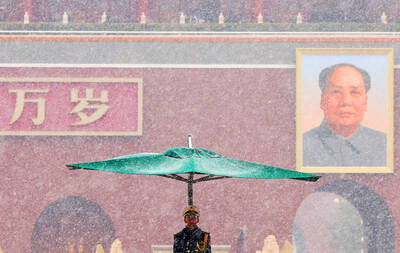
Chinese dissident artist Gao Zhen (高兟), famous for making provocative satirical sculptures of former Chinese leader Mao Zedong (毛澤東), was tried on Monday over accusations of “defaming national heroes and martyrs,” his wife and a rights group said. Gao, 69, who was detained in 2024 during a visit from the US, faces a maximum three-year prison sentence, said his wife, Zhao Yaliang (趙雅良), and Shane Yi, a researcher at the Chinese Human Rights Defenders group which operates outside the nation. The closed-door, one-day trial took place at Sanhe City People’s Court in Hebei Province neighboring the capital, Beijing, and ended without a


 RSS
RSS