


Sniffing the wind, the hardened racing sailors eye their rivals. That the water is waist deep and the boats are toys does nothing to lower the intensity at this century-old sailing club in New York’s Central Park.
The Central Park Model Yacht Club (CPMYC) makes a big thing from miniature voyages.
Every Saturday for as long as anyone can remember, members have shown up at the Conservatory Water to pit their wits against each other in the baffling winds swirling through the park’s trees.
“This is a very pure form of sailing,” said Jon Elmaleh, a wiry 52-year-old, who with his chin stubble, mountaineer-style sunglasses and polo shirt, looked as if he might already be halfway across the Atlantic.
“You get to the core of sailing in a way you don’t on a big boat,” he said.
Central Park’s pond is popular with tourists who rent radio-controlled sailboats, one lever on the controls turning the rudder and another lever to manage the sail.
However, perhaps the most famous race of all is fictional.
In E.B. White’s classic children’s novel Stuart Little, a talented mouse at the wheel of the wooden schooner Wasp defeats the bullying “Lillian B. Womrath.”
In that tale, a huge crowd gathers around the pond, a policeman falls in, and the boats have to navigate fluky winds and an errant paper bag.
The last factor — the sometimes maddening challenges of a pond surrounded by tall trees and the skyscrapers of Manhattan — is something today’s toy sailors can appreciate.
“The wind’s hard. It goes around in circles. It goes straight down,” Elmaleh said, squinting at the sky. “You get to think of it as moving through space as a three dimensional object that’s turning all the time.”
The CPMYC has been around since 1916, and up until the 1970s, boasted about 120 members. Keen amateur model builders came up with designs that would go on to inspire naval architects working on America’s Cup and other big boat races.
Today there are just 25 members.
“It’s kind of dying,” Elmaleh said.
The more than 100 miniature yachts lined up in the red brick boathouse remain an evocative sight. Many are sleek racing machines with narrow hulls. Others are more tubby recreations of ocean sailing boats, complete with cabins, steering wheels and everything a tiny sailor, such as E.B. White’s mouse, would want.
Like any real yacht club, the CPMYC has a leader called the commodore, a vice commodore, a treasurer, a secretary and its own triangular pennant to be flown from the mast.
“Central Park is it. I call it Mecca,” CPMYC commodore John Tucker said. “The entire world sailing fraternity, when they come here to New York, they come to pay homage.”
Tucker, 79, said he had “dabbled” in big boats.
Elmaleh has crossed the Atlantic on a yacht, but insists that model racing is superior: “You can race your own boat without, you know, dockage fees and getting sandwiches for the crew.”
While Elmaleh blamed the ever rising trees and falling wind for the club’s decline, Pat Dworzan, 68, said young people no longer have the needed attention span.
Dworzan’s boat “Incognito” is an amazing piece of handcrafted wood, with every feature of a real boat reproduced, right down to the individual planks laid over ribs and perfectly tied knots in the thread-sized rigging.
“A kid today can’t do that. There’s too much distraction,” he said, rescuing “Incognito” from impending collision with one of the “pain in the ass” vessels rented by tourists.
Dworzan said he had no intention of graduating to a proper boat at sea.
“One time I tried and it scared the hell out of me,” he said.
Elmaleh, whose company Out There Technologies designs everything from toy boats to pool cleaning gizmos and a stool that lets you exercise while sitting, takes racing pretty seriously.
At a three-way contest last weekend, his boat, hand-built to a cutting-edge design, trounced the field.
He had just come back from a national championship in San Diego, where, he says darkly, a competitor from Barbados cheated and ruined his shot at the title. He has also sailed in New Zealand and England.
Tucker called Elmaleh “the king of the water.”
However, not everyone at New York’s miniature yacht club has such big ambition.
“My wife bought a boat for me to get me out of the house,” an elderly man in a Yankees baseball cap said. “The nicest thing about it is the parade.”
A parade? Was this some quirky club tradition?
“Oh no,” the man said, gesturing toward a group of female tourists in shorts. “The women going by. You just sit on the bench and watch them — and to hell with the boats.”

When a hiker fell from a 55m waterfall in wild New Zealand bush, rescuers were forced to evacuate the badly hurt woman without her dog, which could not be found. After strangers raised thousands of dollars for a search, border collie Molly was flown to safety by a helicopter pilot who was determined to reunite the pet and the owner. A week earlier, an emergency rescue helicopter found the woman with bruises and lacerations after a fall at a rocky spot at the waterfall on the South Island’s West Coast. She was airlifted on March 24, but they were forced to
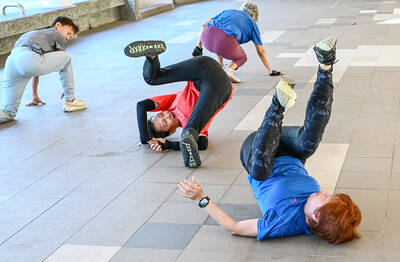
CONFIDENCE BOOSTER: ’After parkour ... you dare to do a lot of things that you think only young people can do,’ a 67-year-old parkour enthusiast said In a corner of suburban Singapore, Betty Boon vaults a guardrail, crawls underneath a slide, executes forward shoulder rolls and scales a steep slope, finishing the course to applause. “Good job,” the 69-year-old’s coach cheers. This is “geriatric parkour,” where about 20 retirees learned to tackle a series of relatively demanding exercises, building their agility and enjoying a sense of camaraderie. Boon, an upbeat grandmother, said learning parkour has aided her confidence and independence as she ages. “When you’re weak, you will be dependent on someone,” she said after sweating it out with her parkour classmates in suburban Toa Payoh,

HIGH HOPES: The power source is expected to have a future, as it is not dependent on the weather or light, and could be useful for places with large desalination facilities A Japanese water plant is harnessing the natural process of osmosis to generate renewable energy that could one day become a common power source. The possibility of generating power from osmosis — when water molecules pass from a less salty solution to a more salty one — has long been known. However, actually generating energy from that has proved more complicated, in part due the difficulty of designing the membrane through which the molecules pass. Engineers in Fukuoka, Japan, and their private partners think they might have cracked it, and have opened what is only the world’s second osmotic power plant. It generates

Chinese dissident artist Gao Zhen (高兟), famous for making provocative satirical sculptures of former Chinese leader Mao Zedong (毛澤東), was tried on Monday over accusations of “defaming national heroes and martyrs,” his wife and a rights group said. Gao, 69, who was detained in 2024 during a visit from the US, faces a maximum three-year prison sentence, said his wife, Zhao Yaliang (趙雅良), and Shane Yi, a researcher at the Chinese Human Rights Defenders group which operates outside the nation. The closed-door, one-day trial took place at Sanhe City People’s Court in Hebei Province neighboring the capital, Beijing, and ended without a


 RSS
RSS