


For tattoo artist Horiyoshi III, the skin into which he sinks his ink-infused needle is a canvas for the myths and legends of Japan — where body art is indelibly linked to the criminal underworld.
The mountains and waves of 18th-century art, or fabulous mythical creatures are a far cry from the stylized designs so common in the West that might usually draw disapproval from parents and teachers, but the tattoo in Japan has a much worse reputation, associated with the violent gangsters of the yakuza criminal underworld — an association that ink proponents argue is unfair.
Horiyoshi — who uses the modern metal variation of a bamboo stick still favored by some traditionalists — says his biggest inspiration is Hokusai, an artist famed for woodblock prints of a tsunami against Mount Fuji.
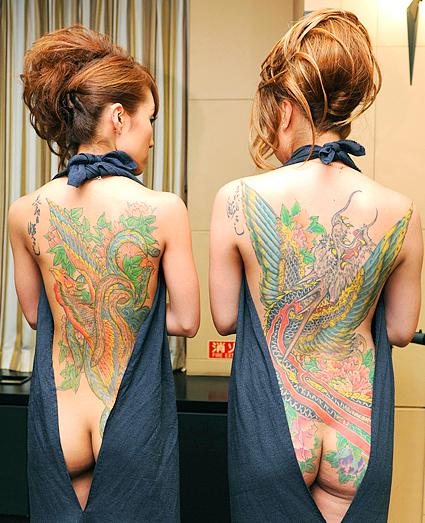
Photo: AFP
“But I am also influenced by other Japanese artists,” he said at an exhibition of his work — with all live subjects — last month in Tokyo, citing Utagawa Kuniyoshi, known for his landscapes, mystical animals and samurai swordfights.
“And of course I do not exactly reproduce their works: I have to adapt their designs to the bodies on which I work,” he said.
Former gym teacher Asada Yoshi is covered with the master’s designs, which re-tell Japanese mythology on the 52-year-old’s body.
“On the right leg, you see a koi [Japanese carp] jumping and on the left leg a creature — half dragon and half koi — and then on the back I designed a massive dragon,” said Horiyoshi, who, like a Kabuki actor, inherited his single name from his teacher.
“It refers to an ancient legend in which the carp turns into a dragon after it swam against a waterfall,” he said.
Alexander Reinke, Horiyoshi’s German-born apprentice who one day hopes to become Horiyoshi IV, said he was attracted to Japanese tattoos because of their singularity.
He says, unlike those popular in the West, tattoos in Japan have their own narrative and do not borrow from other cultures.
The — often badly-rendered — Chinese or Sanskrit characters that adorn bodies in London or New York would not be found in Japan, he said.
“The biggest difference is that tattoos in the West are created to underline a person’s individuality,” he said.
“They want to make a statement or remember something they are a really big fan of,” he added.
“But in Japan some groups get tattoos not to underline their individuality because individuality is not so important in Japan, it’s the group that is important,” Reinke said.
That mentality often translates into tattoo clubs where members meet and show off their designs, just regular people with “normal jobs” who have a passion for body art, he said.
“Usually, a group that is tattooed by the same master kind of forms a little club by themselves, like here today where everybody who is meeting has been tattooed by Mr Horiyoshi and is just having a good time,” Reinke said.
However, Yoshi says that having a tattoo in his old job as a gym coach was “impossible.”
“It’s hard to get a tattoo in Japan,” he said.
“Most people have big prejudices … but my curiosity and my passion was stronger than prejudice,” he added.

‘CROSSING THE LINE’: China’s embassy in Seoul criticized US Forces Korea Commander General Xavier Brunson, asking if his ‘hostile’ remarks were authorized by Washington South Korea and the US are in talks over recent public remarks by the commander of US Forces Korea, Seoul’s presidential office said yesterday, after the comments drew sharp criticism from China. In a recent podcast interview, US Forces Korea Commander General Xavier Brunson described South Korea as “the dagger in the heart of Asia” from China’s east coast, prompting the Chinese embassy in Seoul to say that he had “truly crossed the line.” The interview came amid growing speculation that Washington might seek to expand the role of US Forces Korea in countering the growing regional influence of China, a key

SEEKING ORDER: Rodrigo Paz said that ‘anyone who wants to destroy the nation will have to deal with this president and the full force of the constitution’ Bolivian President Rodrigo Paz on Wednesday said that the nation was at a “breaking point” after nearly a month of protests that have caused shortages of food, fuel and medicine. Paz, who took office six months ago amid the worst economic crisis there in four decades, is battling a groundswell of fury over his policies. The political capital, La Paz, has been besieged by low-income workers and members of the indigenous majority calling for his resignation. “The country needs order and is reaching breaking point,” the 58-year-old said at a public event in La Paz, renewing his appeal for dialogue. On Tuesday, the Bolivian

Through the noise of rushing papers and whirring belts at a print factory in Kyoto, two creators watch their photo essay come to life in broadsheet form — part of an effort to win new audiences in the age of artificial intelligence (AI). Despite the decline of the publishing industry, self-publication and handmade “zine” magazines are growing in popularity in Japan, reflecting the nation’s enduring love of paper in the digital era. While speaking to Agence France-Presse at the plant, his hands black with ink, one of the creators, Kazuma Obara, said: “I think [paper] is a medium that engages all five

Australian researchers have trained lab-grown brain cells on a silicon computer chip to play the 1990s shooter game Doom and said they are just scratching the surface of what the neurons could be capable of doing. It is the science-fiction work of biotech boffins at Cortical Labs, who researched and developed the technology that harnesses the workings of the brain’s networking system. Each so-called “biological computer” contains about 200,000 living human brain cells, grown from stem cells that were harvested from blood donations. Having mastered the simple computer game Pong, where a paddle is moved up and down to send a ball


 RSS
RSS