


Most Pakistanis dislike the police, blaming them for being corrupt and aggressive — but now the media is earning a similar reputation for its frequent attacks on people’s privacy.
Pakistan’s ever-growing freewheeling private TV stations have given birth to “vigilante journalism” aimed at exposing people — often ordinary members of the public — they say are breaching social morals.
Former Pakistani president Pervez Musharraf liberalized the media in 1999, opening the way for the first time to private news and entertainment channels. There are now more than 80, 40 of them broadcasting round-the-clock news in five languages.
In January, TV anchor Maya Khan caused a storm of protest with her show Raid in the Morning, in which she and a group of veiled women chased couples in a park accusing them of behaving immorally.
Many fled, but Khan pounced on one couple and badgered them with questions, tricking them into answering by telling them the camera was not running.
The show provoked furious criticism on social networking Web sites Facebook and Twitter, and eventually a 5,000-name petition forced bosses at Samaa TV station to fire her.
Khan refused repeated requests to talk to Agence France-Presse, but in an interview with Express TV, she was unrepentant, saying what she did was in the public interest.
“My heart is satisfied because whatever I did was done for the betterment of society, but, still if it hurt people, I apologize,” she said, saying that what she presented on her show was “not real, but a re-enactment” of the perceived events.
Pakistani liberals praised Samaa for getting rid of Khan, but their celebrations were short-lived as she was quickly hired by another station to host its morning show.
The Khan incident is typical of stunts carried out by TV stations who say they are safeguarding social morals in what is a deeply conservative country.
Morning shows, such as Khan’s, are the most popular. Hosts are well paid and eager to hold on to their audience in a competitive market.
“Which is why highly paid anchors go for ventures like Maya Khan to keep business going,” one senior official at a private channel said on condition of anonymity.
However, Mehnaz Rehman, a director of the Aurat Foundation, an organization that fights for women’s rights, said it was a dangerous trend that threatened social order.
“This is not journalism, this is purely vigilantism, something that does not suit good people, especially those who claim to be fighting for the rights of masses,” she said. “Media should be responsible and think beyond commercialization, especially where it hits the society’s very social fabric.”
In a country where young people already feel intimidated by intolerance, 25-year-old Mohsin Haleem, an executive, said media has harassed rather than empowered them.
Pakistan has suffered since the 1970s from encroaching Islamization that has made society, particularly in the cities and particularly for women, more conservative.
While the Internet, and sites such as Twitter and Facebook provide some interaction, gender segregation is common and public entertainment is limited.
“The events of vigilantism by our TV channels have discouraged many of our youth to go in public parks, even they preferred to stay elsewhere on Valentine’s Day,” he said.
It is not only courting couples that have been on the receiving end of intrusive TV exposes.
Ghulam Haider works in a health diagnostics laboratory that has been gatecrashed twice by reporters from two different TV channels insisting on filming the premises to check the facilities — an act only the government is authorized to take.
“They are more assertive and ruthless in attacking us in the name of freedom of expression. They don’t respect our freedom and individual liberty,” said Haider, 69.
“The reporters take booms in their hands and gatecrash anywhere without permission. They especially do this in the places which are inhabited or owned by those having little influence in the society,” Haider said.
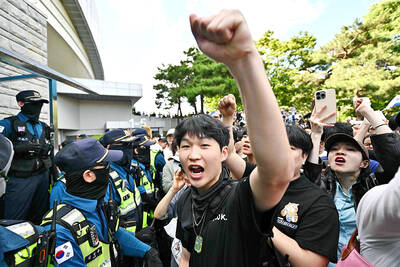
‘ABSURD MISTAKE’: The election commission said that there had been a failure to anticipate turnout after 14 polling stations ran short of ballot papers South Korean riot police yesterday cleared protesters from a Seoul polling station after a 35-hour blockade sparked by a shortage of ballot papers during local elections earlier this week. Wednesday’s election was the first nationwide vote since South Korean President Lee Jae-myung took office following the ouster of Yoon Suk-yeol over his short-lived martial law declaration. Lee’s ruling Democratic Party swept most races, but failed to flip the crucial Seoul mayoral seat. The South Korean National Election Commission apologized, blaming a failure to anticipate turnout after 14 polling stations in Seoul ran short of ballot papers. Some polling stations stayed open until 10pm to

France experienced its hottest spring on record, the French weather service said on Tuesday, after an exceptional early heat wave that also broke highs for the season in England and Wales. Meteo-France said the average nationwide temperature over March to May was 13.8°C — about 1.7°C above the norm, and surpassing records set in 2011 and 2020. “The warmest spring since records began in 1900,” it said in a bulletin. All three months were warmer than average, but the onset of an “unprecedented heatwave” late last month pushed the mercury to highs typically seen at the height of the summer. “Our country had never

A Sherpa guide was found crawling to base camp on Mount Everest a week after he went missing and was reunited with his family, who had given up hope he would return. Dawa Sherpa was last seen on Friday last week descending the mountain, but he did not reach base camp even though his client did. The pair were among the last climbers on the mountain as the climbing season came to an end and the route was dismantled. Dawa was located by a cleaning crew on Thursday morning as he was crawling down the snowy slopes around the Khumbu Icefall, just above
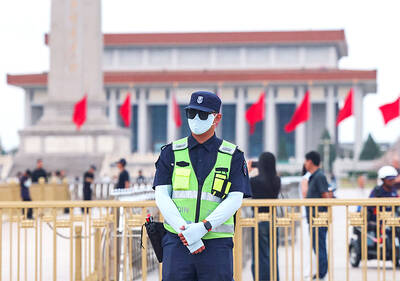
Chinese authorities are snuffing out any remembrance of the deadly 1989 military crackdown on student-led pro-democracy protests in Tiananmen Square, which happened 37 years ago yesterday, in a further tightening of a years-long campaign to erase what happened from public memory. Police told relatives of the victims they would not be allowed to visit a cemetery in Beijing on the anniversary of the crackdown, a person with knowledge of the matter said. Relatives of the victims visited the cemetery on the anniversary for more than 30 years to read memorial statements with police keeping watch, Amnesty International said. Hundreds of people,


 RSS
RSS