


Helsinki’s streets are festive with vibrant Christmas decorations and bright advertisements tout the season’s must-have gifts as shoppers bustle through packed stores, yet something is amiss: There’s no snow.
The absence of white stuff has not only left Christmas revelers gloomy, it has affected businesses ranging from ski resorts to retailers and, of course, snow removal companies.
The situation is in stark contrast to last year’s heavy snowfalls at this time of year, when Finns showed off their “snow-how” to the grid-locked continent, including state-of-the-art snow removal and special motorist support teams.
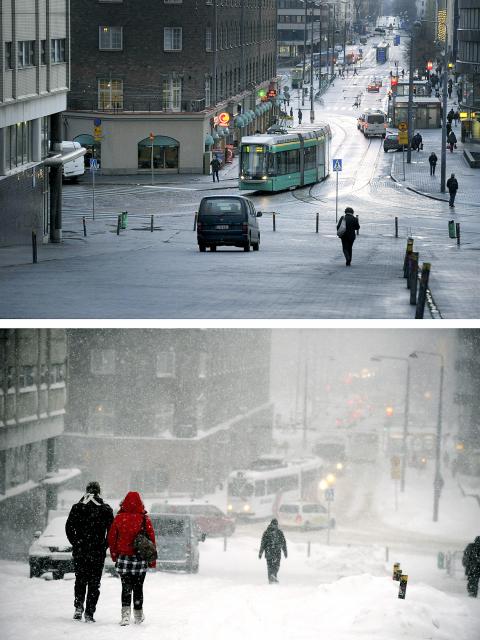
Photo: AFP
However, that was then. Now, Helsinki is experiencing uncharacteristically mild temperatures this month and only light dustings of snow have come and gone.
“At the beginning of December, it was on average 6?C warmer than is usual for this time of year,” meteorologist Pauli Jokinen said.
He said the snow’s no-show in the south of the country this year was partly because of natural variations, but also a footprint of global warming.
“You can’t put a single season down to climate change, but we have seen that climate change has lifted the baseline temperatures,” he said.
The meteorologist confirmed what many Finns, especially in the milder, southern parts of the country, already fear.
“Our best guess is that in many parts of southern and western Finland, it will be a black Christmas,” Jokinen said.
After last year’s excesses, this year’s lack of snow has stonewalled many businesses.
The balmy autumn forced the cancelation of two major skiing events in Levi, Finland’s northern nerve center for competitive and recreational winter sports.
“The World Cup race and the European Cup had to be canceled because of the lack of snow. These are very big events for the area,” said Tarja Nikkanen, marketing manager for Levi Ski Resort.
Nikkanen pointed out though, that with about 25cm of snow on the ground and accommodation booked months in advance, the Christmas season still looks promising for tourists seeking a picture-perfect winter wonderland.
However, she said that the ski slopes tell a different story.
“We have the biggest snow-making equipment in Finland, but we’re not able to use it because the temperatures are not low enough to keep the snow,” she said.
During the dark winter months, when the Finnish sun sets in the mid-afternoon, residents often long for the light-reflecting quality of snow to relieve the gloom.
In northern climes like this, some people are susceptible to Seasonal Affective Disorder, a condition marked by bouts of depression that some research has linked to a lack of sunlight.
This year, the absence of snow, supplanted by heavy rains, has cast its shadow over the retail business as well, Jaana Kurjenoja of the Finnish Trade Association said.
In a recent survey, 42 percent of the association’s retailers said their businesses were suffering as a result of the weather conditions.
“Usually, warm clothes are popular at Christmas time, but they’re not selling this year,” Kurjenoja said. “Skiing and slalom equipment have also suffered and sports retailers say they haven’t been able to sell their winter goods.”
However, one retailer’s gloom is another’s glee.
Some merchants who lost out during last winter’s heavy snows are experiencing windfalls this year, Kurjenoja said.
“During the last two winters, the electronics retailers suffered because people were concerned about insufficient parking [in the snow-bound city] and how to get heavy equipment home,” she said. “This year electronics sales are up.”
While snow lovers and weather-dependent businesses look to the skies for salvation, officials in Helsinki continue their winter preparations just in case.
“There’s always a possibility that big changes could come ... there could be lots of snow in January and February, Jokinen said. “All hope is definitely not lost.”

When a hiker fell from a 55m waterfall in wild New Zealand bush, rescuers were forced to evacuate the badly hurt woman without her dog, which could not be found. After strangers raised thousands of dollars for a search, border collie Molly was flown to safety by a helicopter pilot who was determined to reunite the pet and the owner. A week earlier, an emergency rescue helicopter found the woman with bruises and lacerations after a fall at a rocky spot at the waterfall on the South Island’s West Coast. She was airlifted on March 24, but they were forced to

CONFIDENCE BOOSTER: ’After parkour ... you dare to do a lot of things that you think only young people can do,’ a 67-year-old parkour enthusiast said In a corner of suburban Singapore, Betty Boon vaults a guardrail, crawls underneath a slide, executes forward shoulder rolls and scales a steep slope, finishing the course to applause. “Good job,” the 69-year-old’s coach cheers. This is “geriatric parkour,” where about 20 retirees learned to tackle a series of relatively demanding exercises, building their agility and enjoying a sense of camaraderie. Boon, an upbeat grandmother, said learning parkour has aided her confidence and independence as she ages. “When you’re weak, you will be dependent on someone,” she said after sweating it out with her parkour classmates in suburban Toa Payoh,

HIGH HOPES: The power source is expected to have a future, as it is not dependent on the weather or light, and could be useful for places with large desalination facilities A Japanese water plant is harnessing the natural process of osmosis to generate renewable energy that could one day become a common power source. The possibility of generating power from osmosis — when water molecules pass from a less salty solution to a more salty one — has long been known. However, actually generating energy from that has proved more complicated, in part due the difficulty of designing the membrane through which the molecules pass. Engineers in Fukuoka, Japan, and their private partners think they might have cracked it, and have opened what is only the world’s second osmotic power plant. It generates

Chinese dissident artist Gao Zhen (高兟), famous for making provocative satirical sculptures of former Chinese leader Mao Zedong (毛澤東), was tried on Monday over accusations of “defaming national heroes and martyrs,” his wife and a rights group said. Gao, 69, who was detained in 2024 during a visit from the US, faces a maximum three-year prison sentence, said his wife, Zhao Yaliang (趙雅良), and Shane Yi, a researcher at the Chinese Human Rights Defenders group which operates outside the nation. The closed-door, one-day trial took place at Sanhe City People’s Court in Hebei Province neighboring the capital, Beijing, and ended without a


 RSS
RSS