


The Wereldmuseum in Rotterdam plans to sell its African and American treasures to cover potential funding shortfalls in the face of the economic crisis in Europe and a planned cut in state subsidies to the arts starting in 2013.
It is one of several Dutch museums under pressure to raise money from the public purse, and ideas being explored have ranged from “adopting” star exhibits to opening a hotel on the premises.
“We are going to sell the entire Africa collection and the Americas collection and will only keep the top pieces in the rest of our collection so we can focus on Asian art,” Wereldmuseum director Stanley Bremer said.
“The money we raise we will put in the bank,” he said.
“If you are alert to the situation in Europe, you can see there could be a problem in five or six years’ time. So either we can sit back or we can make a plan and our plan is to raise money to be as self-sufficient as possible,” he said.
The government has said state subsidies for the arts and culture would be cut by 200 million euros (US$288 million) to 700 million euros with effect from 2013, and that in future, museums must find 17.5 percent of their income from new funding sources or partners.
The possible sale — if no other museum in the Netherlands can afford to purchase the works, then other buyers may step in — has prompted an outcry in some quarters.
The African collection at the Wereldmuseum — or World Museum in English — is one of the oldest in Europe and includes pieces collected by Dutch merchants from the 19th century, such as Hendrik Muller, a businessman who traded in Africa.
It features several so-called power figures, which are carved wooden statues with a cavity in the abdomen that a ritual expert fills with ingredients with supernatural power before sealing the cavity with a mirror.
The figures are created to counter disease, disaster or other misfortune thought to be the work of witches.
“It would be a huge loss for the Netherlands — we need to ensure that they stay in the Netherlands,” said Steven Engelsman, chairman of the Netherlands Foundation for Ethnographic Collection, an organization representing the country’s eight ethnographic museums.
Bremer said the museum would focus on its more extensive Asia and Asia-Pacific collections because there are already five other museums in the Netherlands and nearby that focus on Africa.
Museum Boerhaave in Leiden, which concentrates on the history of science and medicine, may also have to resort to the sale of exhibits as it has been threatened with possible closure.
“It is possible that some items could be sold,” director Dirk van Delft said, if it could not raise money in any other way.
The museum’s collection include the world’s first kidney dialysis machine developed by Dutch doctor Willem Kolff during World War II, as well as some of the world’s first microscopes, which were made by Dutch scientist Antonius van Leeuwenhoek in the 17th century.

SPEAKING OUT: After Siranudh Scott’s allegations surfaced, celebrities and public figures took to social media to share their own experiences of sexual misconduct and abuse A high-profile alleged sexual abuse case within a wealthy Thai beer brewing family has prompted a wave of painful accounts from survivors of unconnected abuse in the conservative nation. Siranudh Scott, a member of the billionaire Thai family that founded the ubiquitous Singha beer brand, posted an emotional video this month accusing his elder brother Sunit of repeatedly abusing him when he was a teenager. Sunit, who is in his 30s, later denied the allegations in a video posted online, but Singha parent Boonrawd dismissed him from his executive role with the company on Tuesday last week. “I felt I needed to speak

SEEKING ORDER: Rodrigo Paz said that ‘anyone who wants to destroy the nation will have to deal with this president and the full force of the constitution’ Bolivian President Rodrigo Paz on Wednesday said that the nation was at a “breaking point” after nearly a month of protests that have caused shortages of food, fuel and medicine. Paz, who took office six months ago amid the worst economic crisis there in four decades, is battling a groundswell of fury over his policies. The political capital, La Paz, has been besieged by low-income workers and members of the indigenous majority calling for his resignation. “The country needs order and is reaching breaking point,” the 58-year-old said at a public event in La Paz, renewing his appeal for dialogue. On Tuesday, the Bolivian
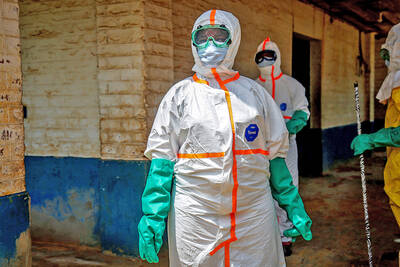
COMMUNITY CONFLICT: Concerns about disease spread from corpses has run up against friends and families’ desire to bury their dead as infection spreads in the area Angry residents of a town at the epicenter of the Ebola outbreak in the Democratic Republic of the Congo (DR Congo) attacked and burned a tent that was part of a health center where people are being treated for the virus, the staff there said Saturday. It was the second such attack in the region in a week. No one was hurt in the attack, according to reports but as patients ran out to escape the fire, 18 people with suspected Ebola infections fled the facility and are unaccounted for, a hospital director said. Angry residents arrived at the clinic in the
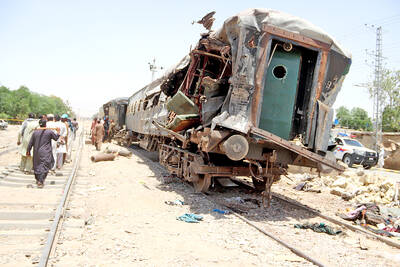
INSURGENT ACTION: A local independence movement in Balochistan, alleged by Pakistan’s government to be backed by India, claimed responsibility for the strike A suicide bomber detonated an vehicle-borne IED near a railway as a passenger train passed through the southwestern Pakistani city of Quetta yesterday, killing at least 23 people and wounding over 70, officials said. The explosion caused two of the train cars to overturn and catch fire, according to footage shared online. The attack happened in an area where security forces are usually stationed, badly damaging several nearby buildings and smashing more than a dozen vehicles parked along the road, according to witnesses and images circulating on social media. Doctors at local hospitals said they had received the wounded, with 20 in critical


 RSS
RSS