


A manned Chinese submersible conducted its first dive to beyond 4,000m yesterday, the government said, in the latest milestone for the country’s deep-sea ambitions.
The Jiaolong undersea craft — named after a mythical sea dragon — reached 4,027m with three people onboard during the dive in the northern Pacific Ocean, China’s State Oceanic Administration said in a statement.
“The success of this test dive has laid a solid foundation for completing the mission of diving to 5,000m,” it said. The craft will attempt to surpass 5,000m in another dive today.
Chinese technical capability has grown in leaps and bounds in recent decades, exemplified by a fast-growing space program that in 2005 made China the third nation to conduct manned space flight.
The Jiaolong’s undersea range theoretically gives China access to nearly all of the world’s deep-sea areas, Chinese officials have said.
The craft is designed to reach a maximum depth of 7,000m and in a dive last year it made China only the fifth country to go deeper than the 3,500m mark, according to previous Chinese reports.
The deepest dive ever conducted was by the US Navy, which reached the bottom of the Mariana Trench — the deepest point in the world’s oceans at 11,000m — in 1960 in a manned undersea craft.
China has said its development of submersible technology is aimed at scientific research and the peaceful exploration and use of natural resources.
The country has pushed hard in recent years to obtain oil, mineral and other natural resources needed to fuel its growth.
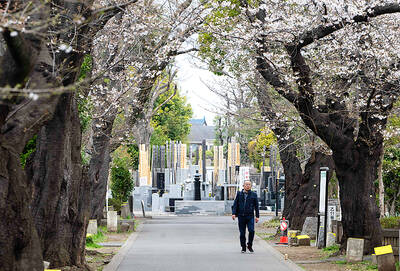
ROCKY RELATIONS: The figures on residents come as Chinese tourist numbers drop following Beijing’s warnings to avoid traveling to Japan The number of Chinese residents in Japan has continued to rise, even as ties between the two countries have become increasingly fractious, data released on Friday showed. As of the end of December last year, the number of Chinese residents had increased by 6.5 percent from the previous year to 930,428. Chinese people accounted for 22.6 percent of all foreign residents in Japan, making them by far the largest group, Japanese Ministry of Justice data showed. Beijing has criticized Tokyo in increasingly strident terms since Japanese Prime Minister Sanae Takaichi last year suggested that a military conflict around Taiwan could
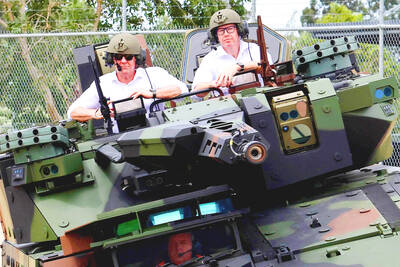
Germany is considering Australia’s Ghost Bat robot fighter as it looks to select a combat drone to modernize its air force, German Minister of Defense Boris Pistorius said yesterday. Germany has said it wants to field hundreds of uncrewed fighter jets by 2029, and would make a decision soon as it considers a range of German, European and US projects developing so-called “collaborative combat aircraft.” Australia has said it will integrate the Ghost Bat, jointly developed by Boeing Australia and the Royal Australian Air Force, into its military after a successful weapons test last year. After inspecting the Ghost Bat in Queensland yesterday,
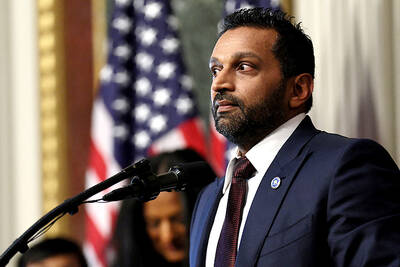
A pro-Iran hacking group claimed to breach FBI Director Kash Patel’s personal e-mail inbox and posted some of the contents online. The e-mails provided by the hacking group include travel details, correspondence with leasing agents in Washington and global entry, and loyalty account numbers. The e-mail address the hackers claim to have compromised has been previously tied to Patel’s personal details, and the leaked e-mails contain photos of Patel and others, in addition to correspondence with family members and colleagues. “The FBI is aware of malicious actors targeting Director Patel’s personal email information,” the agency said in a statement on
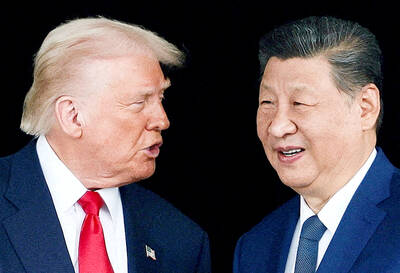
RIVALRY: ‘We know that these are merely symbolic investigations initiated by China, which is in fact the world’s most profligate disrupter of supply chains,’ a US official said China has started a pair of investigations into US trade practices, retaliating against similar probes by US President Donald Trump’s administration as the superpowers stake out positions before an expected presidential summit in May. The move, announced by the Chinese Ministry of Commerce on Friday, is a direct mirror of steps Trump took to revive his tariff agenda after the US Supreme Court last month struck down some of his duties. “China expresses its strong dissatisfaction and firm opposition to these actions,” a ministry spokesperson said in a statement, referring to the so-called Section 301 investigations initiated on March 11.


 RSS
RSS