


On the wooded slopes of southwestern Serbia’s Golija mountain, a dozen nuns at the Gradac monastery have devoted their lives to God, but have not turned their backs on their lifelong passion: painting.
Twenty years ago Jasna Topolski, already a famous artist who had graduated from the Academy of Fine Arts in Belgrade, arrived at this 13th-century monastery. Today, she is Efimija, the mother superior.
“[As an artist] I thought that art would allow me to find the truth, to resolve the mystery of death, but I had found no answer,” the 46-year-old said.

Photo: AFP
“I started looking elsewhere and realized that the church could provide me with the complete answer” to the big questions about life, she said.
When she decided to join the church, she learned icon painting and undertook to renovate the Gradac monastery, reconciling her spiritual and artistic aspirations.
She was soon followed by several other young women, fellow fine arts students who were equally torn between religion and art.
“Some among them were considering joining the order, but were not sure how their artistic sensibility could adjust to monastic life. So when they saw me here, they decided to try. They liked it, so they stayed,” Efimija said.
That’s what happened to Sister Magdalina, Mother Efimija’s closest aide in Gradac. In the convent workshop, she teaches other nuns the art of icon painting.
“The more we paint, the more they [icons] seem to be elusive ... We can never say: ‘I mastered the technique of painting icons,’” Sister Magdalina said. “I believe that great artists are all believers, even though they are not aware of that sometimes. I don’t believe that we can reach such [artistic] depth if there is no [divine] light within ourselves.”
The nun painters of Gradac are much in demand and have decorated walls at several orthodox churches, even in neighboring Croatia, but they prefer icon painting. Icons play a key role in the Orthodox Church, and are displayed in churches and monasteries. At home, believers usually keep icons of their patron saint, whose feast day is lavishly celebrated by the entire family. The work of the Gradac nuns and Mother Efimija has won praise from art critics.
“It is high-level art, spiritual, but at the same time professional,” Serbian art historian Jasa Denegri said.
“I have been working for several days on this icon. I made it for myself,” Mother Efimija said as she carefully worked on an icon of Saint Ksenija.
Her room is also her workshop and looks nothing like the austere cells sometimes associated with convent life.
The walls are adorned with religious, but also figurative modern pieces in light earth tones depicting animals and flowers.
The mother superior said she tried not to copy ancient icons as many religious painters do. She believes her paintings reflect the mysterious communion between the artist and the silhouette of the saint that appears slowly on the board of the icon.
“The most important for me is to think about whom I paint. How to show their expression, their look. I have to feel that they are looking at me and that is an opening towards the heavens,” she said.
In Gradac, everybody is free to express “their God-given talent,” Mother Efimija said.
Father Vitalije, the only man in Gradac, is in charge of religious services at the monastery as the Orthodox religion bans women from performing them.
A former engineer, he has set up the monastery’s Web site (www.manastirgradac.org.rs).
The nuns regularly exhibit their work in galleries around the country and Mother Efimija now has in mind a special project that will show the nuns’ work before and after they joined the order.
“The difference is interesting. In my previous works, I was searching for answers, while today I accept life as it is,” she said.
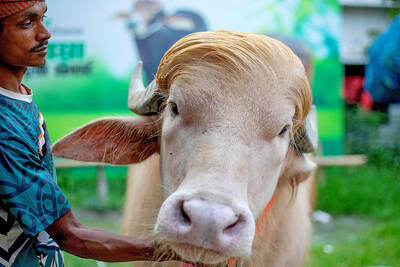
Crowds in Bangladesh are flocking to snap photographs with an unlikely social media star — an albino buffalo with flowing blond hair nicknamed “Donald Trump” that is due to be sacrificed within days. Owner Zia Uddin Mridha, 38, said his brother named the 700kg bull over its flowing helmet of hair resembling the signature look of the US president. “My younger brother picked this name because of the buffalo’s extraordinary hair,” he said at his farm in Narayanganj, just outside the capital, Dhaka. Mridha said that a constant stream of curious visitors — social media fans, onlookers and children — have come throughout

It began as a satirical online project. Now millions of young people in India are flocking to it as an outlet for their frustration. A parody political party called the Cockroach Janta Party, with the insect as its symbol, has exploded across India’s social media by turning absurdist humor into protest. Memes and short videos mocking corruption, joblessness and political dysfunction have flooded social media sites, where millions of users are embracing the cockroach — known for its ability to survive harsh conditions — as a tongue-in-cheek symbol of endurance. The online movement’s rise has been unusually rapid. The Cockroach Janta Party (CJP)
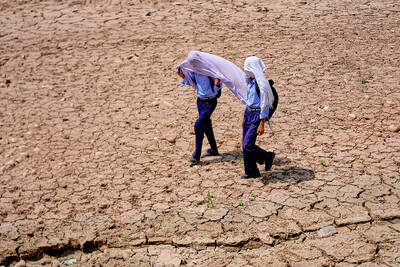
HOTTER: While Indians are accustomed to summer heat, climate change has caused northwestern India to warm faster than other parts of the country, an academic said Roads and markets have emptied during afternoons and some farmers have switched to nighttime work to avoid scorching temperatures as a heat wave grips large parts of India. The India Meteorological Department forecast maximum temperatures for yesterday of about 45°C in the capital, New Delhi, where authorities have opened temporary “cooling zones” to help people cope. The weather department warned that conditions would likely persist across several northern regions in the coming days, with temperatures staying well above seasonal averages. Authorities urged people to stay indoors during the hottest hours and take precautions against heat-related illnesses. India declares a heat wave whenever maximum temperatures

SPEAKING OUT: After Siranudh Scott’s allegations surfaced, celebrities and public figures took to social media to share their own experiences of sexual misconduct and abuse A high-profile alleged sexual abuse case within a wealthy Thai beer brewing family has prompted a wave of painful accounts from survivors of unconnected abuse in the conservative nation. Siranudh Scott, a member of the billionaire Thai family that founded the ubiquitous Singha beer brand, posted an emotional video this month accusing his elder brother Sunit of repeatedly abusing him when he was a teenager. Sunit, who is in his 30s, later denied the allegations in a video posted online, but Singha parent Boonrawd dismissed him from his executive role with the company on Tuesday last week. “I felt I needed to speak


 RSS
RSS