


China released human rights lawyer Teng Biao (滕彪) after 10 weeks in custody, but a second lawyer has disappeared, rights groups said yesterday, amid an ongoing crackdown on dissent.
Advocacy group China Aid said Teng returned home at 3:30pm on Friday, but also said that Li Fangping (李方平) disappeared at about around 5pm after leaving the office building of an AIDS victims group in Beijing.
Teng Biao’s wife confirmed that her husband had returned home but said “it is not convenient to speak now.”
“It’s a relief that Teng Biao has been released after almost 70 days of unlawful confinement at the hands of China’s security forces,” said Phelim Kine, Asia researcher at New York-based Human Rights Watch (HRW).
In February, Teng and other lawyers involved in defending Chen Guangcheng (陳光誠), an activist who has spoken out about forced abortions in China, were arrested, interrogated and beaten by police following a meeting in Beijing.
HRW also named Li as the latest lawyer to disappear since China launched a blitz on government critics following calls for protests to match those rocking the Arab world.
The developments came after the latest human rights dialogue between the US and China in Beijing broke off with the two countries at loggerheads after talks failed to produce any progress.
Renee Xia (夏雷妮), from Chinese Human Rights Defenders said that “nobody has any idea why [Li is being detained] now,” but added “it is not a surprise, he is a very active human rights lawyer.”
China Aid said Teng and Li are both active members of the Chinese Christian Rights Defense Association, which has come to prominence as a result of the repeated arrests of Christians in recent months.
Beijing has long frowned on religion and imposes controls on faith by requiring groups to register for government approval to gather, despite an official policy stipulating religious freedom.
On April 10, nearly 170 church followers were rounded up by police after trying to hold an outdoor service in western Beijing. Nearly 50 were detained a week later and a further 30 were arrested on Sunday last week for trying to hold an Easter service in defiance of the officially atheist government.
Bob Fu (傅希秋), president of China Aid, welcomed Teng’s release, but warned “China cannot continue to play this game by letting one go and taking one in if China wants to be seen as a responsible international partner.”
US Assistant Secretary of State Michael Posner on Thursday accused China of “serious backsliding” on human rights after the two-day US-China Human Rights Dialogue concluded in the Chinese capital.
Chinese authorities have launched their toughest campaign against government critics in years after anonymous online appeals emerged in February calling for weekly protests to emulate those in the Arab world.
Scores of Chinese activists and rights lawyers have been rounded up since the emergence of the “Jasmine” campaign, which has gone largely unheeded.
The US State Department had made clear before the latest dialogue that it would focus on China’s clampdown and a “negative trend of forced disappearances, extra-legal detentions, and arrests and convictions.”
Human rights groups had urged the US to step up pressure in the dialogue, which has been criticized as a toothless talking shop that has achieved failed to pressure China to improve its rights record.
China on Thursday repeated its insistence that its handling of dissent was its own business.
Posner said the US side raised sensitive issues such as restrictions on religious groups, China’s handling of restive minorities such as Tibetans and Muslim Uighurs, and the detentions of scores of rights lawyers and activists.

The team behind the long-awaited Vera Rubin Observatory in Chile yesterday published their first images, revealing breathtaking views of star-forming regions as well as distant galaxies. More than two decades in the making, the giant US-funded telescope sits perched at the summit of Cerro Pachon in central Chile, where dark skies and dry air provide ideal conditions for observing the cosmos. One of the debut images is a composite of 678 exposures taken over just seven hours, capturing the Trifid Nebula and the Lagoon Nebula — both several thousand light-years from Earth — glowing in vivid pinks against orange-red backdrops. The new image
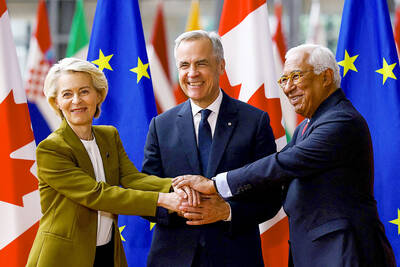
Canada and the EU on Monday signed a defense and security pact as the transatlantic partners seek to better confront Russia, with worries over Washington’s reliability under US President Donald Trump. The deal was announced after a summit in Brussels between Canadian Prime Minister Mark Carney and European Commission President Ursula von der Leyen and European Council President Antonio Costa. “While NATO remains the cornerstone of our collective defense, this partnership will allow us to strengthen our preparedness ... to invest more and to invest smarter,” Costa told a news conference. “It opens new opportunities for companies on both sides of the

ESPIONAGE: The British government’s decision on the proposed embassy hinges on the security of underground data cables, a former diplomat has said A US intervention over China’s proposed new embassy in London has thrown a potential resolution “up in the air,” campaigners have said, amid concerns over the site’s proximity to a sensitive hub of critical communication cables. The furor over a new “super-embassy” on the edge of London’s financial district was reignited last week when the White House said it was “deeply concerned” over potential Chinese access to “the sensitive communications of one of our closest allies.” The Dutch parliament has also raised concerns about Beijing’s ideal location of Royal Mint Court, on the edge of the City of London, which has so
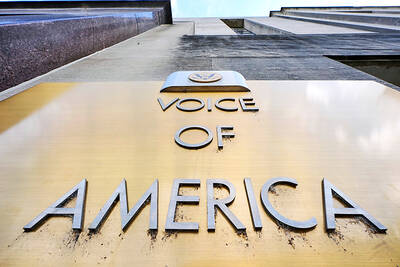
OVERHAUL: The move would likely mark the end to Voice of America, which was founded in 1942 to counter Nazi propaganda and operated in nearly 50 languages The parent agency of Voice of America (VOA) on Friday said it had issued termination notices to more than 639 more staff, completing an 85 percent decrease in personnel since March and effectively spelling the end of a broadcasting network founded to counter Nazi propaganda. US Agency for Global Media (USAGM) senior advisor Kari Lake said the staff reduction meant 1,400 positions had been eliminated as part of US President Donald Trump’s agenda to cut staffing at the agency to a statutory minimum. “Reduction in Force Termination Notices were sent to 639 employees at USAGM and Voice of America, part of a


 RSS
RSS