


Archeologists are unearthing a 2,000-year-old tunnel outside bustling modern day Mexico City searching for clues to one of the region’s most influential former civilizations.
Heavy rains at the site of Teotihuacan, about 40km from the capital, accidentally provided the first sign of the tunnel’s existence in 2003, when the water made a tiny hole in the ground.
Six years later, a team financed by Mexico’s National Institute of Anthropology and History started digging at the site, which is one of the most visited in Mexico.
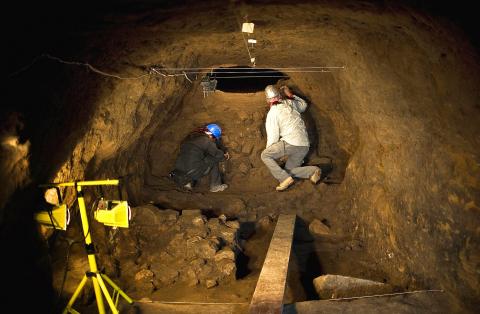
Photo: AFP
Teotihuacan arose as a new religious center around the time of Christ and became possibly the most influential city in pre-Hispanic North America at the time, with a population of 200,000 at its peak.
It is thought to have been abandoned in the seventh century due to economic, social and political problems.
Only around 5 percent of Teotihuacan has been excavated so far despite more than 100 years of exploration of the former city, which stretches over about 25km2.
Archeologists believe the tunnel will lead to three chambers, which could contain the remains of the leaders of the civilization and help explain their beliefs.
No monarch’s tomb has ever been found at the site, which was already deserted when the Aztecs arrived in the area in the 1300s.
However, the search for the tombs is not the only focus of investigation.
“It’s not something we’re obsessed with. We keep working and we’re going to try to understand the tunnel on its own and the implications it has for Mesoamerican thought and religion,” archeologist Sergio Gomez said.
Last August, digging down about 12m, archeologists discovered the tunnel’s opening in front of the Temple of Quetzalcoatl (the Plumed Serpent).
“It was very gratifying to be able to find the tunnel’s entrance because that shows that the hypotheses were correct,” Gomez said.
“We know that Teotihuacan was built as a replica of how they saw the cosmos, the universe. We imagine the tunnel to be a recreation of the underworld.”
About 30 archeologists, biologists and architects work daily under a small tent protecting the tunnel’s opening, to the south of the imposing Pyramids of the Sun and Moon.
As some sieve through piles of stones and earth over wheelbarrows to pick out artifacts retrieved underground, archeologists descend three ladders down a hole several meters wide and 12m deep.
They believe that a deliberate effort was made to pile up stones and even pieces of a destroyed temple to block the tunnel, sometime between 200 AD and 300 AD.
Precious pieces are believed to have been thrown on to the pile as an offering by the elite.
The team has already removed some 300 tonnes of material, including 60,000 tiny fragments of materials such as jade, bone and ceramics.
Most were ornaments used by the elite, as well as beads and shells from both coasts of Mexico, Gomez said.
A small, remote-controlled robot — the first to be used to explore Mexico’s ruins — took a camera inside a small opening before researchers finally entered the tunnel in November.
However, they have advanced only 7m through the tunnel which they believe, thanks to the help of radar technology, to be 120m long.
In the hot, damp underground chamber, small labels hang from the curved, rocky roof to show each meter excavated so far.
Archeologists say they can see tool marks in the ceiling which date from the time the tunnel was excavated in the rock.
Wearing masks and helmets as they chip away with small tools, they expect to reach the end of the tunnel in several years’ time.
“It’s very, very delicate and meticulous work. We have to record every type of change,” researcher Jorge Zavala said.

A humanoid robot that won a half-marathon race for robots in Beijing on Sunday ran faster than the human world record in a show of China’s technological leaps. The winner from Honor, a Chinese smartphone maker, completed the 21km race in 50 minutes and 26 seconds, said a WeChat post by the Beijing Economic-Technological Development Area, also known as Beijing E-Town, where the race began. That was faster than the human world record holder, Ugandan Jacob Kiplimo, who finished the same distance in about 57 minutes in March at the Lisbon road race. The performance by the robot marked a significant step forward

Four contenders are squaring up to succeed Antonio Guterres as secretary-general of the UN, which faces unprecedented global instability, wars and its own crushing budget crisis. Chile’s Michelle Bachelet, Argentina’s Rafael Grossi, Costa Rica’s Rebeca Grynspan and Senegal’s Macky Sall are each to face grillings by 193 member states and non-governmental organizations for three hours today and tomorrow. It is only the second time the UN has held a public question-and-answer, a format created in 2016 to boost transparency. Ultimately the five permanent members of the UN’s top body, the Security Council, hold the power, wielding vetoes over who leads the

An earthquake registering a preliminary magnitude of 7.7 off northern Japan on Monday prompted a short-lived tsunami alert and the advisory of a higher risk of a possible mega-quake for coastal areas there. The Cabinet Office and the Japan Meteorological Agency said there was a 1% chance for a mega-quake, compared to a 0.1% chance during normal times, in the next week or so following the powerful quake near the Chishima and Japan trenches. Officials said the advisory was not a quake prediction but urged residents in 182 towns along the northeastern coasts to raise their preparedness while continuing their daily lives. Prime
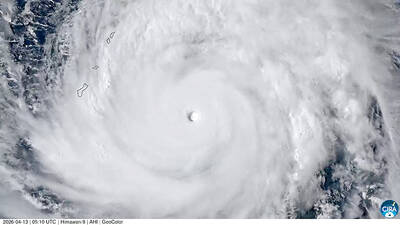
HAZARDOUS CONDITION: The typhoon’s sheer size, with winds extending 443km from its center, slowed down the ability of responders to help communities, an official said The US Coast Guard was searching for six people after losing contact with their disabled boat off the coast of Guam following Typhoon Sinlaku. The crew of the 44m dry cargo vessel, the US-registered Mariana, on Wednesday notified the coast guard that the boat had lost its starboard engine and needed assistance, Petty Officer 3rd Class Avery Tibbets said yesterday. The coast guard set up a one-hour communication schedule with the vessel, but lost contact on Thursday. A Coast Guard HC-130 Hercules aircraft was launched to search for the six people on board, but it had to return to Guam because of


 RSS
RSS