


China has shifted its clampdown on dissent up a gear with the detention of a world-renowned artist, Ai Weiwei (艾未未), revealing a government at once insecure about its grip on power and yet unruffled by Western criticism of its heavy-handed rule.
It is a paradoxical mix of anxiety and disdain that will define the country’s politics as a leadership handover presses closer.
The burst of detentions and arrests of dissidents, human rights lawyers and now Ai — an outspoken artist with a high profile abroad — shows just how far the Chinese Communist Party (CCP) fears the nation’s economic boom will not inoculate it from internal threats.
The government says Ai is suspected of economic crimes, a charge his family says is a pretext for stifling his activism.
Ai’s arrest drew swift condemnation from Western capitals and has raised the prospect of months of diplomatic friction but, hunkering down for a long offensive to stifle opponents at home, Beijing appears emboldened to ignore critics abroad.
The next big test of how far Beijing could push will be whether Ai or well-known detained rights lawyers, such as Teng Biao (滕彪), are formally arrested, bringing trials and convictions by Party-run courts.
“Before they were killing the chickens to scare the monkeys, but with Ai Weiwei, they’re killing a monkey, and that’s a bigger deal,” said Liu Suli (劉蘇里), a bookstore owner in Beijing who was jailed after the 1989 crackdown on pro-democracy protests.
“Killing chickens to scare monkeys” is a Chinese saying used to describe punishing a smaller foe to deter bigger ones.
“Ai Weiwei has many fans here and abroad, so by going after him, you can scare all his fans, all the chickens,” said Liu, a seasoned observer of the Chinese political cycle whose All Sages bookstore is a meeting point for liberal thinkers.
“It’s also killing a monkey to scare the other big monkeys,” he added, referring to other well-known dissidents.
Plenty of experienced observers are dismayed by the extent of the crackdown, even given CCP worries that anti-authoritarian unrest in the Middle East could infect China.
Mass turmoil seems a distant threat. China’s security forces are swimming in cash and bristle with advanced technology to nip unrest in the bud. Beijing has economic headaches, but they reflect a problem that most governments yearn for — too rapid growth.
However, even after the Middle Eastern upheavals have died down, China’s tight grip is unlikely to loosen much as the CCP readies a leadership handover from next year that is likely to see Chinese President Hu Jintao (胡錦濤) stand aside for Xi Jinping (習近平), now vice president.
Speeches and documents on Chinese government Web sites betray official anxiety that Western-backed threats to stability are becoming increasingly entrenched. That will make for economic, social and political policies that prize control above all.
“Many in Beijing are positioning themselves now for the upcoming leadership changes in 2012 and can’t afford to be seen as ‘soft’ or as taking any chances,” said Fei-Ling Wang, a professor at the Georgia Institute of Technology in the US who specializes in Chinese politics.
Beijing intellectuals are divided over whether Xi’s succession will bring some relaxation, but most see relative moderation rather than a springtime of liberalization. Xi is a more personable figure than Hu, but so far has been cautious and conformist.

When a hiker fell from a 55m waterfall in wild New Zealand bush, rescuers were forced to evacuate the badly hurt woman without her dog, which could not be found. After strangers raised thousands of dollars for a search, border collie Molly was flown to safety by a helicopter pilot who was determined to reunite the pet and the owner. A week earlier, an emergency rescue helicopter found the woman with bruises and lacerations after a fall at a rocky spot at the waterfall on the South Island’s West Coast. She was airlifted on March 24, but they were forced to
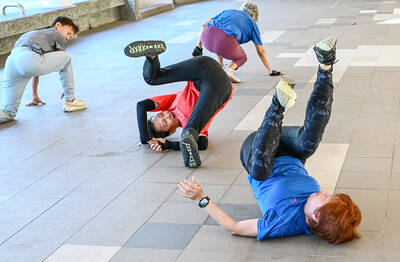
CONFIDENCE BOOSTER: ’After parkour ... you dare to do a lot of things that you think only young people can do,’ a 67-year-old parkour enthusiast said In a corner of suburban Singapore, Betty Boon vaults a guardrail, crawls underneath a slide, executes forward shoulder rolls and scales a steep slope, finishing the course to applause. “Good job,” the 69-year-old’s coach cheers. This is “geriatric parkour,” where about 20 retirees learned to tackle a series of relatively demanding exercises, building their agility and enjoying a sense of camaraderie. Boon, an upbeat grandmother, said learning parkour has aided her confidence and independence as she ages. “When you’re weak, you will be dependent on someone,” she said after sweating it out with her parkour classmates in suburban Toa Payoh,
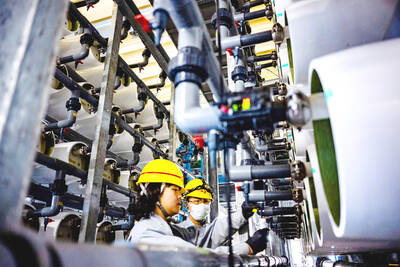
HIGH HOPES: The power source is expected to have a future, as it is not dependent on the weather or light, and could be useful for places with large desalination facilities A Japanese water plant is harnessing the natural process of osmosis to generate renewable energy that could one day become a common power source. The possibility of generating power from osmosis — when water molecules pass from a less salty solution to a more salty one — has long been known. However, actually generating energy from that has proved more complicated, in part due the difficulty of designing the membrane through which the molecules pass. Engineers in Fukuoka, Japan, and their private partners think they might have cracked it, and have opened what is only the world’s second osmotic power plant. It generates
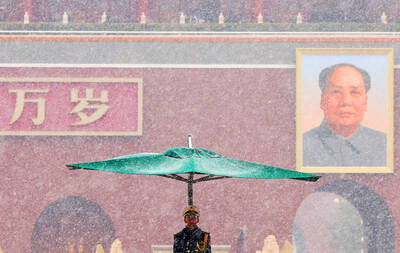
Chinese dissident artist Gao Zhen (高兟), famous for making provocative satirical sculptures of former Chinese leader Mao Zedong (毛澤東), was tried on Monday over accusations of “defaming national heroes and martyrs,” his wife and a rights group said. Gao, 69, who was detained in 2024 during a visit from the US, faces a maximum three-year prison sentence, said his wife, Zhao Yaliang (趙雅良), and Shane Yi, a researcher at the Chinese Human Rights Defenders group which operates outside the nation. The closed-door, one-day trial took place at Sanhe City People’s Court in Hebei Province neighboring the capital, Beijing, and ended without a


 RSS
RSS