


The unfolding nuclear disaster in Japan at reactors damaged by a massive earthquake and tsunami has led some US lawmakers to call for putting the “brakes” on US nuclear development.
“I’ve been a big supporter of nuclear power because it’s domestic, it’s ours and it’s clean,” US Senator Joseph Lieberman told the CBS News television program Face The Nation on Sunday.
Nevertheless “I think we’ve got to ... quietly and quickly put the brakes on until we can absorb what has happened in Japan as a result of the earthquake and the tsunami,” said Lieberman, who is chairman of the US Senate Homeland Security Committee.
Experts must then “see what more, if anything, we can demand of the new power plants that are coming online.”
US President Barack Obama wants to increase nuclear power as part of a US effort to decrease the nation’s dependence on coal and foreign oil. The administration has allocated US$18.5 billion in Department of Energy loan guarantees to spur nuclear development.
“The president believes that meeting our energy needs means relying on a diverse set of energy sources that includes renewables like wind and solar, natural gas, clean coal and nuclear power, White House spokesman Clark Stevens told the New York Times.
“Information is still coming in about the events unfolding in Japan, but the administration is committed to learning from them and ensuring that nuclear energy is produced safely and responsibly here in the US,” the spokesman was quoted by the newspaper as saying.
US Representative Edward Markey, a nuclear power critic, called for a moratorium on building reactors in seismically active areas, the Times said.
However, Senator Charles Schumer told NBC’s Meet the Press on Sunday that the unrest in oil-rich Libya is evidence that “we do have to free ourselves” from dependence on foreign oil.
“Prices are up. Our economy is being hurt by it or could be hurt by it. So I’m still willing to look at nuclear. As I’ve always said it has to be done safely and carefully,” the New York Democrat said.
Senate Minority Leader Mitch McConnell told the Fox News Sunday program that lawmakers should not make snap judgments.
“I don’t think right after a major environmental catastrophe is a very good time to be making American domestic policy,” the powerful Republican said.
Friday’s colossal magnitude 8.9 earthquake and subsequent tsunami, which sparked an emergency at two of Japan’s nuclear power plants and could result in catastrophic meltdowns, has many US nuclear energy advocates thinking twice.
Part of a reactor at Japan’s aging Fukushima No. 1 atomic plant blew up on Saturday, a day after the biggest quake ever recorded in Japan unleashed a 10m tsunami. Another explosion shook the quake-damaged power plant yesterday.
Excessive radiation levels were recorded at a second Japanese nuclear facility, Onagawa, on Sunday, although authorities insisted the facility’s three reactor units were “under control.”

When a hiker fell from a 55m waterfall in wild New Zealand bush, rescuers were forced to evacuate the badly hurt woman without her dog, which could not be found. After strangers raised thousands of dollars for a search, border collie Molly was flown to safety by a helicopter pilot who was determined to reunite the pet and the owner. A week earlier, an emergency rescue helicopter found the woman with bruises and lacerations after a fall at a rocky spot at the waterfall on the South Island’s West Coast. She was airlifted on March 24, but they were forced to

CONFIDENCE BOOSTER: ’After parkour ... you dare to do a lot of things that you think only young people can do,’ a 67-year-old parkour enthusiast said In a corner of suburban Singapore, Betty Boon vaults a guardrail, crawls underneath a slide, executes forward shoulder rolls and scales a steep slope, finishing the course to applause. “Good job,” the 69-year-old’s coach cheers. This is “geriatric parkour,” where about 20 retirees learned to tackle a series of relatively demanding exercises, building their agility and enjoying a sense of camaraderie. Boon, an upbeat grandmother, said learning parkour has aided her confidence and independence as she ages. “When you’re weak, you will be dependent on someone,” she said after sweating it out with her parkour classmates in suburban Toa Payoh,
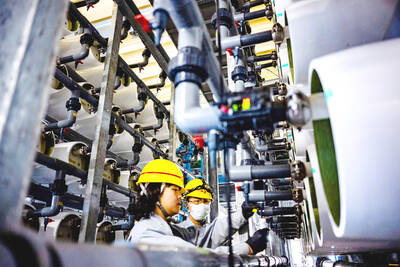
HIGH HOPES: The power source is expected to have a future, as it is not dependent on the weather or light, and could be useful for places with large desalination facilities A Japanese water plant is harnessing the natural process of osmosis to generate renewable energy that could one day become a common power source. The possibility of generating power from osmosis — when water molecules pass from a less salty solution to a more salty one — has long been known. However, actually generating energy from that has proved more complicated, in part due the difficulty of designing the membrane through which the molecules pass. Engineers in Fukuoka, Japan, and their private partners think they might have cracked it, and have opened what is only the world’s second osmotic power plant. It generates
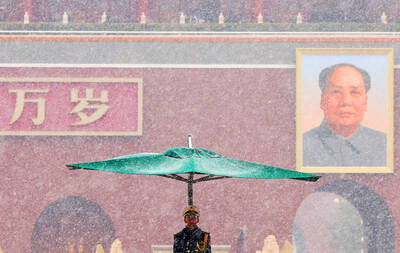
Chinese dissident artist Gao Zhen (高兟), famous for making provocative satirical sculptures of former Chinese leader Mao Zedong (毛澤東), was tried on Monday over accusations of “defaming national heroes and martyrs,” his wife and a rights group said. Gao, 69, who was detained in 2024 during a visit from the US, faces a maximum three-year prison sentence, said his wife, Zhao Yaliang (趙雅良), and Shane Yi, a researcher at the Chinese Human Rights Defenders group which operates outside the nation. The closed-door, one-day trial took place at Sanhe City People’s Court in Hebei Province neighboring the capital, Beijing, and ended without a


 RSS
RSS