


Macau police have arrested more than 100 women on prostitution charges at the Venetian Macao, the first major sex-trade crackdown at the glitzy hotel since it opened in 2007, reports said yesterday.
The former Portuguese colony’s vice squad swooped on the sprawling hotel early yesterday in a raid that coincided with a visit by US gaming tycoon Sheldon Adelson, whose Las Vegas Sands controls the hotel’s operator Sands China.
A Sands China spokeswoman declined comment, but said the company would issue a statement late yesterday.
The raid came a week after the Macau government rejected Sands China’s application to build another multi-billion dollar casino resort on the city’s lucrative Cotai Strip. The firm also operates the Four Seasons and Sands Macao.
Over 70 police officers raided the hotel’s massive gaming floor, taking 110 Chinese women and 22 others thought to be controlling them into custody, reports said.
“They stayed for about two hours and then took away more than 100 people they had an interest in, most of them women,” a Sands China spokeswoman told the South China Morning Post.
She said the hotel had a policy banning sex workers, adding that Adelson’s visit was unconnected to the raid.
The Post said the women were forced to pay their pimps a daily “protection fee” of as much as HK$1,000 (US$130).
Macau is the only Chinese city where casino gambling is allowed and has overtaken Las Vegas in terms of gaming revenue since the sector was opened to foreign competition in 2002.
Prostitutes are commonly seen looking for customers in some of the city’s casino hotels and raids on the sex trade are common.
“Such prostitution activities have always been an on-going issue in Macau and have been very serious,” Macau legislator Au Kam-san (區錦新) was quoted as saying by Hong Kong newspaper the Standard. “The government is not determined enough to combat such crimes.”

SPEAKING OUT: After Siranudh Scott’s allegations surfaced, celebrities and public figures took to social media to share their own experiences of sexual misconduct and abuse A high-profile alleged sexual abuse case within a wealthy Thai beer brewing family has prompted a wave of painful accounts from survivors of unconnected abuse in the conservative nation. Siranudh Scott, a member of the billionaire Thai family that founded the ubiquitous Singha beer brand, posted an emotional video this month accusing his elder brother Sunit of repeatedly abusing him when he was a teenager. Sunit, who is in his 30s, later denied the allegations in a video posted online, but Singha parent Boonrawd dismissed him from his executive role with the company on Tuesday last week. “I felt I needed to speak

SEEKING ORDER: Rodrigo Paz said that ‘anyone who wants to destroy the nation will have to deal with this president and the full force of the constitution’ Bolivian President Rodrigo Paz on Wednesday said that the nation was at a “breaking point” after nearly a month of protests that have caused shortages of food, fuel and medicine. Paz, who took office six months ago amid the worst economic crisis there in four decades, is battling a groundswell of fury over his policies. The political capital, La Paz, has been besieged by low-income workers and members of the indigenous majority calling for his resignation. “The country needs order and is reaching breaking point,” the 58-year-old said at a public event in La Paz, renewing his appeal for dialogue. On Tuesday, the Bolivian
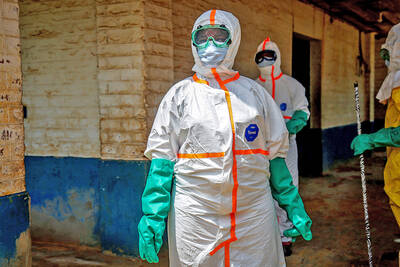
COMMUNITY CONFLICT: Concerns about disease spread from corpses has run up against friends and families’ desire to bury their dead as infection spreads in the area Angry residents of a town at the epicenter of the Ebola outbreak in the Democratic Republic of the Congo (DR Congo) attacked and burned a tent that was part of a health center where people are being treated for the virus, the staff there said Saturday. It was the second such attack in the region in a week. No one was hurt in the attack, according to reports but as patients ran out to escape the fire, 18 people with suspected Ebola infections fled the facility and are unaccounted for, a hospital director said. Angry residents arrived at the clinic in the

Forecasters in Europe yesterday warned of exceptional heat as record temperatures driven by a “heat dome” push temperatures well above seasonal norms across the continent. The surge follows a record-breaking Monday, with France logging its hottest day in the month of May on record, its weather agency said, and the UK also posting unprecedented highs. A so-called “heat dome” of warm air from northern Africa trapped under a high-pressure system over western Europe is behind the high temperatures not usually seen until high summer. Restrictions on outdoor work were imposed in parts of Italy, beaches in southwest France filled earlier than usual and


 RSS
RSS